Vietnamese version:
Chủ thể của Champa: Champa không phải là “dân tộc Cham” - tiếp cận từ bia ký và ngôn ngữ học Chamic
PDF file: https://champa.one/files/Linh%20Tinh%202026/Champa_khong_rieng_dan_toc_Cham.pdf
English version
PFD file: The historical subject of Champa: Champa was not a “Cham ethnic nation”
Abstract
This study reexamines the question of the “historical subject of Champa” through an interdisciplinary approach combining epigraphic analysis, historical linguistics, and modern theories of ethnicity. Based on a systematic survey of Champa inscriptions from the fourth to the fifteenth centuries, the study argues that formulaic expressions such as Rāja Campā (“King of Champa”), Urang Campā (“people of Champa”), and Campādeśa (“the land of Champa”) consistently reflect a mode of identification grounded in territory and political authority rather than ethnic identity. Significantly, the term “Cham” never appears in the inscriptions as an ethnic designation, suggesting that Champa did not define itself as an ethnic community in the modern sense.
Linguistic evidence further supports this interpretation. The language of the inscriptions belongs to an early stage of the Chamic branch within the Austronesian language family, commonly identified as Old Cham or Proto-Chamic (Thurgood 1999). This linguistic layer shows close relationships with present-day Chamic languages such as Cham, Jarai, Rhade, Haroi, Churu, and Raglai, indicating that Champa existed within a broader Chamic linguistic and cultural sphere rather than being exclusively associated with a single Cham group. Phonological and lexical differences between Old Cham and modern Cham reflect regular processes of linguistic change, confirming that modern Cham represents a later development within the Chamic continuum rather than the “original” language of Champa.
From a theoretical perspective, the study draws on the works of Benedict Anderson and Anthony D. Smith to emphasize that “nation” and “ethnicity” are historical constructs associated with the modern era and cannot be directly projected onto premodern societies such as Champa. In this context, the use of the term “Cham” by nineteenth- and twentieth-century Western scholars, including Étienne Aymonier and Georges Maspero, should be understood primarily as a scholarly convention shaped within the framework of colonial-era research rather than as a reflection of Champa’s own modes of self-identification.
The study concludes that equating Champa with a singular “Cham ethnic nation” is a retrospective simplification. Instead, Champa should be understood as a multi-ethnic mandala polity within the broader Chamic world, in which multiple communities participated in overlapping networks of political power, religion, and culture. This approach does not deny the important role of the Cham in certain domains, but situates them within a wider historical and cultural context more consistent with the epigraphic evidence and contemporary scholarship.
Keywords: Champa; Chamic languages; Epigraphy; Ethnicity; Mandala polity; Austronesian; Chamic historiography.
1. Introduction
In studies of Champa, terms such as “Cham king,” “Cham towers,” and “Cham script” have become so commonplace that they are often treated as self-evident categories in both academic scholarship and popular discourse. Since the late nineteenth century, under the influence of the works of Étienne Aymonier, Georges Maspero, and Antoine Cabaton, the term “Cham” gradually came to function as a generalized label for the civilization of Champa as a whole. Over time, this terminology evolved beyond a mere scholarly convention and contributed to a widespread understanding of Champa as a “nation of the Cham people.”
The widespread use of these expressions, however, raises a fundamental methodological question: do terms such as “Cham king,” “Cham towers,” and “Cham script” genuinely derive from Champa’s own primary sources, or are they products of later scholarly interpretation and systematization shaped by colonial and modern intellectual frameworks? Put differently, does the equation of Champa with a singular “Cham ethnic nation” reflect the historical reality of premodern Champa, or does it stem from a retrospective interpretive model constructed in modern scholarship?
This issue is not merely terminological; it directly concerns the identification of the historical subject of Champa itself. If these labels do not originate from indigenous sources, then the interpretation of Champa as an ethnic entity must be reconsidered on the basis of internal evidence and modern theories of ethnicity and nationhood. In this context, the present study returns to the most direct and authoritative body of evidence: the corpus of Champa inscriptions. Produced by the Champa polities themselves, these inscriptions reveal how political authority, territory, and community were defined from an internal perspective, distinct from external representations found in Chinese, Đại Việt, or Western sources.
In addition to epigraphic analysis, this study situates the inscriptions within two broader analytical frameworks. The first is Chamic historical linguistics, particularly the work of Graham Thurgood, which locates the language of Champa within a broader Chamic linguistic sphere that includes Cham, Jarai, Rhade, Haroi, Churu, and Raglai. The second is modern theory on ethnicity and imagined communities, especially the works of Benedict Anderson and Anthony D. Smith, which help clarify the limits of applying the concept of “nation” to premodern societies.
By combining these approaches, the study pursues two principal objectives. First, it evaluates the historical validity of terms such as “Cham” through comparison with epigraphic and linguistic evidence. Second, it proposes an alternative framework for redefining Champa. Rather than viewing Champa as a “nation of the Cham people,” this study argues that Champa should be understood as a multi-ethnic political and cultural entity situated within the broader Chamic world. Within this structure, the Cham played important roles in certain domains, but did not constitute the entirety of the system. Distinguishing between “Cham” as a present-day ethnic group and “Chamic” as a broader historical linguistic and cultural sphere is therefore essential for approaching Champa in a manner consistent with both the primary sources and contemporary scholarship.
2. Champa Inscriptions and Structures of Identification
2.1. Formulaic Terminology
The corpus of Champa inscriptions, spanning from the fourth to the fifteenth centuries, reveals a highly consistent system of identification in which political entities, communities, and monuments were all referenced through the central term Campā. Formulaic expressions such as Rāja Campā, Urang Campā, and Bimong Campā appear continuously across different periods and contexts, from the early inscriptions of Đông Yên Châu and Mỹ Sơn to later texts from Panduranga. Significantly, no corresponding forms such as “Rāja Cham” or “Urang Cham” occur anywhere in the currently known corpus. This systematic absence points to a coherent principle of identification in which Campā functioned as the primary referential unit rather than an ethnic designation.
From grammatical and semantic perspectives, constructions such as Rāja Campā represent possessive or referential relationships. The element Rāja (Sanskrit: “king”) combines with Campā (a proper noun denoting a territory or polity) to produce the meaning “King of Champa,” rather than “King of the Cham people.” Similarly, in the expression Urang Campā, the term Urang (Old Cham: “person,” “inhabitant”) combines with Campā to mean “people of Champa” or “inhabitants of Champa,” reflecting a territorial and political mode of identification. Such constructions are comparable to expressions like “people of Rome” or “people of Angkor,” in which communities are defined through their association with a polity rather than through ethnic identity in the modern sense.
The continuity of these formulae over many centuries indicates that this was not an isolated linguistic phenomenon but a structural convention embedded within the Champa inscriptional tradition as a whole. Regardless of temporal or regional variation, the inscriptions consistently adhere to the same principle: individuals and communities are identified through their relationship to Campā as a territorial and political entity. This reflects a conception of authority and community organized around the polity itself rather than around an ethnic category.
From these observations, an important conclusion may be drawn: within the inscriptional system of Champa, Campā functioned as the fundamental unit of identification, whereas “Cham” as an ethnic designation was entirely absent. This interpretation corresponds closely with the view of Pierre-Bernard Lafont, who argued that Champa should be understood primarily as a political and cultural entity rather than as an ethnic community.
Widely used expressions in modern scholarship such as “Cham king,” “Cham towers,” and “Cham script” therefore do not directly reflect the terminology found in the primary sources. Rather, they are interpretive constructs produced through the processes of scholarly systematization during the modern and colonial periods. Using such terms without distinguishing them from the indigenous terminology of the inscription’s risks conflating Champa as a historical polity with “Cham” as a later ethnic category.
Interim Conclusion:
The formulaic terminology of Champa inscriptions demonstrates a coherent system of identification grounded in territory and political authority, with Campā serving as the central referential concept. The complete absence of “Cham” as an official designation suggests that Champa was not structured as a “nation-state” in the modern sense. Consequently, the use of “Cham” as a substitute term for “Champa” should be critically reexamined within contemporary methodological frameworks.
2.2. Analysis of Representative Inscriptions
To further test the pattern of identification outlined above, it is necessary to examine several representative Champa inscriptions. Three important cases Đông Yên Châu, Mỹ Sơn E1, and Po Nagar demonstrate a consistent pattern: Champa was identified as a political and territorial entity, while any concept equivalent to a “Cham ethnic nation” remained entirely absent.
The Đông Yên Châu inscription, one of the earliest known texts written in Old Cham, provides particularly important evidence. Its content focuses on religious acts and specific individuals, without presenting any form of ethnic identification. Instead, terms such as Campādeśa (“the land of Champa”) and royal titles are used to define political space and authority. Especially significant is the appearance of the expression Urang Campā, which identifies community through association with territory, meaning “people of Champa” or “inhabitants of Champa.” This indicates that from an early period Champa already operated through a territorial and political framework of identification rather than an ethnic one.
The Mỹ Sơn E1 inscription further reinforces this interpretation in the context of kingship and religion. The text concerns rulers such as Bhadravarman I and the establishment of a temple dedicated to Śiva under the title Bhadreśvara. The central term in this inscription is again Campādeśa, in which deśa (Sanskrit) denotes “territory” or “land.” This formulation presents Champa as a sacred political space where royal authority was closely connected to the establishment and patronage of religious centers. As Georges Maspero observed, Champa inscriptions primarily emphasized royal authority and sacred geography rather than the construction of ethnic identity.
The Po Nagar inscriptions provide an additional perspective through the lens of religious ritual. These texts record offerings made by Champa kings to the goddess Yang Po Nagar, thereby affirming political authority through religious patronage. The key expression appearing in these inscriptions is again Urang Campā, in which Urang (Old Cham) signifies “person” or “inhabitant.” Once more, the formulation defines community through its relationship to Champa as a political space, meaning precisely “people of Champa,” not an ethnic designation. Here, the notion of community is territorial and political rather than ethnic.
Taken together, these three cases reveal a consistent pattern throughout the Champa inscriptional tradition. In terminological terms, expressions such as Campā, Campādeśa, and Urang Campā recur continuously, whereas “Cham” never appears as an ethnic label. Structurally, the inscriptions are organized around three interconnected axes: territory, political authority, and religion. The interaction of these elements produced a conception of Champa as a political and sacred community rather than an ethnic one in the modern sense.
Interim Conclusion:
The analysis of these representative inscriptions demonstrates a consistent reality: Champa did not define itself through a “Cham” ethnic identity, but instead identified communities through Campā as a territorial and political entity. Expressions such as Urang Campā simply meant “people of Champa,” comparable to terms such as “Romans” or “people of Angkor” in other premodern civilizations, where identity was primarily political rather than ethnic. This provides a strong empirical basis for reconsidering the modern equation of Champa with a singular “Cham ethnic nation.”
2.3. Conclusions from the Epigraphic Evidence
An examination of Champa inscriptions from the fourth to the fifteenth centuries reveals a consistent pattern: the structures of identification within these texts were organized around territory and political authority rather than around any concept of ethnicity in the modern sense. Formulae such as Campā, Rāja Campā, Bimong Campā, Urang Campā, Campādeśa, and Campānagara demonstrate a system of identification in which Campā functioned as the central referential concept, while individuals and communities were defined through their relationship to a territorial polity. Champa therefore appears in the inscriptions as a political entity and a space of power rather than as an ethnic community.
Particularly significant is the complete absence of ethnic terminology. Nowhere in the inscriptional corpus does “Cham” appear as an official designation, nor is there any equivalent concept corresponding to an “ethnic group” in the modern sense. This absence carries important methodological implications: if ethnicity had been central to the organization of Champa society, it would necessarily have been reflected in official texts such as inscriptions. The total lack of such terminology strongly suggests that ethnicity was not a constitutive category within Champa political thought.
From this evidence, an important scholarly conclusion may be drawn: Champa was organized and conceptualized as a territorial and political community in which royal authority, sacred space, and geography formed the principal foundations of collective identity. This interpretation aligns closely with broader models of premodern Southeast Asia, where political structures were not based on homogeneous ethnic communities but on networks of political relations and religious influence. It also corresponds with the interpretation of Pierre-Bernard Lafont, who viewed Champa primarily as a political and cultural entity rather than an ethnic unit.
The methodological implications of these findings are considerable. They require a clear distinction between the indigenous terminology found in the primary sources where Campā served as the principal referential category and the interpretive terminology developed in modern scholarship, especially “Cham” as an ethnic label. Failure to distinguish between these two levels risks projecting modern categories onto a premodern society, thereby distorting the historical structure of Champa itself.
Interim Conclusion:
The epigraphic evidence demonstrates that Champa functioned as a political entity defined by territory (Campā) and authority rather than by ethnic identity. The complete absence of “Cham” as a formal designation in official inscriptions is a strong indication that Champa was not a “nation-state” in the modern sense. Consequently, interpretations that equate Champa with a singular “Cham ethnic community” should be critically reassessed on the basis of the primary sources themselves.
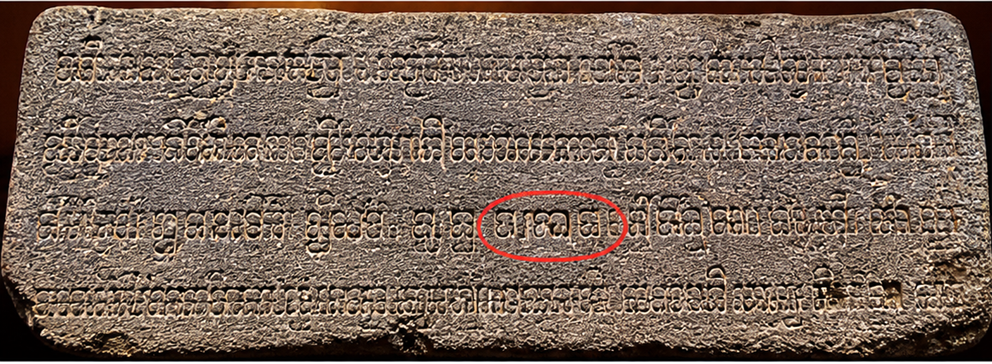
Figure 1. Mỹ Sơn Inscription C.96 (dated 658 CE, during the reign of Prakāśadharma Vikrāntavarman), discovered at the Mỹ Sơn temple complex in Quảng Nam and currently preserved at the Da Nang Museum of Cham Sculpture. The designation Campā (“Champa”) is inscribed in Sanskrit-Old Cham script in the South Indian Pallava style. This inscription is presently regarded as one of the earliest surviving instances in which the name Campā appears directly in Champa epigraphy, reflecting the process by which the Champa kingdom identified itself through the royal designation Campā in seventh-century royal inscriptions. Photo: Putra Podam.
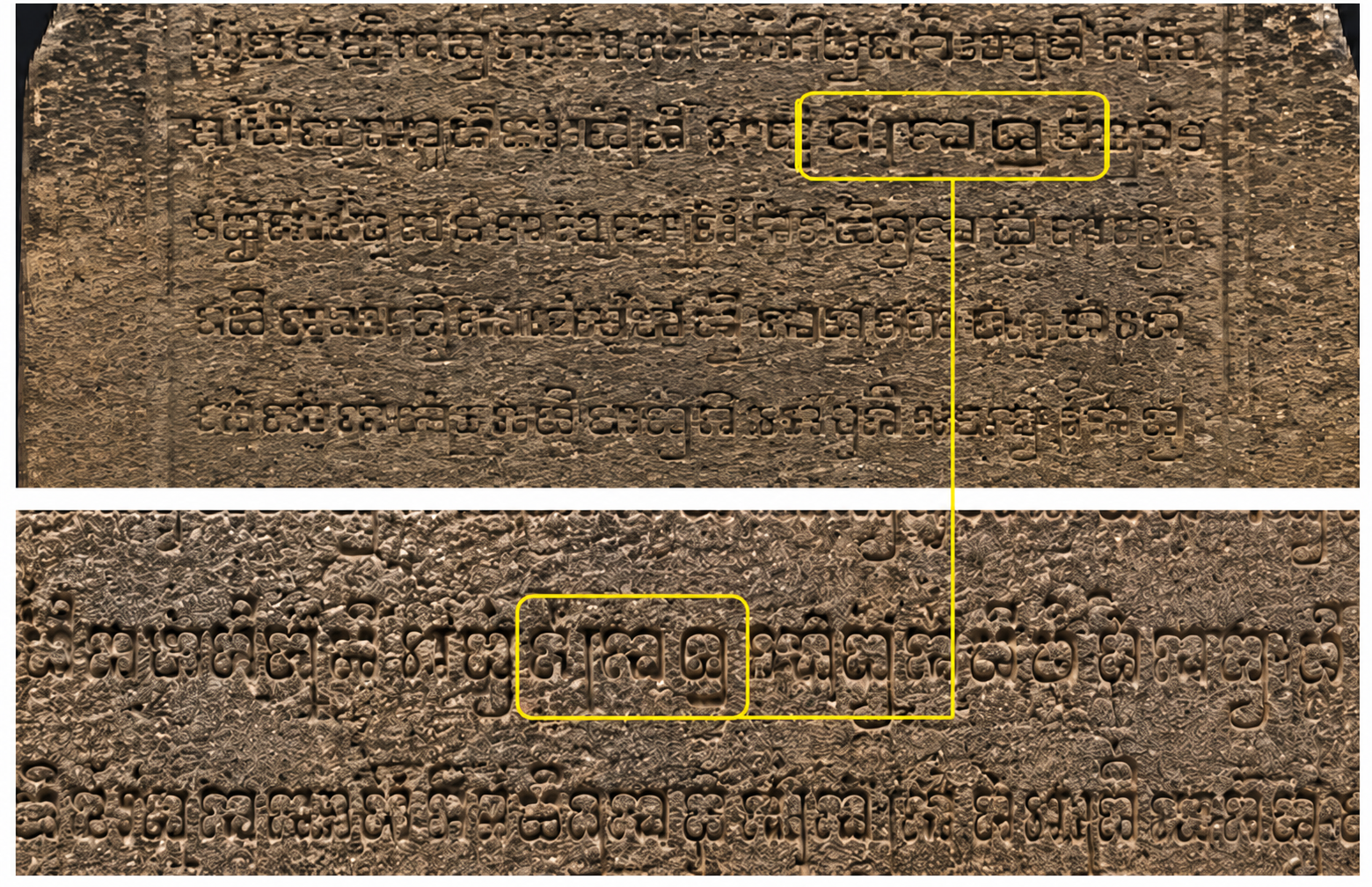
Figure 2. Đồng Dương Inscription C.292 (dated to approximately the late eighth to early ninth century), discovered at the Đồng Dương Buddhist monastery complex in Quảng Nam and currently preserved at the Da Nang Museum of Cham Sculpture. The designation Campā (“Champa”) is inscribed in Sanskrit-Old Cham script following the South Indian Pallava writing tradition. The term Campā appears in the inscription as a royal designation referring to the kingdom of Champa, reflecting the continuation of a tradition of self-identification already attested in earlier inscriptions such as Mỹ Sơn C.96 (658 CE). Inscription C.292 further demonstrates that by the late eighth to early ninth century, the name Campā had become firmly established in both royal and religious inscriptions of Champa. Photo: Putra Podam.
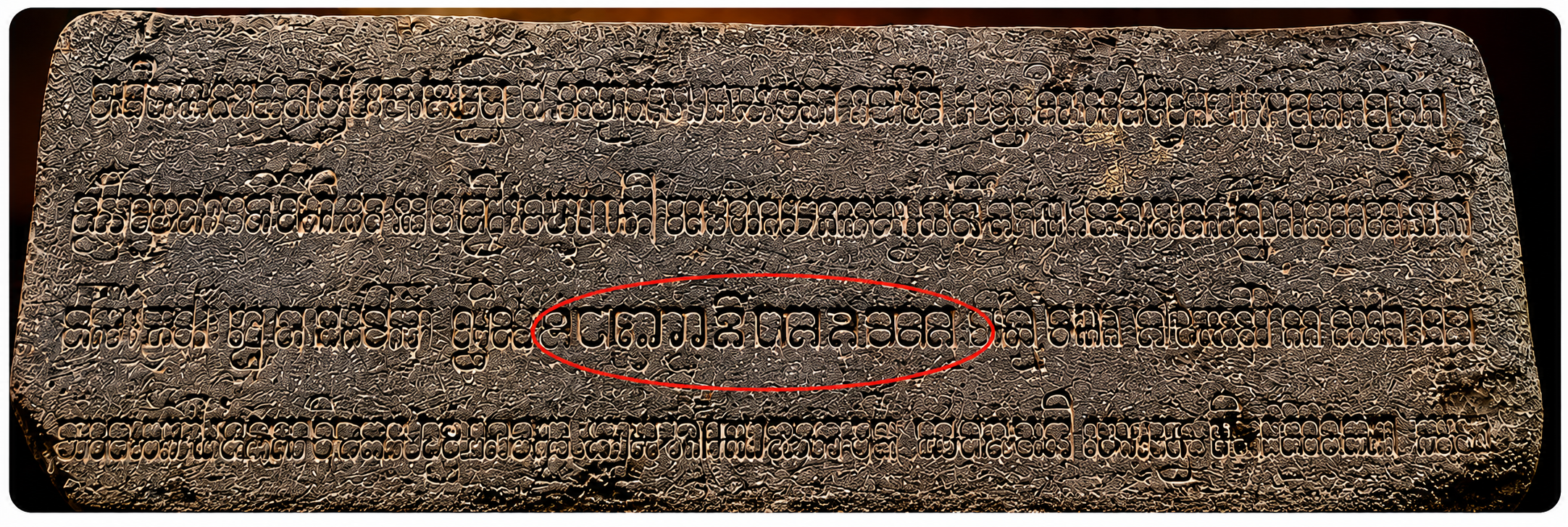
Figure 3. Mỹ Sơn Inscription C.96 (epigraphic reference: C.96), dated 658 CE during the reign of Prakāśadharma Vikrāntavarman, discovered at the Mỹ Sơn temple complex in Quảng Nam and currently preserved at the Da Nang Museum of Cham Sculpture. The expression Campānagara is inscribed in Sanskrit-Old Cham script in the South Indian Pallava style. In this compound, Campā refers to the kingdom of Champa, while nagara in Sanskrit means “city,” “urban center,” or “capital.” The term Campānagara may therefore be interpreted as “the city of Champa” or “the capital of Champa.” This inscription represents one of the earliest known examples directly referring to the political and urban center of the Champa kingdom in seventh-century epigraphy. Photo: Putra Podam.

Figure 4. Đồng Dương Inscription C.292 (dated approximately to the late eighth to early ninth century), discovered at the Đồng Dương Buddhist monastery complex in Quảng Nam and currently preserved at the Da Nang Museum of Cham Sculpture. The designation Campādeśa (“the land of Champa” or “the kingdom of Champa”) is inscribed in Sanskrit-Old Cham script following the South Indian Pallava tradition. The term combines Campā (“Champa”) with deśa (“territory,” “country,” or “realm”), reflecting the way in which the ancient Champa polity employed geographical and political terminology to designate its kingdom in official inscriptions. Inscription C.292 demonstrates that by the late eighth to early ninth century, the names Campā and Campādeśa had become firmly established in royal and religious epigraphy, continuing a tradition of self-identification already attested in earlier inscriptions such as Mỹ Sơn C.96 (658 CE). Photo: Putra Podam.
3. Chamic Linguistics and the Question of “Cham”
3.1. Classification
In historical linguistics, the Chamic branch is classified as part of the Austronesian languages, one of the world’s largest language families, extending from Madagascar to the Pacific. According to the research of Graham Thurgood (1999), the Chamic languages comprise a closely related group that includes Cham, Jarai, Rhade, Haroi, Churu, and Raglai. This classification is not merely descriptive; it also carries important interpretive implications for situating Champa within a much broader linguistic and cultural context.
From a genealogical perspective, Chamic is not an isolated language group but belongs to the Malayo-Polynesian branch of the Austronesian family. This indicates that Champa should be understood within a wider network of Austronesian-speaking communities rather than as a localized phenomenon confined to the central coast of present-day Vietnam. In other words, Champa formed part of a broader historical and linguistic continuum shaped by migration, regional interaction, and long-term cultural exchange.
Within the Chamic branch itself, the modern languages are generally understood as the result of differentiation from a common ancestral language, conventionally termed Proto-Chamic. According to Graham Thurgood, this process produced two major groupings: a coastal group, represented primarily by Cham, and a highland group that includes Jarai, Rhade, Haroi, Churu, and Raglai. This division reflects not only linguistic divergence but also differing ecological settings and historical patterns of settlement between coastal and upland regions.
The implications of this classification for understanding Champa are fundamental. If the language of the Champa inscriptions belongs to an early stage of Chamic whether identified as Proto-Chamic or Old Cham then Champa must be situated within a broader Chamic linguistic sphere rather than equated exclusively with modern Cham. Put differently, Cham does not represent the entirety of the Chamic world but only one later-developing branch within a much more diverse system. Equating Champa solely with the Cham therefore reduces what was historically a complex and multilayered linguistic and cultural landscape.
Moreover, groups such as the Jarai, Rhade, Haroi, Churu, and Raglai should not be regarded as peripheral to Champa but rather as communities sharing a common Chamic foundation. The linguistic relationships among these groups point to a shared historical heritage and suggest that Champa operated within a broad sphere of interaction among Chamic-speaking communities rather than being tied to a single ethnic group.
Interim Conclusion:
The classification of the Chamic languages demonstrates that Cham represents only one branch within a broader linguistic family. The existence of a Proto-Chamic stage implies that the language of Champa inscriptions cannot be directly equated with modern Cham, but instead reflects a wider Chamic continuum in which groups such as Jarai, Rhade, Haroi, Churu, and Raglai shared a common historical foundation. This provides an important linguistic basis for reconsidering the equation of Champa with a single “Cham ethnic nation.”
3.2. Old Cham and Early Chamic
The language attested in the Champa inscriptional corpus cannot be directly equated with modern Cham. Historical linguistic studies, particularly those of Graham Thurgood (1999), demonstrate that this language reflects an earlier stage in the development of the Chamic branch, commonly referred to as Old Cham or as a form closely related to Proto-Chamic, the reconstructed common ancestor of the present-day Chamic languages. This distinction is fundamental because it situates Champa within a long-term process of linguistic development rather than identifying it directly with modern forms of Cham.
Structurally, Champa inscriptions employed two languages in parallel: Sanskrit in ritual and political contexts, and Old Cham in administrative and social texts. Old Cham, however, was not identical to the modern Cham spoken today in Ninh Thuận, Bình Thuận, or Cambodia. Rather, it represented a linguistic layer that had not yet fully differentiated within the broader Chamic system. In other words, it reflects an intermediate stage preceding the clear separation of the modern Chamic languages.
The clearest evidence for this distinction lies in patterns of phonological change. Lexical forms reconstructed for Proto-Chamic or preserved in inscriptions display systematic correspondences with modern Cham. For example, the older forms Ama (“father”), Anak (“child”), Asau (“dog”), and Tasik (“sea”) correspond to the modern Cham forms Amâ, Anâk, Thau, and Thik. These developments can be explained through well-established phonological processes, including vowel shifts, consonantal changes, and adjustments in syllable structure. The regularity and predictability of these transformations indicate that they resulted from internal evolution within the same linguistic branch rather than from differences between unrelated languages.
When Old Cham forms are compared more broadly across the Chamic languages, they often show closer affinities with Jarai, Rhade, Haroi, Churu, and Raglai than with modern Cham itself. This suggests that modern Cham is not a uniquely “primitive” or “original” form, but rather one branch that underwent more extensive transformations during its historical development. Modern Cham therefore represents a later stage of differentiation, whereas Old Cham reflects an earlier phase in which Chamic features remained comparatively unified.
From a scholarly perspective, these findings carry important implications. The language of Champa cannot be understood as the language of a single community corresponding to the modern “Cham ethnic group,” but must instead be situated within a broader Chamic continuum. Champa was therefore not the expression of a singular linguistic unit, but rather a political and cultural structure operating within a linguistic sphere still undergoing differentiation.
Interim Conclusion:
Linguistic evidence demonstrates that the language of Champa inscriptions corresponds to an early stage of the Chamic branch rather than to modern Cham. Phonological differences between older forms such as Ama, Anak, and Asau and their modern counterparts Amâ, Anâk, Thau, and Thik reflect systematic processes of linguistic evolution. These findings confirm that modern Cham represents a later development within the Chamic continuum, and that the linguistic foundation of Champa must be understood within a broader Chamic framework rather than reduced to a single Cham group.
4. Champa as a Multi-Ethnic Mandala
One of the most influential approaches in the study of premodern Southeast Asia is the mandala model, in which political entities were not organized as centralized territorial nation-states in the modern sense, but functioned instead as flexible, multi-centered, and hierarchical networks of power. Within this framework, authority was not defined by fixed borders but by varying degrees of political, religious, and economic influence radiating from different centers.
Placing Champa within this theoretical framework allows us to move beyond the traditional interpretation that equates Champa with a singular “Cham nation.” Instead, Champa may be understood as a mandala-type political structure in which multiple centers and multiple communities participated in a shared network of power. As Michael Vickery observed, Champa was not a unified nation-state but rather “a network of regional polities.” This approach emphasizes the decentralized and multi-component nature of Champa rather than imagining it as a unified nation in the modern sense.
4.1. The Mandala Structure of Champa
Within this framework, Champa did not exist as a centralized state governed from a single political center. Rather, it consisted of multiple centers of power, commonly identified in historical sources as Amaravati, Vijaya, Kauthara, and Panduranga. These centers were not merely administrative divisions but relatively autonomous political entities, each possessing its own demographic composition, religious institutions, and historical trajectory.
One of the defining characteristics of this structure was its multi-centered nature. At different historical moments, the political prominence of Champa shifted from one region to another, reflecting changes in the internal balance of power. Amaravati played a major role during the early period through religious centers such as Mỹ Sơn; Vijaya emerged as the principal political center from the tenth to the fifteenth centuries; while Panduranga retained considerable importance during the later phases of Champa history. This continual redistribution of political influence indicates that Champa did not possess a single permanent capital but instead operated as a flexible system in which multiple centers coexisted and competed for influence.
At the same time, each subregion of Champa displayed distinct demographic characteristics, reflecting the internal diversity of the system. Coastal regions such as Amaravati and Vijaya were closely connected to maritime communities and long-distance trade networks, whereas regions such as Kauthara and especially Panduranga represented zones of interaction between lowland and highland populations where multiple Chamic-speaking groups coexisted. Champa was therefore not a socially homogeneous territory but a multi-ethnic structure organized through regional centers of power.
An important consequence of this model was the relatively loose nature of political integration. The centers of Champa were not unified through a centralized administrative apparatus or clearly demarcated territorial borders, but through political, religious, and economic relationships. Authority within the system functioned through networks of tribute, alliances, and religious symbolism rather than through direct territorial control.
From this perspective, Champa may be understood more accurately as a “space of power” than as a fixed territorial state. Its multi-centered organization and flexible political cohesion correspond closely to the mandala polity models used in the study of premodern Southeast Asia, where political unity rested not on ethnic homogeneity but on dynamic relationships among regional centers of influence.
4.2. The Flexibility of Political Power
Within the mandala model, political authority was not organized through fixed territorial boundaries as in the modern state system, but operated according to a decentralized and flexible logic. Power was neither absolute nor uniform; instead, it manifested in varying degrees of influence depending on the relative position of each center within the broader political network.
Applied to Champa, this framework suggests that authority was not primarily based on the direct control of a clearly defined territory. Rather, it was maintained through diverse forms of relationship, including political influence, tributary networks, and religious patronage. The spheres of influence associated with particular centers could expand or contract according to changing historical circumstances, producing a political structure in which boundaries remained fluid rather than fixed.
Within this context, “Champa” should not be understood simply as a territorial unit with clearly demarcated borders. Instead, it functioned as a space of power continuously formed and reconfigured through political and religious relationships. The persistence of Champa therefore depended less on the establishment of stable geographic boundaries than on the maintenance of networks of influence linking centers and communities together.
This perspective carries important methodological implications. If political authority was not organized around fixed territorial sovereignty, then Champa cannot be understood as a “state” in the modern sense, much less as a polity based on a homogeneous ethnic community. Rather, Champa should be interpreted as a flexible political structure in which authority operated through multidimensional relationships a defining characteristic of many premodern Southeast Asian societies.
4.3. Demographic Composition: A Multi-Ethnic Chamic World
Within the mandala framework, Champa was not only a multi-centered political system but also a multi-ethnic demographic space. Linguistic and historical evidence indicates that Champa encompassed numerous communities belonging to the Chamic branch of the Austronesian language family, distributed across different ecological environments and social formations.
In the coastal lowlands particularly in major political and religious centers such as Amaravati, Vijaya, and Panduranga the Cham communities occupied especially prominent positions. They were closely associated with literacy, inscriptional traditions, and temple architecture, and consequently appear more visibly in archaeological and textual sources. This high degree of “documentary visibility” largely explains why the Cham have frequently been treated in traditional scholarship as the principal representatives of Champa as a whole.
However, when the analysis is extended to the broader Champa world, the presence of numerous other communities becomes evident, particularly in the highlands and transitional zones between lowland and upland regions. Groups such as the Jarai, Rhade, Churu, Raglai, and Haroi all belonged to the Chamic linguistic sphere, shared close linguistic relationships, and possessed many common cultural and historical features. Their distribution reflects a complex demographic structure in which communities did not exist in isolation but were interconnected through networks of economic exchange, political alliance, and cultural interaction.
Importantly, these highland groups should not be regarded as “peripheral” to Champa. Rather, they constituted integral components of a broader Chamic world. The linguistic relationships among these communities point to a shared historical foundation, while differences in ecological setting and cultural form reflect processes of adaptation and internal differentiation. Champa was therefore not the product of a single homogeneous community, but the outcome of long-term interaction among multiple Chamic-speaking groups.
From this perspective, reducing Champa solely to the Cham community becomes academically insufficient. Although the Cham occupied central positions in certain domains particularly in writing, ritual practice, and temple architecture this prominence was functional rather than fully representative of the entire system. Champa should instead be understood as a multi-ethnic structure in which multiple communities participated in the formation and maintenance of a shared political and cultural sphere.
4.4. Non-Chamic Communities within the Champa Sphere
Although linguistic evidence indicates that Champa operated primarily within a broader Chamic sphere, this does not mean that all populations within its zone of influence belonged to the Chamic branch of the Austronesian language family. Historical, ethnographic, and historical-geographical evidence demonstrates that the political sphere of Champa also included non-Chamic-speaking communities, particularly groups belonging to the Austroasiatic languages (Mon-Khmer) linguistic family.
Communities such as the Kaho (K’ho), Bahnar, Sedang, Jeh, Stieng, Mnong (Bunong), H’re, Katu, and other upland groups long inhabited the transitional zones between the central coastal regions and the Central Highlands areas that frequently fell within the economic, political, or ritual networks of the Champa centers. Although these communities were not Chamic in linguistic terms, they nevertheless participated in the broader systems of exchange and regional interaction associated with Champa.
The presence of these non-Chamic groups demonstrates that Champa cannot be understood as an ethnically or linguistically homogeneous entity. Rather, it functioned as a flexible political space in which multiple communities participated to varying degrees. Highland and upland populations played important roles in networks involving forest products, elephants, precious woods, inland commodities, and trade routes connecting the coast with the interior regions of mainland Southeast Asia.
In many cases, the relationships between Champa centers and non-Chamic communities did not take the form of territorial domination in the modern state sense, but instead reflected the mandala logic characteristic of premodern Southeast Asia. Champa’s influence over these groups may have been expressed through tributary relations, trade exchange, political alliances, marriage ties, or ritual networks rather than through centralized and uniform administrative control.
This point carries particular methodological importance. If even the broader sphere of Champa included numerous non-Chamic communities, then the reduction of Champa to a single “Cham ethnic nation” becomes even more problematic. Champa should instead be understood as a multi-component political structure in which Chamic-speaking communities played prominent roles in many domains but did not constitute the sole elements of the Champa world.
From this perspective, the “Champa sphere” should be envisioned as a regional network of interaction linking coastal and highland populations, as well as Chamic and non-Chamic communities, rather than as a homogeneous ethnic territory. This diversity constituted one of the fundamental characteristics of Champa within the historical landscape of premodern Southeast Asia.
Interim Conclusion:
The presence of non-Chamic communities such as the Kaho (K’ho), Bahnar, Sedang, Jeh, Stieng, Mnong (Bunong), H’re, and Katu demonstrates that Champa was not merely a Chamic sphere but a multi-component political structure integrating diverse populations. This further supports the argument that Champa cannot be interpreted as a singular “nation-state,” but should instead be understood as a multi-ethnic mandala within the broader context of premodern Southeast Asia.
4.5. Relations among Communities within Champa
The communities inhabiting the Champa sphere did not exist as isolated units but were interconnected through diverse and enduring networks of interaction. These relationships extended beyond the economic sphere to include political, social, and cultural dimensions, thereby creating an internally connected structure across the broader Champa system.
Economic exchange between the coastal lowlands and the highlands formed one of the principal foundations of these relationships. Coastal centers where maritime trade and craft production were concentrated maintained regular exchange networks with upland communities, which supplied forest products and inland resources. These interactions produced an interregional economic network that linked different Chamic-speaking groups within a shared system of exchange and mutual dependence.
Political marriages also played an important role in strengthening ties among communities and centers of power. Through marital alliances, different groups established long-term political relationships that integrated them into the broader structure of Champa authority. Such connections were not merely personal in nature but served important political functions by promoting stability and extending influence between regional centers.
In addition, military alliances and cooperation during periods of conflict further illustrate the degree of interconnectedness among these groups. In particular historical circumstances, communities could coordinate in order to defend shared interests or respond to external threats, thereby reinforcing the cohesion of the wider system.
Taken together, these forms of interaction demonstrate that Champa was not a loose aggregation of unrelated populations, but rather a multilayered social and political structure in which numerous communities participated in interconnected economic, political, and cultural networks. This cohesion was not founded upon a homogeneous ethnic identity, but upon practical and flexible relationships a defining characteristic of the mandala model in premodern Southeast Asia.
4.6. Implications for the Concept of the “Historical Subject of Champa”
Situating Champa within the mandala framework, together with the preceding analyses of its multi-centered and multi-ethnic structure, leads to an important scholarly implication: Champa cannot be understood as a polity possessing a single “subject ethnicity” in the modern sense. Rather, it should be viewed as a political and social structure formed through the interaction of multiple communities within the broader Chamic world.
Within this structure, communities did not exist within a rigid linear hierarchy but participated in the Champa system through different roles determined by geography, economic function, and degrees of connection to regional centers of power. Coastal communities especially the Cham occupied particularly prominent positions in areas such as literacy, ritual practice, and temple architecture, and consequently possessed greater “documentary visibility” within archaeological and epigraphic sources. This prominence, however, reflected functional centrality rather than exclusive representation of Champa as a whole.
At the same time, other Chamic-speaking groups such as the Jarai, Rhade, Churu, Raglai, and Haroi also participated in the system through interregional networks of trade, politics, and culture. Their presence demonstrates that Champa was a multi-component sphere in which numerous communities contributed to the formation and maintenance of a shared structure of authority. Reducing Champa entirely to a single group therefore obscures the internal complexity of the system itself.
From this perspective, the concept of the “historical subject of Champa” must be reconsidered. Rather than searching for a singular “subject ethnicity” modeled after the modern nation-state, Champa should be understood as a multilayered historical subject in which different communities collectively participated in a shared political and cultural sphere. This approach does not deny the important role of the Cham, but situates them within a broader structure more consistent with the evidence from epigraphy, historical linguistics, and mandala theory.
4.7. Comparison with Similar Models
Interpreting Champa as a multi-centered and multi-ethnic mandala structure is not exceptional, but corresponds closely with established models in the study of premodern Southeast Asia. Political formations such as Angkor, Srivijaya, and the mandala polities of Java display similar characteristics: authority was not organized through fixed territorial boundaries but radiated through political, religious, and economic networks, while demographic structures remained multi-component rather than reducible to a single ethnic category.
In the case of Angkor, royal authority was reinforced through religious institutions and divine kingship, while society itself consisted of multiple communities linked to centers of power. Similarly, Srivijaya functioned as an expansive commercial and political network in which authority depended more upon the control of trade routes and tributary relations than upon direct territorial sovereignty. The mandala systems of Java followed comparable patterns, with multiple centers simultaneously competing and cooperating within a flexible political sphere.
Situating Champa within this comparative framework reveals a broader regional pattern: in premodern Southeast Asia, “state” did not necessarily correspond to “nation.” Political entities were defined primarily through networks of relationships and influence rather than through a unified ethnic identity. Consequently, interpreting Champa as a “state of the Cham people” is not only unsupported by internal evidence but also inconsistent with comparative regional models.
Interim Conclusion:
The comparative approach demonstrates that Champa functioned as a flexible and multi-centered political system integrating multiple communities within a broader Chamic sphere. Rather than a unified ethnic nation-state, Champa should be understood as a network of regional polities in which authority and identity were constructed through multidimensional relationships. This interpretation not only challenges the traditional equation of Champa with a singular “Cham ethnic nation,” but also places Champa within the broader comparative context of premodern Southeast Asia, where multi-ethnic and multi-centered political structures were the norm rather than the exception.
5. The Formation of the Concept of “Cham”
5.1. The Colonial Period
The concept of “Cham” as a unified ethnic designation was not a self-evident reality inherited directly from the Champa period itself. Rather, it was largely shaped within the context of colonial scholarship during the late nineteenth and early twentieth centuries. During this period, French scholars such as Étienne Aymonier, Antoine Cabaton, and Georges Maspero played central roles in systematizing knowledge about Champa through archaeology, epigraphic collection, and linguistic research.
Within their works, expressions such as “Cham people,” “Cham language,” and “Cham civilization” gradually became standardized as basic analytical categories. These terms possessed two principal characteristics: first, a tendency toward generalization, whereby diverse historical and cultural phenomena were subsumed under the common label “Cham”; and second, a process of systematization, through which Champa was presented as the historical expression of a relatively unified community. As a result, a coherent interpretive framework emerged in which “Cham” functioned as the central referential category.
The selection of “Cham,” however, was not arbitrary but closely connected to the specific research conditions of the colonial period. First, major archaeological sites and inscriptions such as Mỹ Sơn, Po Nagar, and the temple complexes of Bình Định were concentrated primarily in coastal regions where Cham communities continued to maintain a visible presence. Second, the Cham preserved a written tradition through the use of the Akhar Thrah (Srah) script and associated textual practices, thereby facilitating linguistic research and the translation of inscriptions. Third, the fieldwork of Western scholars was conducted predominantly within these coastal zones, while upland Chamic-speaking groups such as the Jarai, Rhade, Haroi, Churu, and Raglai received comparatively limited scholarly attention. These conditions produced a methodological bias in which the Cham became the most accessible object of study and were consequently elevated into representatives of Champa as a whole.
From a theoretical perspective, “Cham” in colonial scholarship may therefore be understood as a constructed category developed to meet the classificatory and organizational needs of colonial-era knowledge production. The term did not directly reflect the self-designation of Champa found in the inscriptions where Campā served as the central referential concept but instead reflected the epistemological logic of Western scholarship within a colonial framework. In other words, “Cham” functioned primarily as an analytical label rather than as an indigenous designation originating from premodern Champa itself.
The consequences of this standardization were substantial. First, it encouraged the equation of Champa with “Cham,” transforming a political and territorial entity into an ethnic community in modern interpretation. Second, it narrowed the broader Chamic world by marginalizing groups such as the Jarai, Rhade, Haroi, Churu, and Raglai within academic discourse. Finally, it generated a new discourse of “Cham civilization” that, while descriptively useful, also risked oversimplifying a historical structure that was fundamentally multi-centered and multi-component.
More recent scholarship has begun to reassess this interpretive framework. Scholars such as Pierre-Bernard Lafont and Po Dharma have emphasized the need to distinguish between Champa as a historical entity and “Cham” as a later-formed ethnic category. This distinction does not seek to dismiss the value of colonial scholarship, but rather to situate it within its proper historical and methodological context.
Interim Conclusion:
The concept of “Cham” as a unified ethnic category emerged primarily within the context of colonial scholarship, where researchers sought to systematize Champa through accessible archaeological and linguistic evidence. Although this interpretive framework played an important role during the early stages of Champa studies, it also introduced a significant degree of simplification by reducing a multi-ethnic political structure to a single ethnic label. “Cham” should therefore be understood primarily as a historiographical construct rather than as a direct reflection of premodern historical reality.
5.2. Causes of the Formation of the “Cham” Category
The emergence of “Cham” as the representative term for Champa in modern scholarship was not an inevitable conclusion derived directly from the primary sources. Rather, it resulted from a combination of research conditions and methodological choices shaped within the colonial context. Taken together, these factors produced an interpretive bias in which the Cham were elevated into the principal referential category for Champa as a whole.
First, the geographical focus of Western scholarship in the late nineteenth and early twentieth centuries concentrated primarily on the coastal regions of central Vietnam, where major archaeological and epigraphic sites such as Mỹ Sơn, Po Nagar, and Bình Định were located. These same areas also constituted zones of continuous Cham habitation in which ritual and textual traditions remained active. As a result, Champa was initially approached largely through the coastal sphere, and the Cham being the most visible local population in these regions came to be treated as representative of the broader system.
Second, fieldwork conditions produced a significant imbalance in the collection of data. Scholars could directly interact with Cham communities, document their language, collect manuscripts, and observe cultural practices firsthand. By contrast, upland Chamic-speaking groups such as the Jarai, Rhade, Haroi, Churu, and Raglai because of their geographical distribution and more limited accessibility received comparatively little systematic attention during the early stages of research. Consequently, data concerning the Cham became abundant and highly organized, whereas information concerning other Chamic groups remained fragmented and disconnected. In this context, the elevation of the Cham into the center of scholarly interpretation reflected methodological circumstances more than historical reality itself.
Third, the dominant research methods of the colonial period privileged material and textual evidence, especially archaeology, epigraphy, and written language. These forms of evidence were closely associated with coastal centers and with Cham communities, which maintained traditions of literacy and temple architecture. Highland groups, by contrast, whose cultural traditions relied more heavily upon oral transmission, left fewer traces in the types of sources prioritized by colonial scholarship. This produced what may be termed a “visibility effect,” whereby the Cham became disproportionately prominent within the documentary record while other components of the broader Chamic world faded into the background of academic interpretation.
Finally, the intellectual framework of colonial-era scholarship played a decisive role in shaping classificatory models. Western scholars tended to organize data according to categories such as “race,” “ethnic group,” and “tribe,” seeking clearly identifiable social units that could be systematically classified. Within this process, “Cham” came to be defined as a relatively stable ethnic category, while Champa which had historically functioned as a political and territorial entity was gradually reinterpreted as the historical expression of a single ethnic community. This transformation from polity to ethnic category originated not from indigenous sources, but from the classificatory logic of colonial-era scholarship.
Taken together, these factors demonstrate that the emergence of “Cham” as the representative category for Champa was the product of a historically and methodologically specific process involving the selection of research spaces, differential access to communities, the privileging of certain forms of evidence, and colonial classificatory frameworks. The equation of Champa with “Cham” should therefore be understood as the outcome of particular scholarly conditions rather than as an intrinsic feature of premodern Champa itself.
Interim Conclusion:
The emergence of “Cham” as the dominant category representing Champa reflects the specific conditions of colonial-era scholarship, including the archaeological focus on coastal regions, direct engagement with Cham communities, and the privileging of textual and architectural evidence. These factors elevated the Cham into the central analytical category while leaving other Chamic-speaking groups comparatively marginalized. The identification of Champa with “Cham” should therefore be understood as a historically and methodologically constructed interpretive framework rather than as a direct reflection of premodern reality.
6. The Problem of the Concept of Ethnicity and Nation
One of the central methodological issues in the study of Champa concerns the application of concepts such as “ethnicity” and “nation” to a premodern context. This is not merely a terminological question; it directly shapes how Champa itself is interpreted as a historical entity. To clarify this issue, Champa must be situated within modern theoretical frameworks concerning ethnicity and political community.
According to Benedict Anderson in Imagined Communities (1983), the nation is not a natural entity existing continuously throughout history, but rather an “imagined community” formed under specific historical conditions associated with the modern era. This perspective emphasizes that national communities are not timeless units inherited from the distant past, but products of relatively recent social, cultural, and political processes.
The works of Anthony D. Smith and many other scholars likewise demonstrate that the formation of modern nations depended upon a series of structural conditions, including linguistic standardization, the development of centralized states, and the emergence of collective identities extending beyond local affiliations. These conditions became particularly pronounced only from approximately the eighteenth century onward, especially within the European context, before later spreading to other regions.
In premodern societies, including Champa, such conditions did not yet exist. Political and social structures were not organized around the concept of a “nation,” but instead around kingship, territory, religious authority, and networks of political relationships. This interpretation corresponds closely with the evidence from Champa inscriptions, where formulaic expressions consistently revolve around Campā as a territorial and political entity, while any equivalent notion of a “Cham nation” remains entirely absent.
From this perspective, the use of terms such as “Cham king” or “Cham nation” to describe premodern Champa may be understood as a form of retrospective projection, in which modern categories are imposed upon the past. Such an approach is not only historically imprecise, but also obscures the actual structure of Champa as a multi-centered and multi-ethnic political and cultural formation.
Methodologically, it is therefore essential to distinguish clearly between Champa as a premodern historical entity and “Cham” as an ethnic category shaped within the modern period. This distinction not only helps prevent interpretive distortions, but also allows for a reconstruction of Champa that is more consistent with both the primary sources and contemporary theoretical frameworks.
Interim Conclusion:
The concept of the “nation,” as theorized by Benedict Anderson, is fundamentally a product of the modern era and cannot be directly applied to premodern societies such as Champa. The absence of any form of ethnic self-identification within Champa inscriptions is therefore not a deficiency, but rather a structural characteristic of the Champa system itself. Champa should consequently be understood as a political and cultural entity rather than interpreted through modern ethnic categories such as “Cham.”
7. Redefining the Historical Subject of Champa
7.1. A Common Misconception
One of the most widespread yet problematic assumptions in Champa studies is the equation of Champa with a singular “Cham ethnic nation,” often reduced to the formula: Champa = the Cham people. This interpretation appears not only in popular discourse but also within portions of academic scholarship, reinforced through familiar expressions such as “Cham king,” “Cham towers,” and “Cham script.” When examined against the primary sources and modern theoretical frameworks, however, this interpretation emerges as a retrospective simplification that does not accurately reflect the historical structure of Champa.
First, this equation is inconsistent with the epigraphic evidence. The Champa inscriptions consistently employ formulae such as Rāja Campā and Urang Campā, in which Campā serves as the central referential category. The complete absence of “Cham” as a formal designation in official texts demonstrates that Champa did not define itself as an ethnic community in the modern sense.
Second, linguistic evidence does not support such an interpretation. Research on the Chamic branch particularly the work of Graham Thurgood demonstrates that Cham represents only one branch within a broader linguistic system derived from Proto-Chamic. The language of the Champa inscriptions reflects an early Chamic layer that had not yet fully differentiated into the modern forms. Equating Champa solely with the Cham therefore reduces what was historically a much broader and more diverse linguistic and cultural continuum.
Third, this interpretation does not correspond to the political structure of Champa as understood through the mandala model. As Michael Vickery argued, Champa functioned as a network of regional polities characterized by multi-centered and multi-component organization. Within such a structure, no single “subject ethnicity” existed that could represent the entire system.
Fourth, from a theoretical perspective, the application of the concept of “nation” to premodern Champa is methodologically problematic. According to Benedict Anderson, the nation is a historical construct associated with the modern era. Consequently, speaking of a “Cham nation” in the context of premodern Champa does not reflect historical reality, but rather projects modern categories backward onto the past.
The origins of this interpretation can largely be traced to the context of colonial scholarship, when scholars such as Étienne Aymonier and Georges Maspero adopted “Cham” as a central classificatory label based upon specific research conditions, including the continued presence of Cham communities in coastal regions and the accessibility of written materials. Over time, this methodological choice gradually became naturalized as a default assumption within scholarship.
The consequences of this simplification are significant. It not only obscures the roles of other Chamic-speaking groups such as the Jarai, Rhade, Haroi, Churu, and Raglai, but also reduces a historically multi-centered structure into a linear ethnic model. More importantly, it distorts the fundamental nature of Champa as a multi-ethnic political and cultural formation.
Interim Conclusion:
The equation of Champa with a singular “Cham ethnic nation” represents a historiographical simplification that is inconsistent with the epigraphic evidence, linguistic data, and theoretical frameworks concerning premodern societies. Rather than reflecting historical reality, this interpretation emerged from modern interpretive frameworks and specific research conditions, and therefore requires critical reassessment.
7.2. A Scholarly Reinterpretation
Based on the combined evidence from epigraphy, Chamic linguistics, mandala theory, and modern theories of ethnicity and nationhood, this study proposes an alternative interpretation to the traditional model that equates Champa with a singular “Cham ethnic nation.” Champa should instead be understood as a political and cultural entity operating within a broader Chamic sphere in which the Cham occupied important positions, but not an exclusive or all-encompassing role.
First, from the perspective of epigraphy, Champa appears fundamentally as a territorial and political entity. The consistent use of formulae centered on Campā demonstrates that rulers, communities, and monuments were identified through their relationship to a political space rather than to an ethnic community. This confirms that Champa was not structured as a “nation-state,” but as a premodern political formation.
Second, linguistic evidence demonstrates that Champa existed within a broader Chamic continuum encompassing multiple communities with close historical and linguistic relationships, including the Cham, Jarai, Rhade, Haroi, Churu, and Raglai. The existence of a Proto-Chamic linguistic layer indicates that the linguistic foundation of Champa cannot be reduced to a single group, but instead reflects a diverse and interconnected linguistic and cultural ecosystem.
Within this structure, the Cham occupied especially prominent positions in certain domains particularly textual production (inscriptions), architecture (temple construction), and ritual practice and therefore possessed greater “documentary visibility” within the surviving historical record. This prominence, however, represented a form of functional centrality rather than exclusive representation of the entire Champa world. Equating Champa solely with the Cham therefore obscures the participation of other Chamic-speaking communities that also constituted integral components of the system.
Third, from a political perspective, Champa corresponds closely to the mandala model in which authority was decentralized, flexible, and multi-centered. Champa was not a territorially fixed state with clearly demarcated borders, but a space of power maintained through networks of political, religious, and economic relationships. Such a structure inherently involved multiple communities participating in the formation and maintenance of the wider system.
From these observations, several methodological implications may be drawn. Terminologically, scholars should exercise caution in the use of expressions such as “Cham king,” “Cham towers,” and “Cham script,” since these terms do not directly reflect the language of the primary sources; terminology associated with Champa as a historical entity should instead be preferred where appropriate. Methodologically, it is essential to distinguish between Champa as a premodern historical formation and “Cham” as a modern ethnic category. Finally, future research should broaden its analytical scope to include other Chamic-speaking groups rather than maintaining a narrowly Cham-centered approach.
8. Conclusion
This study has reexamined the question of the “historical subject of Champa” through an interdisciplinary approach combining epigraphic analysis, Chamic historical linguistics, and modern theories of ethnicity and nationhood. From the evidence and arguments presented throughout the study, several fundamental conclusions may be drawn for a reconsideration of Champa within the broader context of premodern Southeast Asia.
First, the Champa inscriptional corpus provides no evidence for the existence of a “Cham ethnic identity” in the modern sense. Formulae such as Rāja Campā, Urang Campā, and Campādeśa demonstrate a consistent system of identification in which individuals and communities were defined through their relationship to Champa as a territorial and political entity associated with royal authority and sacred space, rather than through ethnic affiliation.
Second, linguistic evidence indicates that the language of the Champa inscriptions belongs to an early Chamic layer identified as Old Cham or Proto-Chamic with close relationships to other Chamic languages such as Jarai, Rhade, Haroi, Churu, and Raglai. This situates Champa within a broad linguistic and cultural sphere extending beyond modern Cham alone and confirms that Champa cannot be reduced to a single ethnic group.
Third, the use of “Cham” as a unified ethnic designation emerged primarily through processes of scholarly standardization within the colonial context, shaped by specific research conditions and the classificatory needs of Western scholarship. “Cham” should therefore be understood as a historiographical construct rather than as an indigenous category reflecting how Champa defined itself.
Placed within a broader theoretical framework, these conclusions demonstrate that applying the modern concept of “nation” to Champa constitutes a form of retrospective projection inconsistent with the structure of premodern societies. Champa should instead be understood as a political and cultural formation operating according to mandala principles, characterized by multi-centered authority and multi-ethnic composition.
On this basis, the study proposes an alternative interpretation: Champa was not a “nation-state of the Cham people,” but a complex political and cultural structure within a broader Chamic world in which multiple communities participated in overlapping networks of power, religion, and economy. Within this structure, the Cham occupied central positions in certain domains, but did not represent the entirety of the system.
Concluding Statement
Champa should be understood not as a nation-state, but as a multi-ethnic Chamic polity in which identity was defined through territorial, political, and cultural relationships rather than through ethnic identity in the modern sense.
Finally, these conclusions open several important directions for future research. First, a clear distinction must be maintained between Champa as a premodern historical entity and “Cham” as a modern ethnic category. Second, the scope of research should be broadened to incorporate other Chamic-speaking communities rather than maintaining an exclusively Cham-centered approach. Third, scholarly terminology should be reconsidered in order to reflect more accurately the historical structure of Champa itself. Such directions will not only contribute to a redefinition of Champa, but also deepen our understanding of political and cultural formations in premodern Southeast Asia.
References
Anderson, Benedict. Imagined Communities: Reflections on the Origin and Spread of Nationalism. London: Verso, 1983.
Aymonier, Étienne. Première étude sur les inscriptions tchames. Paris: Ernest Leroux, 1891.
Bergaigne, Abel, and Étienne Aymonier. Inscriptions Sanscrites de Campā et du Cambodge. Paris: Imprimerie Nationale, 1893.
Coedès, George. Inscriptions du Cambodge. Hanoi/Paris: École française d’Extrême-Orient (EFEO), 1937-1966.
Finot, Louis. “Les inscriptions de Mỹ Sơn.” Bulletin de l’École française d’Extrême-Orient 4 (1904): 897-977.
Finot, Louis. “Notes d’épigraphie XI: Inscriptions du Musée de Đà Nẵng.” Bulletin de l’École française d’Extrême-Orient (1904-1915).
Hall, Kenneth R. A History of Early Southeast Asia: Maritime Trade and Societal Development, 100-1500. Lanham: Rowman & Littlefield, 2011.
Hardy, Andrew, Mauro Cucarzi, and Patrizia Zolese, eds. Champa and the Archaeology of Mỹ Sơn (Vietnam). Singapore: NUS Press, 2009.
Jacques, Claude. “Notes on the Inscriptions of Campā.” In various issues of Bulletin de l’École française d’Extrême-Orient and collected studies on Champa.
Lafont, Pierre-Bernard, ed. Le Campā: Géographie, population, histoire. Paris: École française d’Extrême-Orient (EFEO), 1987.
Lafont, Pierre-Bernard. Études Cham. Paris: École française d’Extrême-Orient (EFEO).
Majumdar, Ramesh Chandra. Inscriptions of Kambuja. Calcutta: Asiatic Society, 1953.
Maspero, Georges. Le Royaume de Champa. Paris: G. Van Oest, 1928.
Parmentier, Henri. Inventaire descriptif des monuments Cams de l’Annam. Paris: Ernest Leroux, 1909.
Po Dharma. Champa 1802-1835: Its Relations with Vietnam. Kuala Lumpur: International Office of Champa, 2001.
Po Dharma. Le Panduranga (Campa) 1802-1835. Paris: École française d’Extrême-Orient (EFEO), 1987.
Reynolds, Craig J. “A New Look at Old Southeast Asia.” The Journal of Asian Studies 54, no. 2 (1995): 419-446.
Schweyer, Anne-Valérie. Ancient South East Asian Epigraphy. Bangkok: River Books, 2019.
Scott, James C. The Art of Not Being Governed: An Anarchist History of Upland Southeast Asia. New Haven: Yale University Press, 2009.
Smith, Anthony D. The Ethnic Origins of Nations. Oxford: Blackwell, 1986.
Southworth, William A. The Coastal States of Champa. Leiden: Brill, 2011.
Tambiah, Stanley Jeyaraja. World Conqueror and World Renouncer. Cambridge: Cambridge University Press, 1976.
Thurgood, Graham. From Ancient Cham to Modern Dialects: Two Thousand Years of Language Contact and Change. Honolulu: University of Hawai‘i Press, 1999.
Tran Ky Phuong and Bruce Lockhart, eds. The Cham of Vietnam: History, Society and Art. Singapore: NUS Press, 2011.
Vickery, Michael. Champa Revisited. Kuala Lumpur: Monash Asia Institute, 2005.
Wolters, O. W. History, Culture, and Region in Southeast Asian Perspectives. Ithaca: Cornell Southeast Asia Program, 1999.
APPENDICES
INSCRIPTION C.96 AT MỸ SƠN (658 CE)
THE ETHNONYM “CAMPĀ” IN ANCIENT CHAMPA EPIGRAPHY
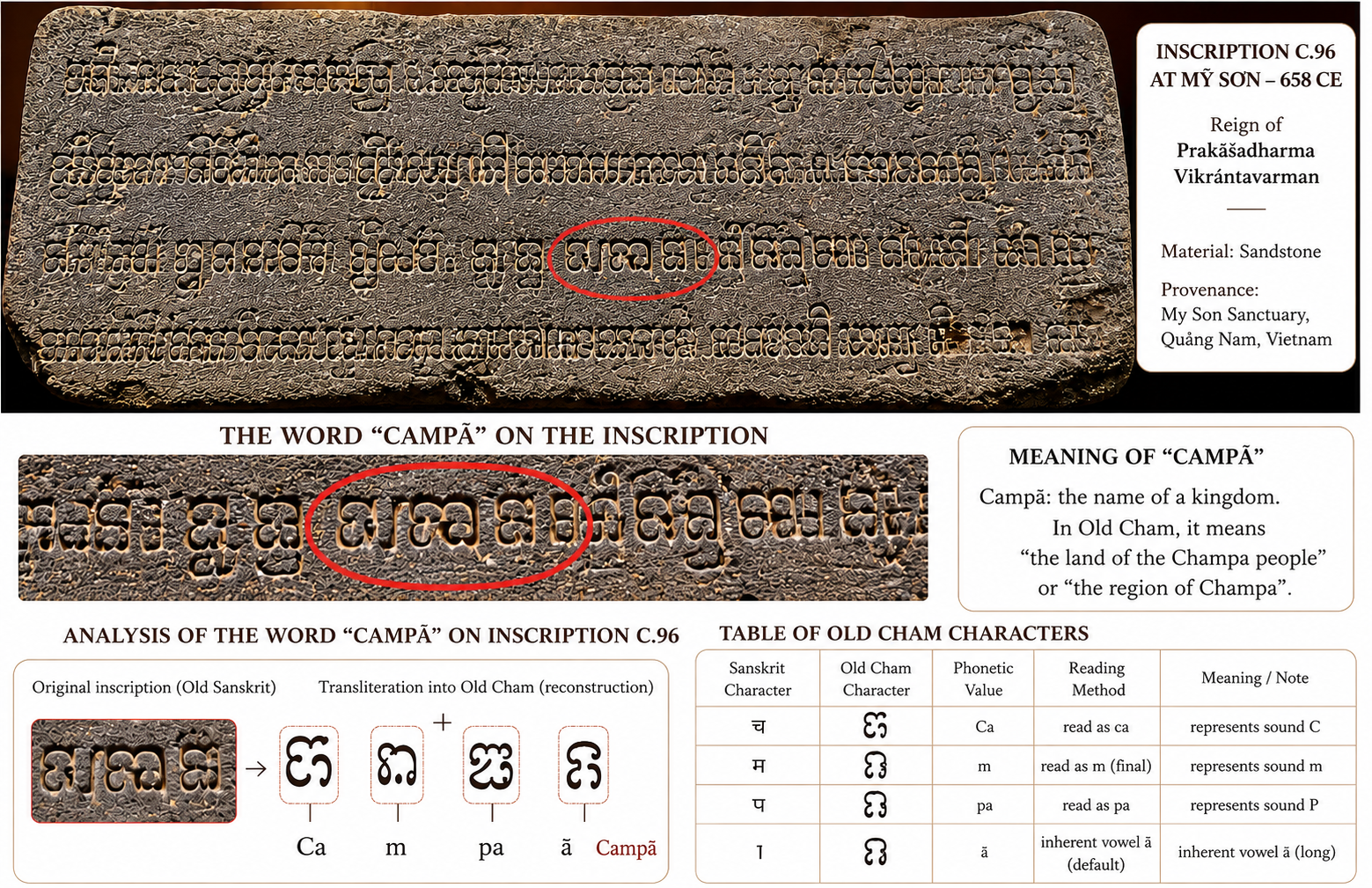
Figure 5. Mỹ Sơn Inscription C.96 (dated 658 CE, during the reign of Prakāśadharma Vikrāntavarman), discovered at the Mỹ Sơn temple complex in Quảng Nam and currently preserved at the Da Nang Museum of Cham Sculpture. The designation Campā (“Champa”) is inscribed in Sanskrit-Old Cham script in the South Indian Pallava style. This inscription is currently regarded as one of the earliest surviving examples in which the name Campā appears directly in Champa epigraphy, reflecting the process by which the Champa kingdom identified itself through the royal designation Campā in seventh-century royal inscriptions.
ĐỒNG DƯƠNG INSCRIPTION (C.292) - LATE 8TH CENTURY TO EARLY 9TH CENTURY
THE ETHNONYM “CAMPĀ” IN ANCIENT CHAMPA EPIGRAPHY
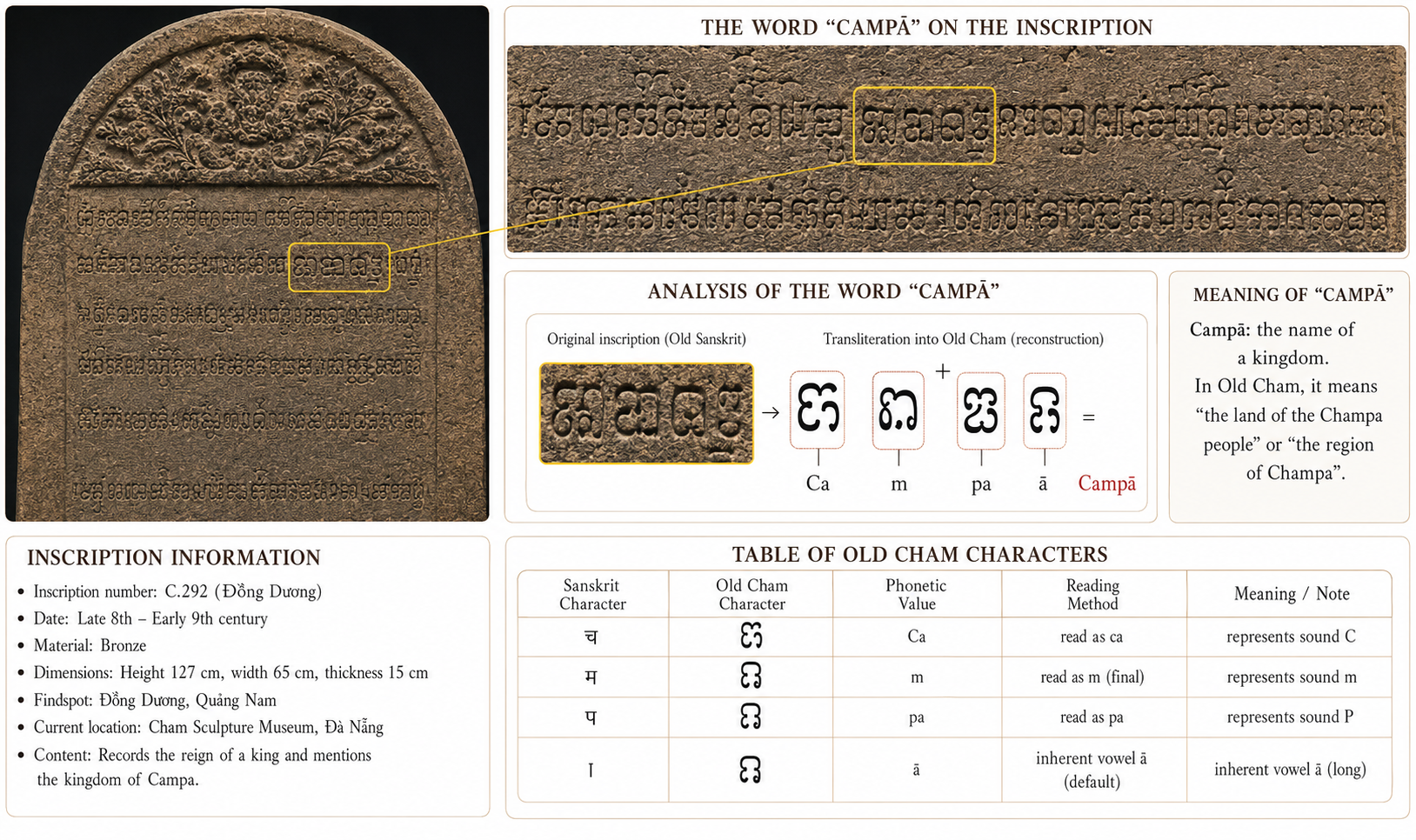
Figure 6. Đồng Dương Inscription C.292 (dated approximately to the late eighth to early ninth century), discovered at the Đồng Dương Buddhist monastery complex in Quảng Nam and currently preserved at the Da Nang Museum of Cham Sculpture. The designation Campā (“Champa”) is inscribed in Sanskrit-Old Cham script following the South Indian Pallava writing tradition. The term Campā appears in the inscription as a royal designation referring to the kingdom of Champa, reflecting the continuation of a tradition of self-identification already attested in earlier inscriptions such as Mỹ Sơn C.96 (658 CE). Inscription C.292 further demonstrates that by the late eighth to early ninth century, the name Campā had become firmly established in both royal and religious inscriptions of Champa.
INSCRIPTION C.96 AT MỸ SƠN (658 CE) - THE LINE CONTAINING “CAMPĀNAGARA”
One of the earliest inscriptions recording a name associated with the “City of Champa.”
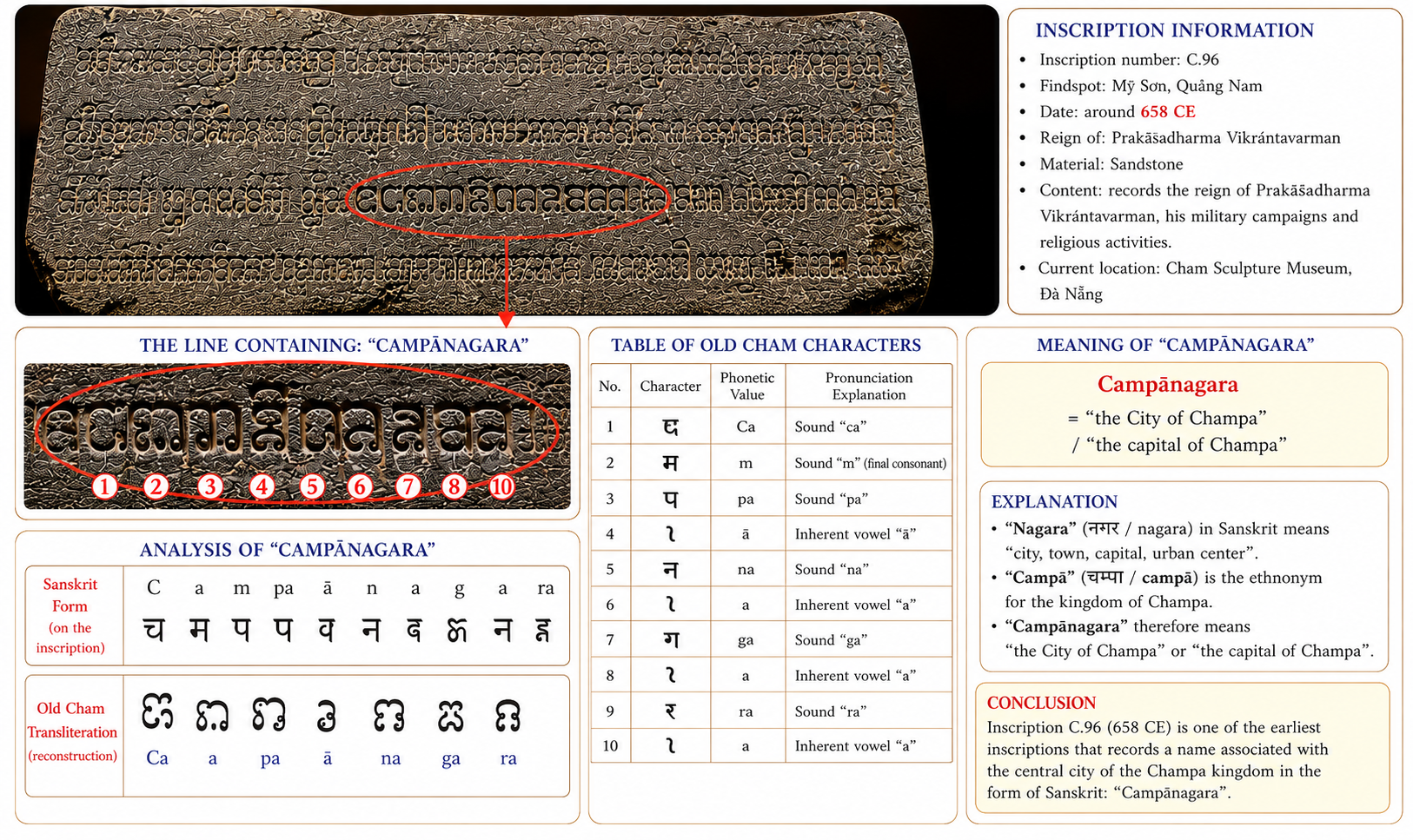
Figure 7. Mỹ Sơn Inscription C.96 (epigraphic reference: C.96), dated 658 CE during the reign of Prakāśadharma Vikrāntavarman, discovered at the Mỹ Sơn temple complex in Quảng Nam and currently preserved at the Da Nang Museum of Cham Sculpture. The expression Campānagara is inscribed in Sanskrit-Old Cham script in the South Indian Pallava style. In this compound, Campā refers to the kingdom of Champa, while nagara in Sanskrit means “city,” “urban center,” or “capital.” The term Campānagara may therefore be interpreted as “the city of Champa” or “the capital of Champa.” This inscription represents one of the earliest known examples directly referring to the political and urban center of the Champa kingdom in seventh-century epigraphy.
ĐỒNG DƯƠNG INSCRIPTION C.292 (LATE 8TH - EARLY 9TH CENTURY)
THE ETHNONYM “CAMPĀDEŚA” IN ANCIENT CHAMPA EPIGRAPHY
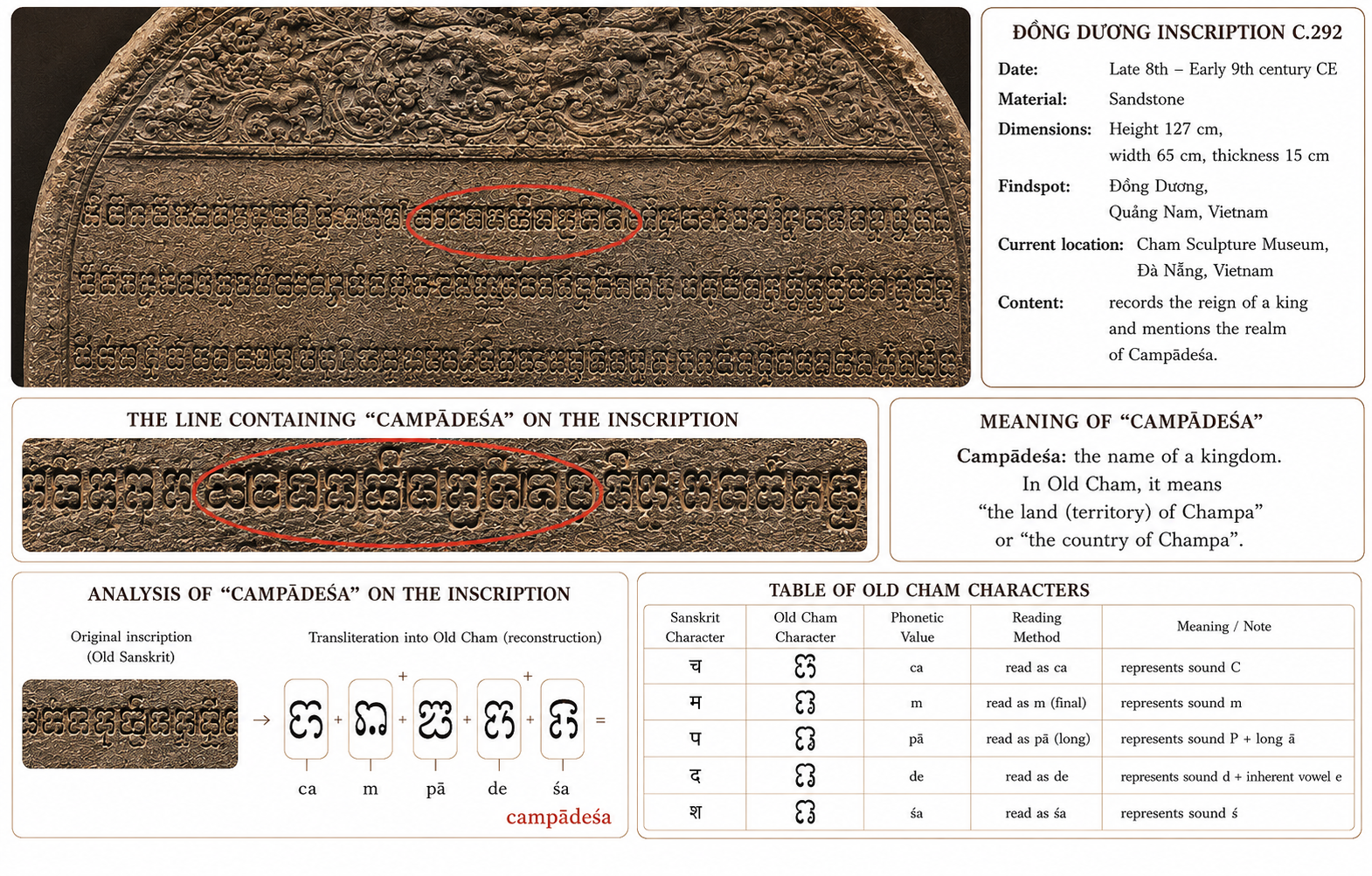
Figure 8. Đồng Dương Inscription C.292 (dated approximately to the late eighth to early ninth century), discovered at the Đồng Dương Buddhist monastery complex in Quảng Nam and currently preserved at the Da Nang Museum of Cham Sculpture. The designation Campādeśa (“the land of Champa” or “the kingdom of Champa”) is inscribed in Sanskrit-Old Cham script following the South Indian Pallava tradition. The term combines Campā (“Champa”) with deśa (“territory,” “country,” or “realm”), reflecting the manner in which the ancient Champa polity employed geographical and political terminology to designate its kingdom in official inscriptions. Inscription C.292 demonstrates that by the late eighth to early ninth century, the names Campā and Campādeśa had become firmly established in royal and religious epigraphy, continuing a tradition of self-identification already attested in earlier inscriptions such as Mỹ Sơn C.96 (658 CE).