
Trầm hương được xem là một loại gỗ quý hiếm, một sản vật tinh túy của trời không những hương thơm huyền dịu mà còn mang lại giá trị tâm linh, phong thủy,... Tục đốt trầm hương được xem như có từ lâu đời của người Đông Nam Á nói riêng và người Châu Á nói chung. Theo các nhà sử học, các dấu tích về việc đốt một thứ nào đó có mùi hương tại các ngôi mộ cổ ở Ai Cập, cũng như Trung Quốc,…cho thấy khởi nguồn của việc đốt trầm hương đã có cách đây hàng ngàn năm. |

Người Chăm là dân tộc thiểu số ở Việt Nam thuộc nhóm ngữ hệ Nam Đảo. Tiếng nói Chăm xuất hiện khá sớm, được chạm khắc trên bia đá Đông Yên Châu (Trà Kiệu) vào thế kỷ thứ 4 và được sử dụng phổ biến đến ngày nay. Để thuận lợi hơn cho việc bảo tồn và phổ biến chữ viết Chăm, nghiên cứu này đưa ra giải pháp ứng dụng công nghệ thông tin (CNTT) trên điện thoại Android gồm ba bộ là Cham Thrah, Champa và Cham Rumi; Bàn phím Chăm đa năng sử dụng cho máy tính PC; bộ chuyển đổi Cham Rumi sang chữ Chăm truyền thống sử dụng trên web; bàn phím Chăm ảo sử dụng để dạy và học chữ Chăm trực tuyến; tự điển điện tử Chăm Việt, Việt Chăm; font chữ Chăm – chuẩn Unicode; video clip và tài liệu học tiếng Chăm online. |

Bulan Ramawan, lakau "Ikak aek", tel harei “Talaih aek”. |

Tháng Ramadan sắp đến cộng đồng Champa hãy gửi cho nhau những tắm thiệp, những tin nhắn, mừng tháng Ramadan Bani. @“Ash Ha Du Allah Ila Ha Il Lallah Wa Ash ha du an na Muhammader rosu Lullah”@ |

Tết té nước là một trong những lễ hội văn hoá truyền thống của các nước Đông Nam Á. Người Thái Lan gọi là Songkran, người Lào gọi là Bunpimay, người Campuchia gọi là Chol Chnam Thmey, người Myanmar gọi là Thingyan, người Cham có lễ hội Raja nagar,… |

Năm mới sắp đến, đúng 1 tuần nữa là đã đến thời khắc trọng đại Thun Baru Champa 2018, “Di thun nasak Asau di bulan 1 di harei 1 bangun Adit”. Cộng đồng Champa hãy gửi cho nhau những tin nhắn, dành cho nhau những lời chúc yêu thương một năm mới tràn đầy hạnh phúc, may mắn và thành công. |

Panuec Langkar - Daa Po là phiên bản Surat E101A |

The main purpose of this research is to explore the preferable Cham script and Cham Latin; to develop application and evaluate the application products. Research sample is divided into two groups and the research instrument distributed into two forms of survey. The application was developed using ADDIE model. This survey, the acceptance of Cham script by religious group is 100%, Cham script online voting by student is 90.09%, Cham script by online questionnaire is 98.3%. EFEO Cham Latin by religious group is 100%, EFEO Cham Latin by online questionnaire is 95.4%. Viewed by sixteen experts using Fuzzy Delphi the results show that percentage of all items are 100%, more than what required (75%), the value of d for total construct is 0.02 (required ≤ 0.2). For conversion application, we have checked the accuracy percentage of four Cham poems and results Ariya Gleng Anak 99.88% (n=2459); Nai Mai Mang Makah 100% (n=2523); Ariya Cam Bini 100% (n=1823); Ariya Po Ceng 99.91% (n=2202). Using technologies to preserve the Cham language heritage is not only theoretically significant but also practically significant. |
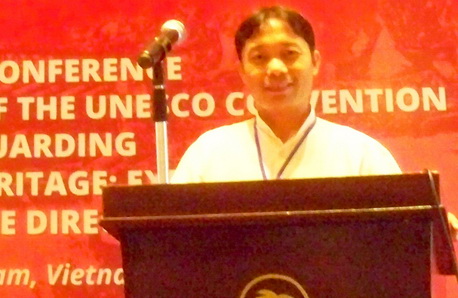
The Cham people who are now the minority ethnic in Vietnam speaks with the language familiar used as others Malay groups but differ in their written language. Cham Script inscriptions appear on Dong Yen Chau stone stele (Tra Kieu) in 4th century and the Cham are using this script system until today. Ensuring the preservation of Cham language, this study intended to design a tool to convert the EFEO Cham Latin in Malay system to Cham Akhar Thrah. The method used is by converting Latin EFEO into intermediate characters code followed by assigning it to Akhar Thrah backwards. Cham font conversion application has been created, which has carried out a number of technical requirements, and content conversion ensures correct in vocabulary, semantics and grammar. In this experiment we have checked the accuracy percentage of three Cham poems and results Ariya Cam Bini 100% (n=1823); Ariya Gleng Anak 99,88% (n=2459); Nai Mai Mang Makah 100% (n=2523). Cham font conversion is necessary and meaningful in conservation of Cham script. It will be used in schools, institutions in the country and overseas as well as assist in teaching and learning Cham language. |
The main purpose of this research is to explore the preferable Cham script and Cham Latin; to develop application and evaluate the application products. Research sample is divided into two groups and the research instrument distributed into two forms of survey. The application was developed using ADDIE model. This survey, the acceptance of Cham script by religious group is 100%, Cham script online voting by student is 90.09%, Cham script by online questionnaire is 98.3%. EFEO Cham Latin by religious group is 100%, EFEO Cham Latin by online questionnaire is 95.4%. Viewed by sixteen experts using Fuzzy Delphi the results show that percentage of all items are 100%, more than what required (75%), the value of d for total construct is 0.02 (required ≤ 0.2). For conversion application, we have checked the accuracy percentage of four Cham poems and results Ariya Gleng Anak 99.88% (n=2459); Nai Mai Mang Makah 100% (n=2523); Ariya Cam Bini 100% (n=1823); Ariya Po Ceng 99.91% (n=2202). Using technologies to preserve the Cham language heritage is not only theoretically significant but also practically significant. |
Cham Photos »
Cham websites »
Cham literatures »
Cham Heritage »
Cham Video »
Lễ tấu chức sư cả Cham Bani
Ramadan Cham Bani