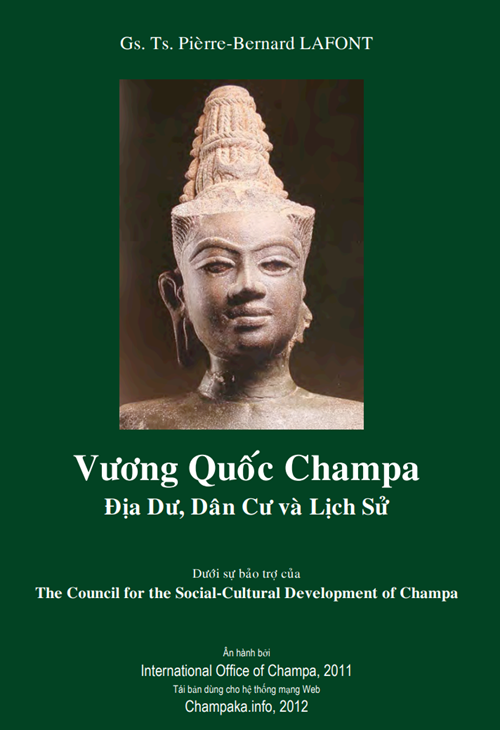
This study analyzes the origins, meanings, and functions of the two concepts of Awal and Ahier in Panduranga-Champa society. The author argues that Awal and Ahier are not merely the names of two religious’ communities, but also reflect two different stages and two different forms of the reception of Islam in Cham history. Awal is associated with early Islam, Allah, the Qur’an (Koran), and the role of religious clerics (acar), while Ahier is associated with the system of deities, temple-towers, and traditional Cham rituals. Through Akhar Thrah manuscripts, epic narratives, genealogies, and the studies of French scholars such as Étienne Aymonier, Antoine Cabaton, and Pierre-Bernard Lafont, this study demonstrates that Awal and Ahier are two complementary elements within the same distinctive social and religious structure of Panduranga-Champa.
1. Introduction
In studies of Cham society and religion after the sixteenth century, the Cham are often divided into two major communities: on the one hand, the community associated with temple towers, deities, and traditional rituals, commonly referred to as Cham Balamon; on the other hand, the community influenced by Islam, commonly referred to as Cham Bani. However, this classification reflects only part of the historical reality, because “Balamon” and “Bani” are primarily terms used in modern social life and do not fully express the distinctive religious structure of Panduranga.
In the indigenous tradition of the Cham in Panduranga, especially in present-day Ninh Thuận and Bình Thuận, the pair of concepts Awal and Ahier constitutes the most important categories for defining religious life. These are not simply the names of two different communities, but also reflect two levels, two forms, and two stages of the reception of Islam in Cham history.
Awal is generally understood as an early form of Islam or an original Islam in Panduranga. This community accepted Islam relatively early, established Allah as the supreme and only deity, yet still maintained many cultural elements and traditional customs of Champa. In ritual life, the Awal community is associated with the Qur’an (Koran), Ramadan (Ramawan), funerary rites, prayer, and the role of religious clergy (acar) such as Imam and Katip. However, the Islam of Awal is not identical to orthodox Islam in the Arab or Malay worlds, but rather represents a form of Awal Islam within the Cham cultural environment.
By contrast, Ahier reflects another layer of belief in which Allah is still regarded as the supreme deity, but not the sole object of worship. The Ahier community continues to maintain the indigenous pantheon of deities such as Po Yang, Po Ina Nagar, Po Rome, Po Klong Garai, Po Dam, mountain spirits, river spirits, ancestors, and the entire Cham temple-tower system. Therefore, Ahier cannot be regarded as pure Hinduism in the orthodox Indian sense, but rather as a form of indigenous Cham belief that has accepted Islam to a certain extent while still preserving the traditional foundations of deities and rituals.
Although they coexist within the same social space, Awal and Ahier are not two completely merged systems. Each side maintains its own hierarchy of religious officials, ritual system, and sphere of practice. The clergy (acar) of Awal mainly perform rituals related to Allah, the Koran, prayer, funerary rites, and Ramawan, while Ahier dignitaries such as Po Adhia, Paseh, Kadhar, and Muk Pajau are responsible for rituals related to temple towers, deities, ancestors, and traditional ceremonies. This division of religious responsibilities creates a parallel and complementary religious mechanism within Panduranga society.
From the perspectives of linguistics and religious history, the pair of concepts Awal-Ahier has far greater explanatory value than the pair of terms Bani–Balamon. In Arabic, “Banī” (بني) originally means “descendants of,” “lineage of,” or “community of followers,” rather than the name of a religion. In the Cham context, “Bani” is mainly used to refer to the community of followers of Allah or people who “have religion,” especially the Awal community. Therefore, “Agama Awal” is a more accurate designation that reflects the religious nature of this community.
Many scholars have recognized the distinctive character of the Awal-Ahier structure in Panduranga society. As early as the late nineteenth century, Étienne Aymonier, in his work Les Chams et leurs religions, noted the existence of two major Cham communities: one associated with temple towers and another influenced by Islam. Later, Antoine Cabaton further emphasized that these two communities did not exist as opposing religions, but rather maintained close ties within the same social structure. By the second half of the twentieth century, Pierre-Bernard Lafont and Po Dharma developed this perspective further by arguing that Awal and Ahier reflect two different forms of the reception of Islam in the history of Panduranga.
From a historical and anthropological perspective, Awal-Ahier is the result of a process of Islamization that lasted for centuries without leading to the complete elimination of older beliefs. Instead, the Cham selectively adopted Islam while preserving their system of deities, temple towers, and Cham cultural memory. This process produced a distinctive religious structure that is both Islamized and deeply indigenized, differing significantly from many other Muslim communities in Southeast Asia.
2. The Linguistic Origins of the Term Awal
The term Awal originates from the Arabic word “awwal” (أوّل), meaning “first,” “earliest,” “initial,” “original,” or “belonging to an early stage.” In Arabic usage, this term is commonly employed to refer to what comes first, an opening stage, or an initial form of a process. A familiar example is the name of the month Rabi’ al-Awwal, meaning “the first spring” or “the first month of spring.”
In the context of Panduranga, the term Awal does not merely carry a linguistic sense of sequence, but also implies an early stage of the reception of Islam in Cham society. Therefore, when it appears in the phrase Agama Awal, the term may be understood as “the religion of Awal,” “the original religion,” or “early Islam.” It refers to the Cham community that accepted Islam relatively early but had not yet completely separated itself from the traditional religious foundations and social organization of Champa.
The word “Agama” in the phrase “Agama Awal” derives from the Sanskrit term “Āgama,” meaning “religion,” “doctrine,” “sacred teaching,” or “holy tradition.” This term is widely used in the Malay-Indonesian world to refer to religion in general. Even today, in Malay and Indonesian, “agama” still means “religion.” The combination of Agama and Awal therefore creates a concept that contains both Sanskrit and Arabic elements, clearly reflecting Champa’s cultural interaction with both the Indian and Islamic worlds.
In many Akhar Thrah manuscripts from Panduranga, Agama Awal is used to refer to the Cham Muslim community that still strongly preserves indigenous customs. These customs are reflected in funerary rites, communal rituals, village organization, kinship relations, and various forms of folk belief. Awal is therefore not only a linguistic term, but also a historical concept reflecting an early form of Islamization that had not yet been fully standardized according to the Qur’an, Hadith, and Shari’a law as in orthodox Muslim communities.
When considered in relation to Ahier, Awal more clearly expresses the meaning of “coming first” or “the beginning.” If Awal represents the opening stage, the earlier phase, and the initial process of Islamization, then Ahier reflects the continuation, the later phase, or the layer of belief that still preserves the system of deities, temple towers, and traditional Cham rituals. Thus, the pair Awal-Ahier carries not only linguistic significance, but also reflects two cultural layers and two stages of religious development in the history of Panduranga.
An important distinction must be made between “Awal” and “Bani.” Awal is the name of a religious structure, whereas “Bani” is not the name of a religion in Arabic. From the perspectives of linguistics, history, and anthropology, “Banī” (بني) actually means “descendants of,” “lineage of,” or “those who belong to,” and is commonly used to refer to a tribe, clan, or community. For example, Banī Hāshim means “the Hashim lineage,” while Banī Umayyah means “the Umayyah lineage.” In the Qur’an (Koran), the phrase “Bani Israel” likewise refers to “the children of Israel” or “the descendants of Israel,” rather than the name of a religion.
In Cham society, “Bani” is used in a broader sense to refer to those who follow Allah or those who “have religion.” Accordingly, “Bani Cham” may be understood as Cham Muslims, “Bani Jawa” as Javanese Muslims, and “Anak Bani” as children born into a community that believes in Allah. Thus, “Bani” functions primarily as a marker of a community of believers rather than the name of an independent doctrinal system.
In this broader sense, the word “Bani” may sometimes mean “religious people,” “those who believe in Allah,” or “a community that worships Allah.” In some cases, it is used to distinguish believers from those who “have no religion.” Linguistically, expressions such as Bani Awal, Bani Ahier, Bani Islam, Bani Catholic, Bani Protestant, or Bani Hinduism may appear. However, these expressions merely indicate a community of followers rather than the name of a religion.
In the context of Panduranga, the more precise and appropriate terms remain Agama Awal and Agama Ahier, because these expressions more clearly reflect the distinctive religious and social structure of the Cham. If Awal is the name of a religious system, then “Bani” simply refers to the followers of Awal or to people who possess religious faith.
For this reason, from the perspective of linguistics and religious history, Agama Awal is the most accurate term to describe an early form of Islam in the Cham environment, where the Cham established Allah as the supreme and only deity while continuing to preserve many traditional cultural elements, rituals, and social relations. This is also why many modern scholars such as Pierre-Bernard Lafont, Po Dharma, William Noseworthy, Sakaya, Putra Podam, and Basiron argue that the term Awal (Agama Awal) fully reflects the historical and religious nature of the Cham Muslim community in Panduranga-Champa.
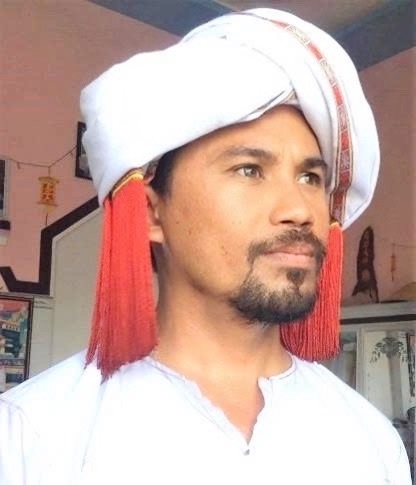
Figure 1. Katip Nguen (ꨊꨶꨮꩆ), a clergy member (Acar) of the Agama Awal tradition (early Islam, Cham Islam) at Magik (Masjid) Dik, Bình Thuận-Lâm Đồng. Photo: Putra Podam.
3. The Linguistic Origins of the Term Ahier
If Awal means “first,” “original,” or “coming before,” then Ahier is its corresponding term within the Cham system of thought and language. Both words derive from Arabic: Awal comes from “awwal” (أوّل), meaning “first,” while Ahier derives from “ākhir” (آخر), meaning “last,” “coming after,” or “later.” When adopted into the Cham language, “ākhir” underwent a phonetic transformation and became “Ahier.” Therefore, Ahier is commonly understood as “coming later,” “the continuation,” “the next stage,” or “the concluding part.”
In classical Cham and in many Akhar Thrah manuscripts, Awal and Ahier do not merely carry temporal meanings, but are also used to determine position, function, and sequence in ritual life. If Awal signifies the opening stage, what comes first, and the original element, then Ahier signifies the continuation, what comes later, and the completed element. The pair Awal–Ahier reflects a fundamental logic of opposition in Panduranga society: before-after, beginning-continuation, and origin-completion.
In the context of the religious history of Panduranga-Champa, Ahier may be understood as a later form of the reception of Islam in comparison with Awal. If Awal reflects an early stage of Islamization in which Allah was established as the supreme and only deity, then Ahier reflects another stage in which Allah is still regarded as the supreme deity, but not the sole object of worship.
Alongside Allah, the Ahier community continues to maintain the worship of Po Yang, ancestors, local deities, and the Cham temple-tower system. Deities such as Po Ina Nagar, Po Rome, Po Klong Garai, and Po Dam continue to occupy an important place in the ritual life of the community. However, in the Ahier worldview, these deities do not exist on an equal level with Allah, but belong instead to an indigenous layer of belief situated beneath the supreme power of Allah. This demonstrates that Ahier does not reject Islam, but rather accepts it within the framework of a multi-layered belief system.
This characteristic means that Ahier cannot be regarded as pure Hinduism, nor is it entirely equivalent to the concept of “Balamon” in the sense of orthodox Indian Hinduism. Ahier is, in fact, a form of indigenous Cham belief that has accepted Islam to a certain degree while still preserving the system of deities, temple towers, and traditional Cham rituals. Within this structure, Allah appears in certain prayers, ritual formulas, and religious concepts, but the center of Ahier religious life remains focused on indigenous deities, ancestors, and temple-tower centers.
Unlike the Awal community, where religious authority is concentrated among clergy (acar) such as Imam and Katip, the Ahier community is associated with a separate hierarchy of religious dignitaries, including Po Adhia, Paseh, Kadhar, Muk Pajau, and Ka-ing. These religious officials are responsible for organizing sacrificial rites, maintaining temple towers, preserving sacred objects, and conducting communal rituals. Major ceremonies such as Kate, Rija Nagar, Rija Praong, the opening of temple towers, and rituals at the towers of Po Rome, Po Klong Garai, and Po Dam all belong to the sphere of Ahier.
Therefore, the distinction between Awal and Ahier lies not only in their objects of worship, but also in their systems of religious officials, ritual spaces, and spheres of religious practice. If Awal reflects a clearer tendency toward Islamization, then Ahier reflects the deeper indigenous layer of belief within Panduranga society. Many Akhar Thrah manuscripts, Ariya texts, and ritual epics indicate that Ahier was commonly used to refer to the community associated with the temple-tower system and Cham deities, while also distinguishing it from Awal in matters of social organization, ritual practice, marriage, and funerary rites.
From a historical perspective, Ahier reflects a later stage in the process of Islamization in Panduranga. If Awal represents early Islam with its emphasis on Allah as the sole deity, then Ahier reflects a process in which Islam was accepted without completely replacing older beliefs. This shows that Islam in Panduranga did not develop through a complete break with the past, but rather through adaptation, synthesis, and restructuring on the basis of traditional Cham culture.
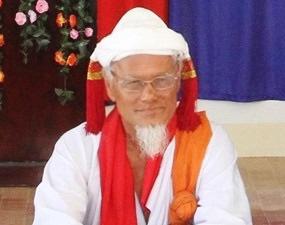
Figure 2. Po Adhia Hán Đô (ꨨꩆ ꨙꨯ), Chairman of the Brahmanic Religious Council (Agama Ahier) of Ninh Thuận Province. (“Po” means “Lord” or “Sir”). Photo: Putra Podam.
4. Why Did the Two Terms Awal and Ahier Emerge in Panduranga?
Panduranga was the southernmost region of Champa and maintained a relative degree of independence from the seventeenth century until the early nineteenth century. It was also a region simultaneously exposed to multiple cultural and religious traditions, including indigenous Cham beliefs, residual Hindu influences from earlier periods, Islam from the Malay-Javanese world, and the growing influence of the Vietnamese. In this context, Panduranga society did not develop by completely abandoning older beliefs and replacing them with a new religion. Instead, it formed a mechanism of accommodation in which multiple belief systems coexisted and complemented one another. It was through this process that the two categories of Awal and Ahier emerged as distinct but closely related components within the Cham religious structure.
According to many modern studies by Po Dharma, Sakaya, Danny Wong Tze Ken, Putra Podam, and Basiron, Awal and Ahier originally reflected the historical sequence of the Islamization process in Panduranga. If Awal means “coming first,” “the beginning,” or “early Islam,” then Ahier means “coming later,” “the continuation,” or “a later stage.” According to Po Dharma’s interpretation, Awal refers to the Cham groups that accepted Islam before the reign of Po Rome, while Ahier refers to the groups that accepted Po Uluah (Allah) at a later stage, especially after the time of Po Rome. These two terms therefore reflect not only differences in ritual practice and objects of worship, but also two distinct stages in the Cham reception of Islam.
Islam began to enter Champa around the tenth and eleventh centuries through maritime trade networks linking Champa with Java, Patani, Kelantan, and the Middle East. In the early stages, the Cham gradually adopted Islamic elements such as Allah, the Qur’an (Koran), Islamic funerary rites, Ramadan (Ramawan), and the role of religious clergy. However, they did not completely abandon the system of indigenous deities and beliefs that had long been deeply rooted in Cham society. Po Yang, ancestor worship, mountain spirits, river spirits, and the temple-tower system continued to play an important role. Rather than forming a completely separate Islamic community detached from older traditions, Panduranga gradually developed two parallel categories: Awal, referring to the group oriented toward Allah and Islamic rituals, and Ahier, referring to the group that continued to preserve the foundations of temple-tower worship and Cham deities.
The role of Cham kingship, especially under the reign of Po Rome, was particularly significant in consolidating the Awal–Ahier structure. Many historical and oral traditions suggest that Po Rome had close ties with the Malay-Muslim world, especially Kelantan and Patani. Some Malay sources even claim that Po Rome bore the Islamic name Nik Mustafa, with the full name Nik Mustafa Bin Wan Abul Muzaffar Waliyullah, and the regnal title Sultan Abdul Hamid Shah. Po Rome is also said to have spent time studying in Kelantan before ascending the throne. Many scholars agree that the reign of Po Rome marked a period in which Panduranga significantly strengthened its relations with the Malay world.
Studies by Pierre-Bernard Lafont and Po Dharma suggest that Po Rome acted as an intermediary figure who promoted reconciliation between the Cham groups influenced by Islam and those who maintained the traditional temple-tower beliefs. In this model, the Awal community was encouraged to adopt Islam while still preserving Cham customs, whereas the Ahier community continued to maintain its system of deities and temple towers while acknowledging Allah as the supreme being. This mechanism created a distinctive form of accommodation in Panduranga, in which Islam did not completely eliminate older beliefs but instead coexisted with them.
In social reality, Awal and Ahier did not exist as two completely separate communities. Members of both groups could live in the same palei, belong to the same lineage, intermarry, and participate together in many life-cycle rituals. Nevertheless, each side maintained its own hierarchy of religious officials and ritual system. Awal was associated with Imam, Katip, and rituals related to Allah, the Koran, funerary rites, and Ramawan, while Ahier was associated with Po Adhia, Paseh, Kadhar, Muk Pajau, and rituals related to temple towers, deities, ancestors, Kate, Rija Nagar, and Rija Praong. This division of roles allowed Panduranga society to preserve both Islamization and indigenous belief within the same cultural space.
Many French scholars of the early twentieth century also recognized this distinctive characteristic. Étienne Aymonier observed that the “Bani” community in Panduranga differed from orthodox Malay Islam because it retained many indigenous beliefs. Later, Antoine Cabaton further emphasized that the two Cham communities associated with Islam and temple towers did not exist as opposing religions, but rather maintained close relations within the same social structure. These observations suggest that Awal and Ahier were not the result of religious division, but rather the outcome of a long process of accommodation and adaptation.
From the perspective of religious history, the emergence of Awal and Ahier shows that Islam in Panduranga did not develop according to a model in which older beliefs were completely replaced, as occurred in many other parts of the Muslim world. Instead, Islam was accepted gradually and integrated into the existing culture of Champa. This mechanism of accommodation enabled the Cham to preserve their system of temple towers, deities, and traditional rituals while also accepting Allah, the Koran, and Islamic elements. It was also one of the key reasons why Panduranga was able to maintain social stability and a distinctive cultural identity for many centuries.
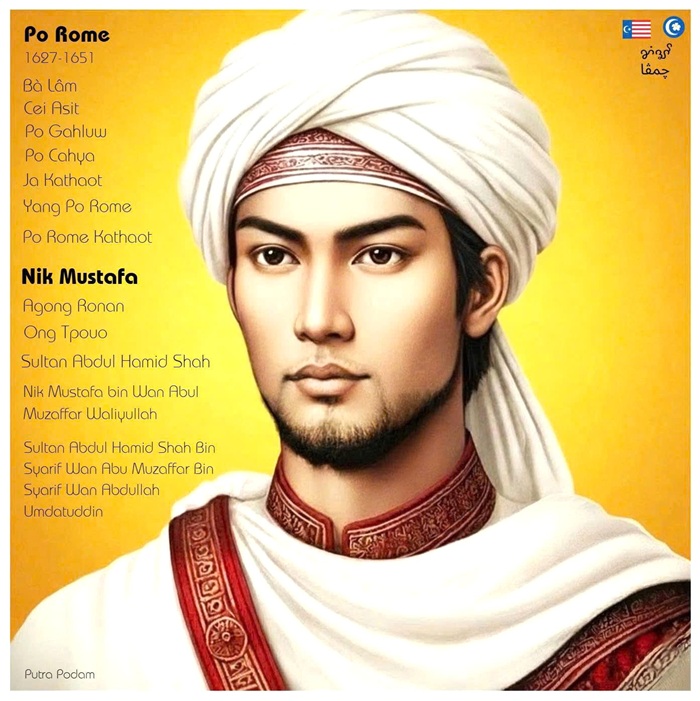
Figure 3. King Po Rome (Nik Mustafa, Sultan Abdul Hamid Shah, Nik Mustafa Bin Wan Abul Muzaffar Waliyullah). Po Rome, who ruled Panduranga-Champa from 1627 to 1651, was an outstanding Muslim ruler who inherited and continued the foundations established by the reign of Po Klong Mah Nai (Po Mah Taha), the powerful and highly influential Islamic king of Panduranga-Champa. During his stay in Makkah, which the Malays referred to as Serembi Makkah in the minor kingdom of Kelantan, Malaysia, he married an Islamic princess, Puteri Siti (Princess Siti). This marriage formally made Po Rome a member of an Islamic royal lineage in Malaysia. Malaysian chronicles also record that the ruling dynasty of present-day Kelantan traces its origins to the lineage of King Po Rome. Photo: Putra Podam.
5. When Did Awal and Ahier Emerge?
It is very difficult to determine precisely when the two terms Awal and Ahier first appeared in Cham history, because no inscription, ancient text, or administrative document has yet been discovered that clearly records the date of their emergence. However, based on Akhar Thrah manuscripts, epic narratives, genealogies, ritual documents, and the writings of French scholars from the late nineteenth and early twentieth centuries, it may be argued that Awal and Ahier had already existed in a relatively stable form in Panduranga since at least the seventeenth century.
Islam began to enter Champa around the tenth and eleventh centuries through maritime trade routes linking Champa with the Malay world, Java, India, and Arab merchants. In its early stages, Islam was mainly present among merchants, sailors, nobles, and a segment of the coastal population, rather than becoming a widespread religion throughout Cham society. This indicates that the early presence of Islam did not immediately result in the formation of a fully Islamized community.
One important source demonstrating the early presence of Islam in Champa is the research of Paul Ravaisse on Arabic and Kufic inscriptions in Champa. In his work Étude sur les inscriptions arabes du Campa, published in 1922, Ravaisse discovered and analyzed two early Islamic inscriptions in central Vietnam, which are often regarded as evidence that Islam had already appeared in Champa by at least the tenth or eleventh century. These inscriptions contain early Arabic script and are connected to the maritime trade networks of Muslim communities. Ravaisse’s findings show that Islam was not merely a late element in Cham history, but had been present from a very early period and underwent a process of development over many centuries.
Some studies further suggest that Champa not only received Islam from outside influences, but also served as an intermediary in transmitting Islam to other regions within the Southeast Asian maritime world. In present-day Indonesia, there are still many legends, tombstones, and historical materials related to Cham Muslims, especially stories concerning Cham merchants, Cham envoys, and figures known as Putri Champa, as well as Cham tombstones. These traces indicate that Champa maintained long-standing ties with the Malay-Indonesian Islamic world from an early period.
However, it was not until around the seventeenth century, when Panduranga became the last center of Champa and simultaneously strengthened its relations with Kelantan, Patani, and the Malay world, that the process of Islamization became more intensive. It was in this context that Awal and Ahier gradually took shape as two different forms of the reception of Islam in Cham society.
The reign of Po Rome is often regarded as a crucial period in consolidating the Awal-Ahier structure. Many modern studies suggest that Po Rome maintained close relations with Kelantan, Patani, and the Malay world, while also pursuing a policy of reconciliation between Cham groups that had accepted Islam and those that maintained the traditional temple-tower belief system. In this context, Awal gradually came to refer to the group oriented toward Allah, the Koran, and Islamic rituals, while Ahier referred to the group that continued to preserve the system of deities, temple towers, and Cham beliefs.
Many Akhar Thrah texts such as Ariya Cam-Bani, Ariya Tuen Phaow, Dalikal texts, ritual epics, genealogies, and Panduranga funerary documents all indicate that Awal and Ahier had become familiar categories in Cham society before the nineteenth century. These materials do not describe Awal and Ahier as two completely separate communities, but rather as two groups coexisting within the same palei, lineage, and life-cycle rituals. In many cases, Awal and Ahier are presented as two complementary components within the same social and ritual structure.
By the late nineteenth and early twentieth centuries, French scholars began to record more clearly the existence of two Cham religious communities in Panduranga. Étienne Aymonier, in his work Les Chams et leurs religions, described the Cham as divided into two major groups: one associated with temple towers and Brahmanic rituals, and another called “Bani,” meaning the Cham community influenced by Islam. He also mentioned the term “Ahiér” or “Akaphier” to refer to the Cham group that maintained the temple-tower system and traditional deities. According to Aymonier, the Bani community in Panduranga represented a form of Islam separated from orthodox Islam and strongly influenced by the indigenous religious environment.
After Aymonier, Antoine Cabaton, in Nouvelles recherches sur les Chams, continued to divide the Cham into two major groups: “Brahmaniques” and “Cham Bani.” However, Cabaton also observed that the two communities maintained very close connections in terms of family, village life, lineage, and life-cycle rituals. The Cham could live in the same palei, marry one another, participate together in communal ceremonies, and share many common cultural elements. This suggests that Awal and Ahier did not function as opposing religions, but rather as complementary elements within the same society.
George Maspero, in Le Royaume de Champa, argued that Islam began influencing Champa relatively early through maritime trade networks linking the Arab world, Persia, Gujarat, Java, and the Malay world. According to Maspero, Islam in Panduranga did not completely replace older beliefs, but coexisted alongside the system of temple towers, deities, and indigenous rituals. This interpretation is very close to the current understanding of Awal-Ahier as two different forms of the reception of Islam coexisting within Cham society.
The archaeological and descriptive works of Henri Parmentier on Po Rome, Po Klong Garai, Po Dam, Po Nagar, and many other sites in Panduranga also demonstrate that by the late nineteenth and early twentieth centuries, the Cham temple-tower system still occupied a central place in the ritual life of the Ahier community. This proves that Islam in Panduranga did not destroy or replace the indigenous system of deities, but coexisted with it within a distinctive social structure.
Only from the second half of the twentieth century onward did scholars such as Pierre-Bernard Lafont, Po Dharma, Sakaya, William Noseworthy, Danny Wong Tze Ken, Putra Podam, and Basiron begin to emphasize that Awal and Ahier are not merely the names of two religious communities, but also reflect two different stages in the history of Islamization in Panduranga. According to Po Dharma’s interpretation, Awal refers to the Cham who accepted Islam “before” the reign of Po Rome, while Ahier refers to those who accepted Po Uluah (Allah) “after” the reign of Po Rome. This perspective demonstrates that Awal and Ahier are not merely religious concepts, but also historical categories reflecting the developmental sequence of Cham society.
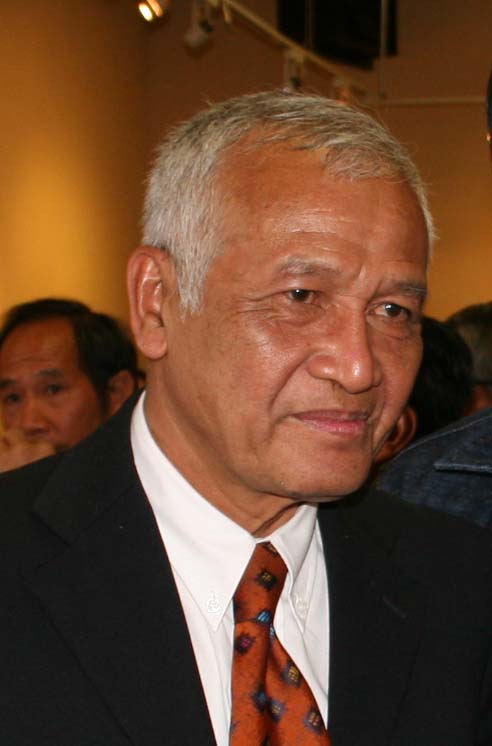
Figure 4. Associate Professor Dr. Po Dharma argues that Awal refers to the Cham groups that accepted Islam “before” the time of Po Rome, while Ahier refers to those who accepted Po Uluah (Allah) “after” the time of Po Rome. If Awal reflects an early stage of Islamization in which Allah was established as the supreme and only deity, then Ahier reflects another stage in which Allah is still regarded as the supreme deity but not the sole object of worship. In Ariya Cam-Bani, he also affirms that “Bani” means “Muslim.”
6. The Social and Ritual Functions of Awal-Ahier
Awal and Ahier play a particularly important role in maintaining the religious, social, and cultural stability of Panduranga. However, when examining the relationship between these two communities, it is important to note that the main distinction does not lie among ordinary believers, but rather in the systems of clergy, religious officials, and ritual spheres associated with each side. Awal and Ahier do not perform the same ritual system; instead, each side fulfills its own functions, maintains its own boundaries, and observes its own prohibitions. This reflects a relatively clear mechanism of religious division of labor within Panduranga society.
Within the traditional social structure of the Cham, Awal and Ahier do not exist as two completely opposing communities, but rather as two complementary elements within the same cultural and ritual system. Awal is responsible for rituals related to Allah, the Koran, funerary rites, prayer, and forms of Awal Islam, while Ahier is responsible for the Cham pantheon, temple towers, ancestors, and traditional ceremonies. This division of ritual responsibilities enables Panduranga society to maintain both Islamization and indigenous belief at the same time.
Within the Awal community, the central role belongs to religious officials such as Imam, Katip, and especially the clergy (acar). In Cham religious life, the acar serves as the representative of Allah within the community, responsible for reciting the Koran, leading prayers, conducting funerary rites, carrying out Ramawan rituals, and offering blessings and protection. The role of the acar is not limited to ritual practice, but also includes educational and moral functions, since they transmit codes of conduct, religious norms, and regulations related to communal life.
By contrast, Ahier is closely connected with the Cham temple-tower system, indigenous deities, ancestors, and traditional ceremonies. Ahier dignitaries such as Po Adhia, Paseh, Kadhar, Muk Pajau, and Ka-ing are responsible for maintaining temple towers, preserving sacred objects, organizing sacrificial rites, and conducting communal rituals. They are the only individuals authorized to enter the sacred inner spaces of the towers in order to present offerings, recite invocations, perform sacrificial rites, and preside over ceremonies related to Po Yang, Po Ina Nagar, Po Rome, Po Klong Garai, Po Dam, and other local deities.
During major ceremonies held within the temple-tower system, such as Kate, the opening of temple towers, or rituals at Po Klong Garai, Po Rome, Po Nagar, and Po Dam, only Ahier dignitaries are permitted to perform rituals inside the towers. The interior space of the tower is regarded as a sacred area reserved for the Cham pantheon and for those entrusted with Ahier ritual authority. Awal followers, including the clergy (acar), generally participate only in the areas outside the tower or in communal spaces surrounding the festival. This reflects a fairly clear ritual boundary between the two belief systems.
For Awal clergy (acar), entering the inside of a tower to perform rituals directly is considered taboo. This is because the function of the acar is restricted to rituals related to Allah and the Koran. The acar does not worship Po Yang, does not present offerings to deities, does not pour ritual wine, and does not directly participate in the deity-centered rituals of Ahier. This distinction is very important for differentiating the role of Awal clergy from that of Ahier dignitaries, while also avoiding the mistaken assumption that Awal clergy directly participate in the worship of Cham deities.
However, this does not mean that Awal is completely absent from Ahier rituals. In many Ahier communal and family ceremonies such as Rija Nagar, Rija Praong, Rija Malam, Rao Sang, and Kamruai Sang Baruw, the clergy (acar) are often invited to participate by reciting the Koran, asking Allah to witness the ritual, and offering blessings to the family or lineage organizing the ceremony. In these cases, the acar does not preside over the deity-centered portion of the ritual, but only carries out prayers to the supreme being, Po Allah.
Typically, the acar recites certain surahs and du-a (da-a) for protection, health, good fortune, and peace for the family. Frequently used passages include Surah Al-Fatihah, Ayat al-Kursi, Surah Ash-Shams, and several traditional du-a prayers. The role of the acar in these rituals is not to replace the Ahier dignitaries, but rather to invite Allah to be present as a witness and source of blessing. This demonstrates that Awal and Ahier do not exclude one another, but instead participate together in a shared ritual space while maintaining different roles.
One of the ritual systems that most clearly reflects the relationship between Awal and Ahier is Rija (Raja). This is a ritual performance tradition originating from the Malay world, especially from Kelantan and Pattani. In Malay tradition, Raja Mak Yong was originally associated with royalty and the nobility before spreading into wider society. When it reached Champa, Rija was localized and became an important component of Cham cultural and religious life.
For the Cham in Panduranga, Rija was formerly organized at many levels, including the royal court, the palei, lineages, and individual families. It was not only a religious ritual but also a form of folk performance combining dance, song, music, prayer, and communal ceremony. Rija carried many meanings, including prayers for protection, agricultural fertility, health, prosperity, and blessings for families and communities, while also helping people reconnect with their ancestors and cultural origins.
Today, many forms of Rija are gradually disappearing. Rija Praong is almost no longer practiced in either the Awal or Ahier communities. Rija Nagar is still maintained in some Ahier villages, but has declined significantly among the Awal. Meanwhile, “Rao Sang” and “Kamruai Sang Baruw” continue to survive in many families, especially in rituals for blessing and protecting newly formed households.
Many studies suggest that Rija is closely related to Malay royal performance traditions such as Mak Yong and Menora. However, in many modern Muslim regions, these forms are often regarded as incompatible with orthodox Islam. In 1992, the government of Kelantan banned Raja Mak Yong (Rija) on the grounds that it contained superstitious elements and was inconsistent with Islamic teachings. Nevertheless, Mak Yong was later recognized by UNESCO as an Intangible Cultural Heritage of Humanity.
For the Cham community, Rija still holds an important place in religious and cultural life. Although many rituals have been simplified or disappeared, Rija continues to help the Cham preserve collective memory, maintain connections with their ancestors, and protect their cultural identity. This demonstrates that Awal and Ahier are not only two different ritual systems, but also two complementary elements within the same social and cultural structure of Panduranga-Champa.
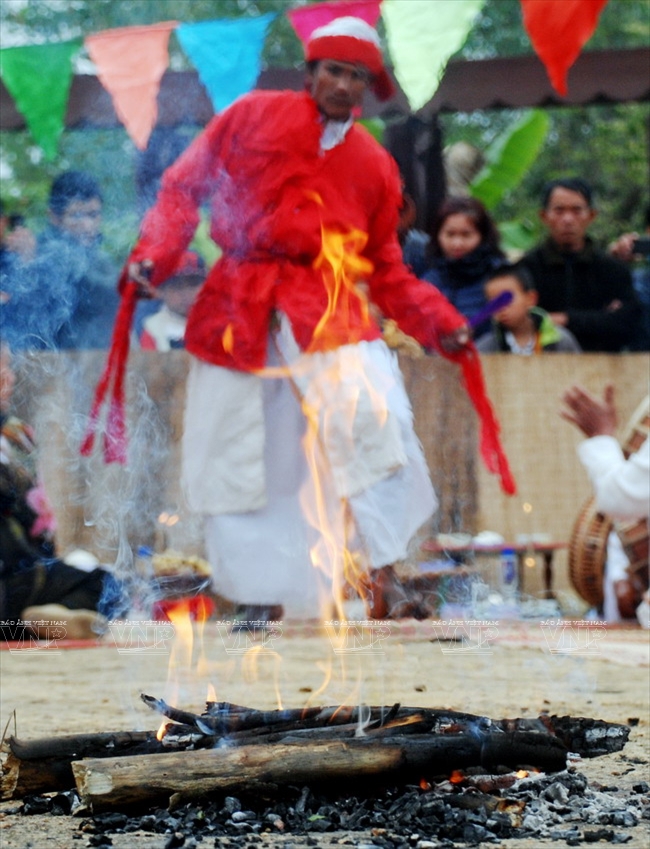
Figure 5. A Ka-ing performing the fire-stepping dance at Rija Nagar. Ka-ing is regarded as an important component within the system of folk ritual officiants in Cham religious culture. Although Ka-ing plays an important role in ritual life, he belongs to the category of “folk ritual specialists” or “folk ceremonial officiants,” distinct from the higher-ranking religious dignitaries responsible for ceremonies inside temple towers. Photo: Quỳnh Anh.
7. Conclusion
Awal and Ahier are not simply the names of two different religious communities, but rather two categories that reflect two stages and two forms of the reception of Islam in the history of Panduranga-Champa. If Awal reflects an early form of Islam that was still strongly influenced by indigenous customs while establishing Allah as the supreme and only deity, then Ahier reflects a later stage of Islamic reception in which Allah still occupies the highest position but is not the sole object of worship. Alongside Allah, the Ahier community continues to maintain the system of deities, ancestors, temple towers, and traditional rituals of Champa.
Unlike the contemporary classification into the pair “Cham Bani” and “Cham Balamon,” the pair of concepts Awal–Ahier makes it possible to identify more fully the nature of religious life in Panduranga. In reality, Awal is not a fully orthodox form of Islam like modern Malay Islam or Sunni Islam as commonly practiced in Southeast Asia. Conversely, Ahier is not pure Hinduism in the sense of orthodox Indian Hinduism. Both are connected to Islam and both acknowledge Allah as the supreme deity, but there are clear differences between them in terms of the degree of Islamic reception, the objects of worship, ritual forms, and the role of religious officials.
The studies of Étienne Aymonier, Antoine Cabaton, George Maspero, Henri Parmentier, Paul Ravaisse, Pierre-Bernard Lafont, as well as modern scholars such as Po Dharma, Sakaya, Danny Wong Tze Ken, William Noseworthy, Putra Podam, and Basiron, all demonstrate that Islam in Champa did not develop according to a model in which older beliefs were completely replaced, as happened in many other parts of the Muslim world. Instead, Islam was accepted gradually and integrated into the existing social and religious structure of Panduranga. The result of this process was the formation of the two categories of Awal and Ahier, which coexist side by side while remaining closely connected in Cham communal life.
In Panduranga society, the clergy (acar) of Awal are mainly responsible for rituals related to Allah, the Koran, Ramawan, funerary rites, prayers for protection and blessing, and indigenous Islamic ceremonies. The acar do not participate in Cham deity rituals, do not enter the interior of temple towers, and do not perform ceremonies dedicated to Po Yang, Po Ina Nagar, Po Rome, or other indigenous deities. By contrast, Ahier dignitaries such as Po Adhia, Paseh, Kadhar, Muk Pajau, and Ka-ing are directly responsible for maintaining temple towers, organizing Kate and Rija, conducting sacrificial rites, and performing ceremonies related to indigenous deities. However, in many cases, the Ahier community still invites Awal clergy (acar) to recite the Koran and ask Allah to witness their ceremonies. This demonstrates that Awal and Ahier always maintain a certain social and religious connection, even though each side preserves its own hierarchy of religious officials and ritual sphere.
From historical and anthropological perspectives, Awal-Ahier is a distinctive religious structure that appears most clearly in Panduranga. It is the result of a process of Islamization lasting many centuries, during which the Cham both accepted Islam and preserved their traditional belief system and cultural heritage. When studying Cham religion in Panduranga, it is therefore necessary to move beyond the simple categories of “Islam” and “Balamon” and instead recognize Awal and Ahier as two different religious forms that are closely connected historically, socially, and ritually.
Awal and Ahier are not opposed to one another in the sense of mutual exclusion, but rather exist as two complementary elements within the same Cham social and cultural structure. One side preserves early Islam and the role of Allah, while the other preserves the system of deities, temple towers, and Cham cultural memory. It is this combination that has created the distinctive identity of Panduranga and enabled the Cham community to maintain cultural continuity through many historical changes.
Phụ Lục
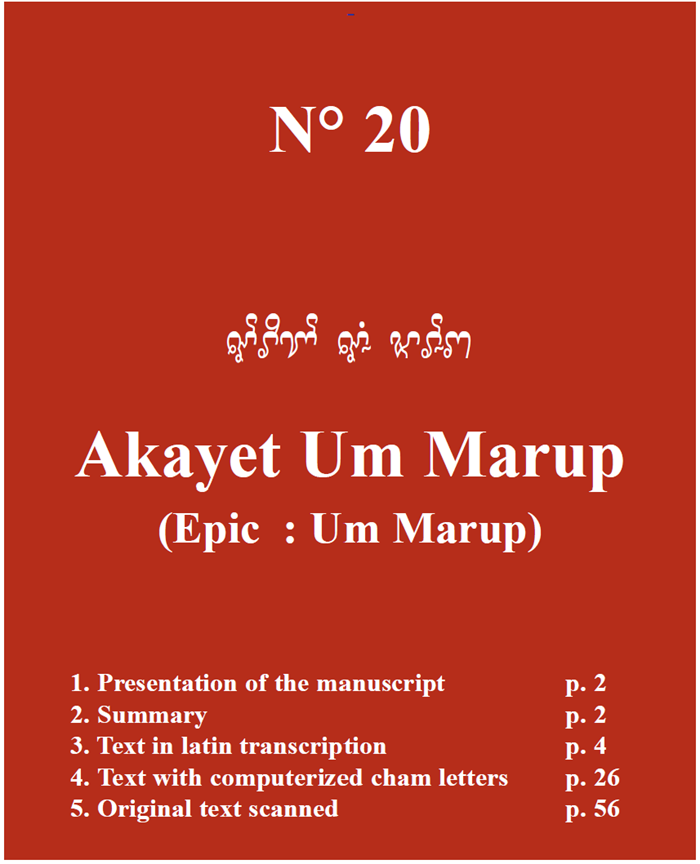
Figure 6. Akayet Um Marup, published in volume no. 20, edited by Po Dharma. Department of Museums and Antiquities Malaysia and École Française d’Extrême-Orient, Kuala Lumpur, 2003.
Summary: Um Marup was the son of King Harum Mak. One day, he left the royal palace to hunt and encountered Po Nabi (the Prophet), together with the two khalifs Po Ali and Abukhar Uman Suman. Po Ali explained to him the importance of Islam and showed him a vision of the joys of the afterlife.
After this encounter, Um Marup decided to renounce the throne and convert to Islam in order to attain the blessings of paradise. His father, the king, became extremely angry and tried to stop him, believing that Um Marup was weakening the ancestral traditions of the kingdom. However, all of these efforts proved useless: with the help of Po Nabi, Um Marup overcame every trial imposed upon him by his father.
In the final battle between Um Marup and his father’s army, Um Marup was on the verge of victory when he was suddenly attacked and killed by the giant Kai Glong. Afterwards, Po Nabi and the heavenly maidens carried Um Marup’s remains before the throne of Po Aluah.
To avenge the prince, Po Nabi launched a fierce attack against King Harum Mak. The king was eventually defeated and agreed to convert to Islam, just as his son had done. See the English version, Figure 7.
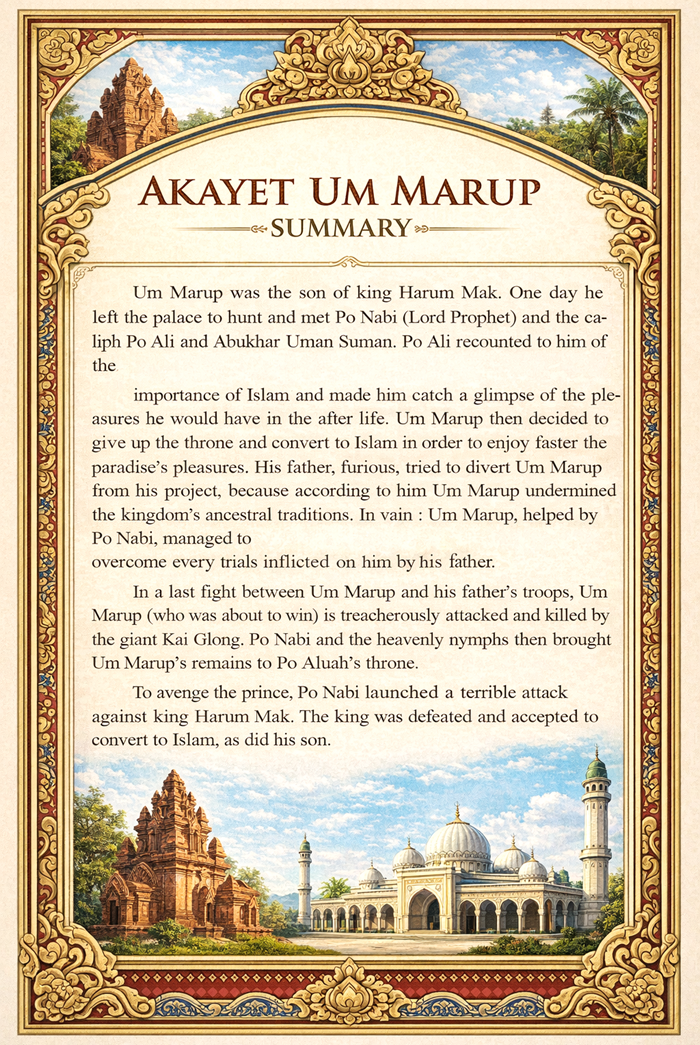
Figure 7. Summary of Akayet Um Marup, published in volume no. 20, edited by Po Dharma. Department of Museums and Antiquities Malaysia and École Française d’Extrême-Orient, Kuala Lumpur, 2003.
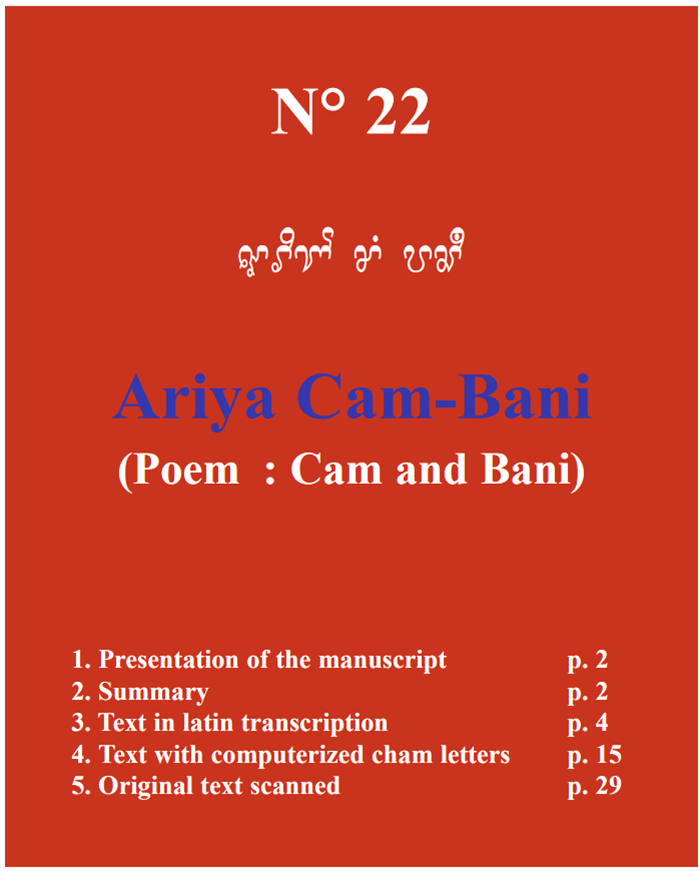
Figure 8. Ariya Cam-Bani (Poem: Cam and Bani), currently preserved at the École Française d’Extrême-Orient, is a famous Cham tragic epic written in classical Cham script (Akhar Thrah) on palm leaves or traditional paper. The work is believed to have been composed after the era of Po Rome (Nik Mustafa), around the eighteenth to nineteenth centuries, and tells the tragic love story between a Bani (Muslim) man and a Cham Ahier woman. The work was published as volume no. 22, edited by Po Dharma, by the Department of Museums and Antiquities Malaysia in cooperation with the École Française d’Extrême-Orient in Kuala Lumpur in 2003.
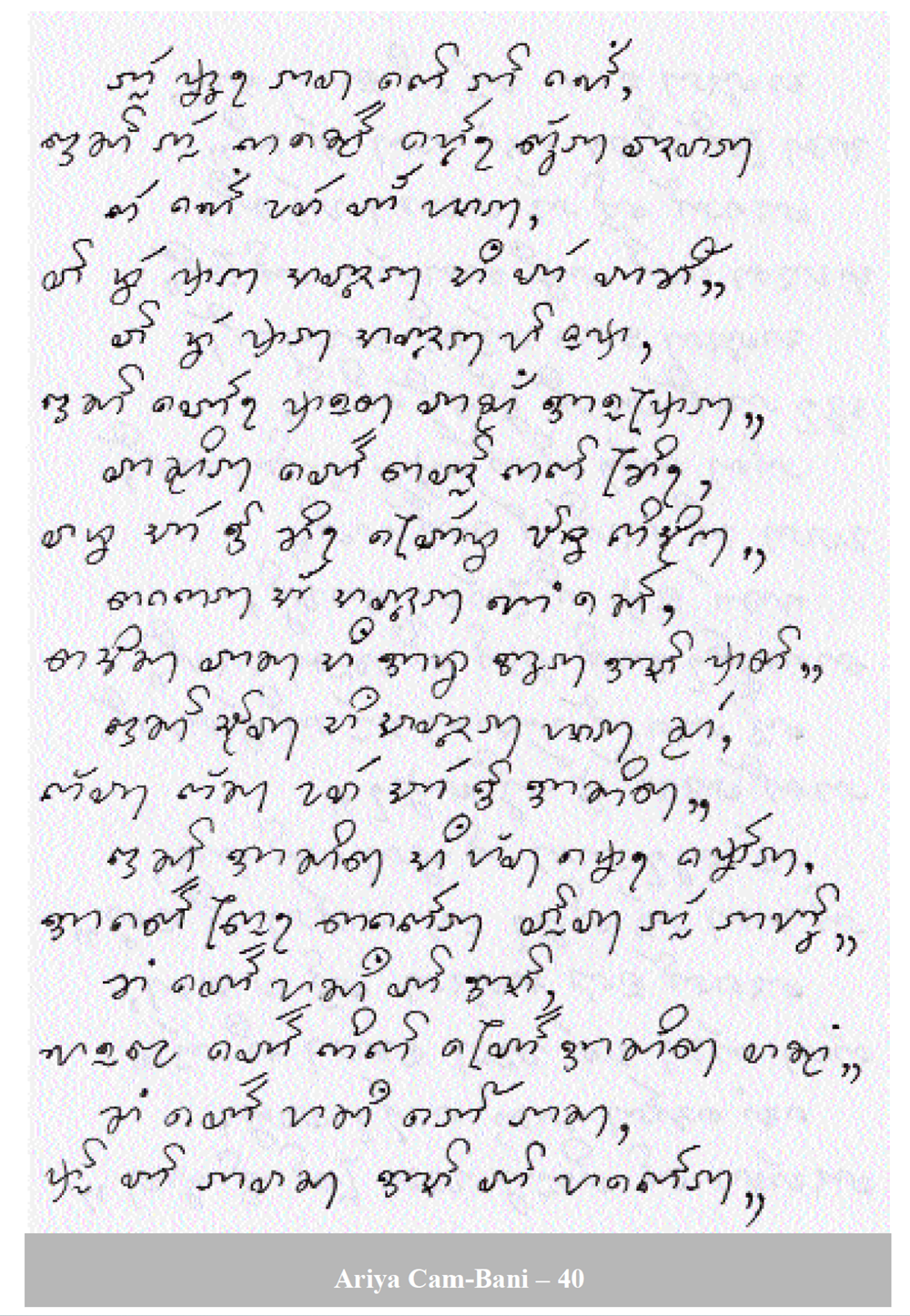
The last four sentences in the text above:
"Cam saong Bani sa aia,
sa-ai saong gila, praong anit ra-nam,,
Cam saong Bani ké kan,
mu sa karan, aia sa balaok,, ".
Figure 9. Ariya Cam-Bani (Akhar Thrah manuscript version), currently preserved at the École Française d’Extrême-Orient. The work is believed to have been composed after the era of Po Rome (Nik Mustafa), around the eighteenth to nineteenth centuries, and recounts the tragic love story between a Bani (Muslim) man and a Cham Ahier woman. The work was published as volume no. 22, edited by Po Dharma, by the Department of Museums and Antiquities Malaysia in cooperation with the École Française d’Extrême-Orient in Kuala Lumpur in 2003.
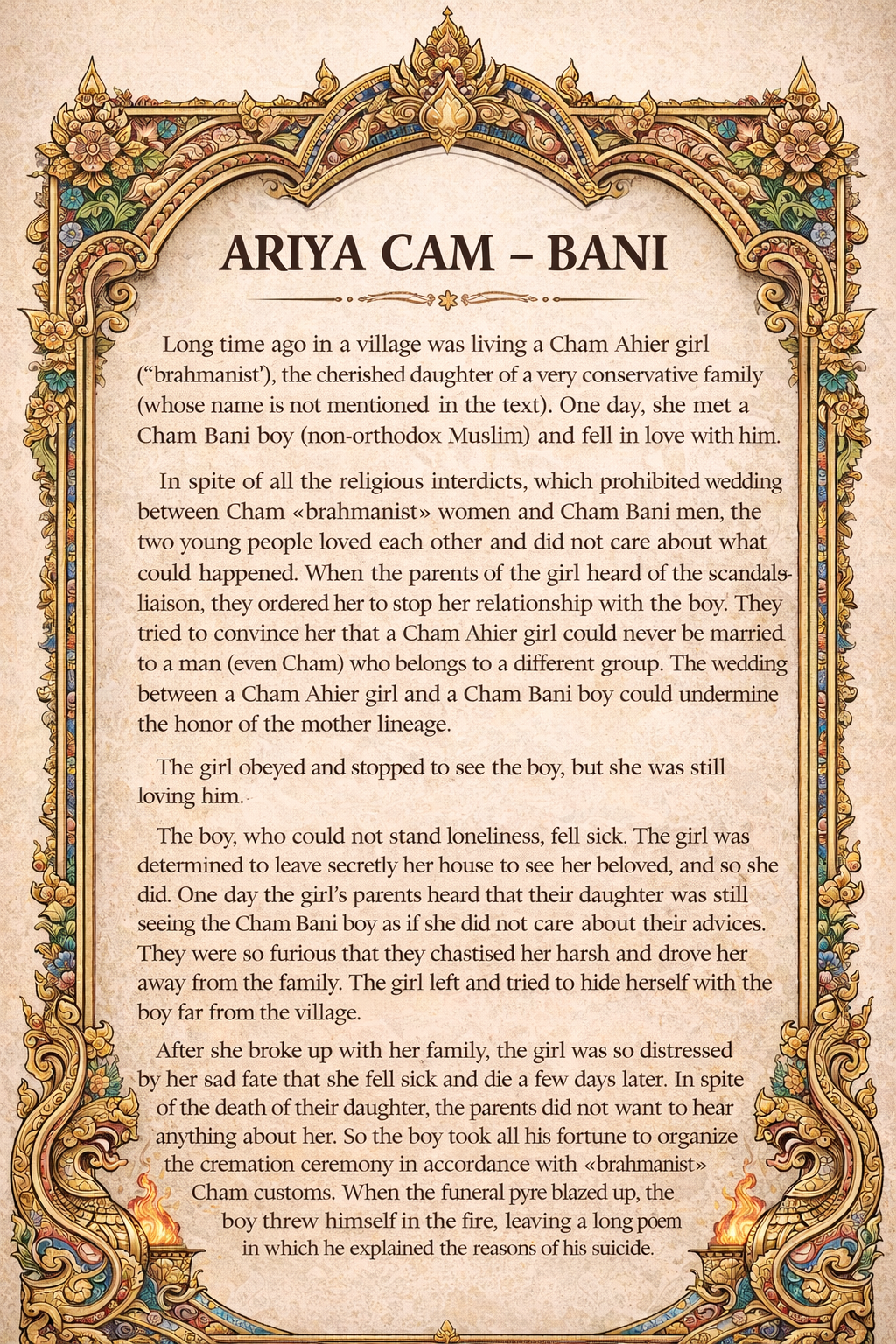
Figure 10. Summary of Ariya Cam-Bani (Cam and Bani), published in volume no. 22, edited by Associate Professor Dr. Po Dharma, by the Department of Museums and Antiquities Malaysia in cooperation with the École Française d’Extrême-Orient in Kuala Lumpur in 2003.
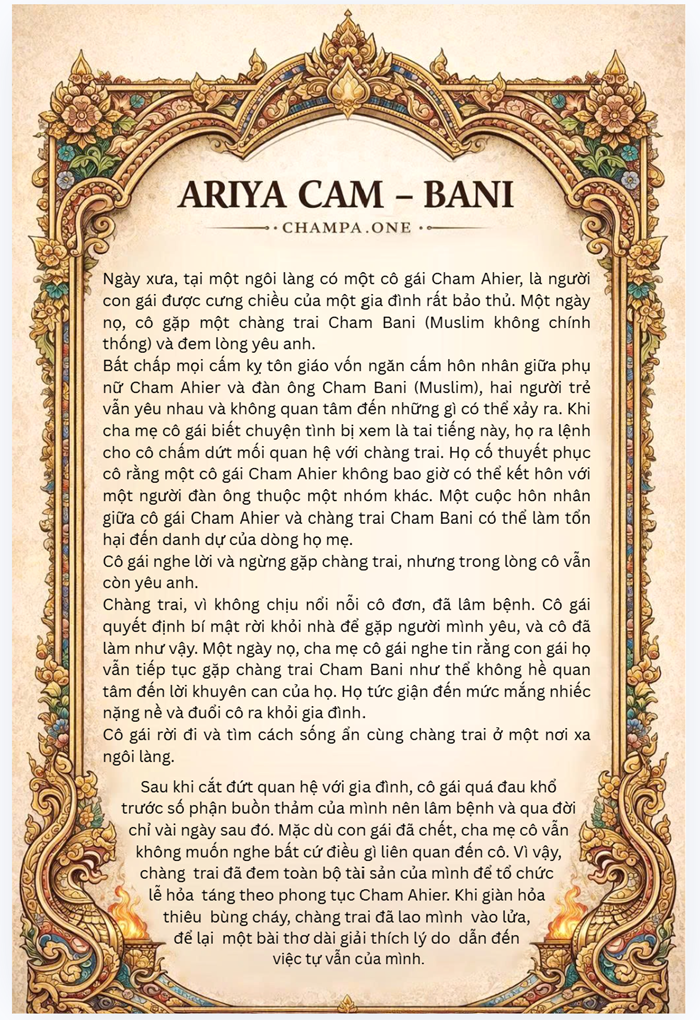
Figure 11. Ariya Cam-Bani (summary section), published in volume no. 22, edited by Associate Professor Dr. Po Dharma, by the Department of Museums and Antiquities Malaysia in cooperation with the École Française d’Extrême-Orient in Kuala Lumpur in 2003.
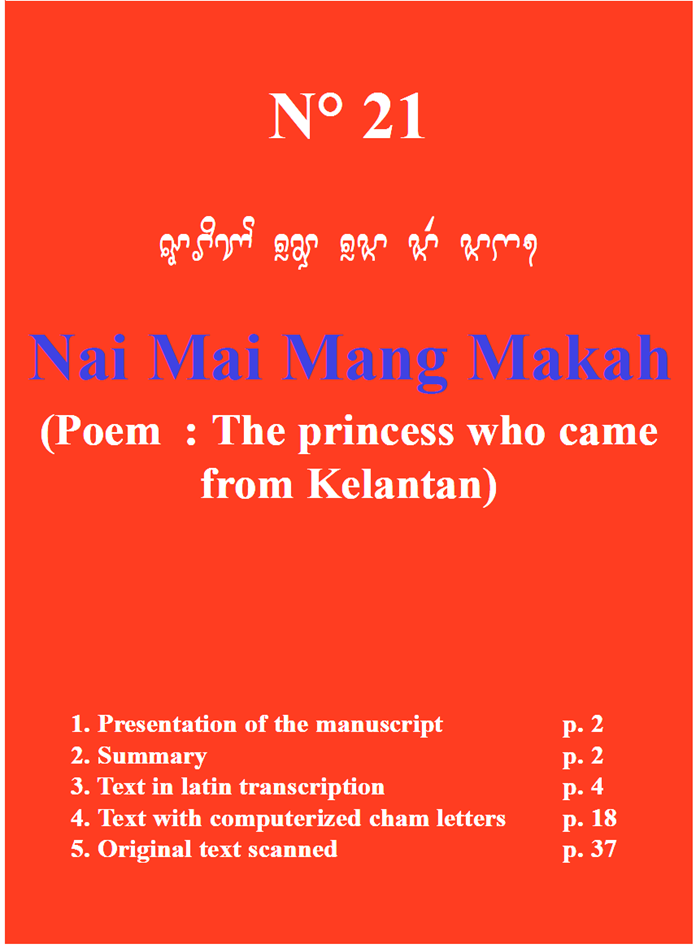
Figure 12. Nai Mai Mang Makah, published in volume no. 21, edited by Po Dharma, by the Department of Museums and Antiquities Malaysia in cooperation with the École Française d’Extrême-Orient in Kuala Lumpur in 2003.
Summary: Nai Mai Mang Makah is a poem about the journey of a princess from Kelantan to Panduranga-Champa, where a Cham prince falls in love with her.
The text tells the story of the prince’s impossible love for the princess, who came to Panduranga-Champa not out of romantic affection, but in order to convert the prince to Islam.
Rather than focusing only on the actions of the prince and princess, whether Cham or Malay, the poet may have intended to portray the qualities and weaknesses of men and women in love. The princess embodies everything that a man might fear in a woman: she claims to accept the prince’s love, yet does nothing to demonstrate her own feelings for him. In reality, the only thing that truly matters to her is the prince’s conversion to Islam.
The author portrays the prince as an idealistic man and has him express his admiration for the princess, an admiration that quickly turns into deep love after their first meeting. The poet places side by side the image of a strong-willed woman and a man blinded by passion: in order to please the woman he loves, the prince agrees to worship Allah, go to the mosque, and accept being manipulated. See the English version, Figure 13.
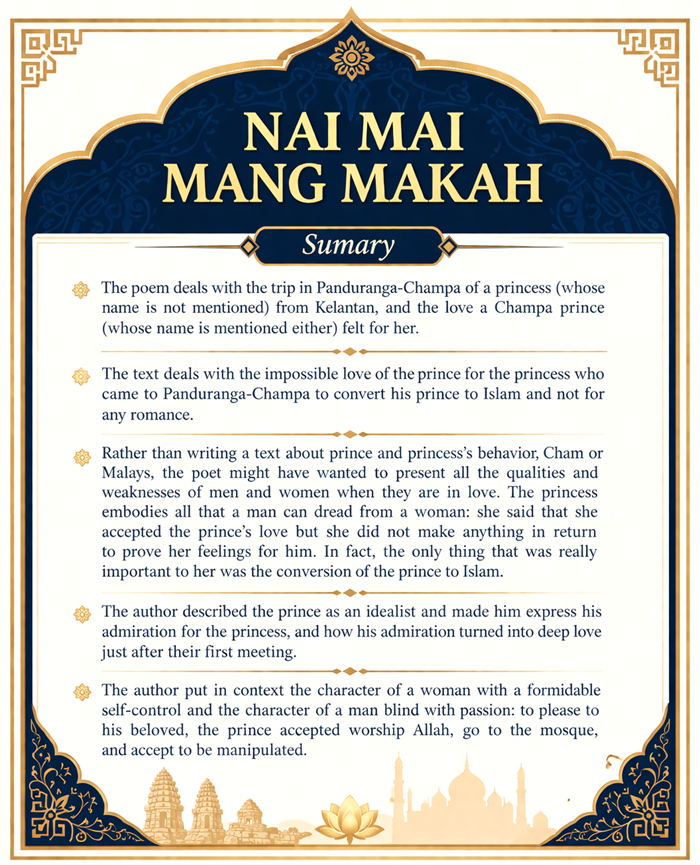
Figure 13. Summary of Nai Mai Mang Makah, published in volume no. 21, edited by Po Dharma, by the Department of Museums and Antiquities Malaysia in cooperation with the École Française d’Extrême-Orient in Kuala Lumpur in 2003.
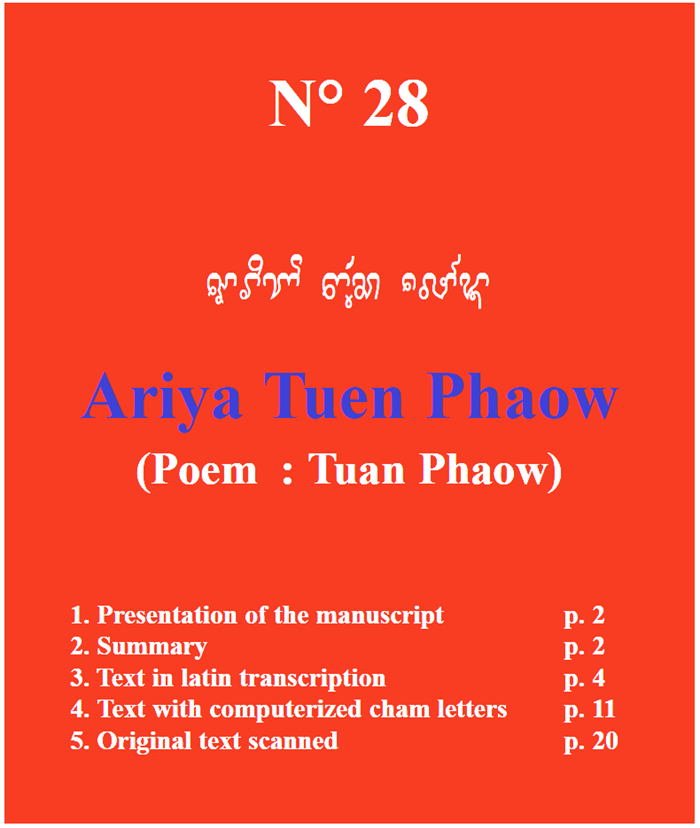
Figure 14. Ariya Tuen Phaow, published in volume no. 28, edited by Po Dharma, by the Department of Museums and Antiquities Malaysia in cooperation with the École Française d’Extrême-Orient in Kuala Lumpur in 2003.
Summary: Tuan Phaow, an important figure from Makah (Kelantan), arrived in Panduranga-Champa in the Year of the Dragon (1796) together with Cham supporters from Cambodia in order to lead an uprising against the Vietnamese occupying forces of Nguyễn Ánh and the Tây Sơn.
Upon reaching Bicam, a mountainous region west of Phan Rí, he established his base there. He built fortresses and military training camps, then proclaimed himself Lord Bho Radhik, a descendant of Nabi Muhammad and Ali.
After several months of preparation, in the seventh month of the Cham calendar of the Year of the Dragon (1796), he launched a war to liberate Champa from Vietnamese occupation. Thousands of his supporters, including Cham from Cambodia, Cham from Panduranga-Champa, Raglai, Cru, and Kahaw people, attacked Vietnamese military posts.
After liberating the highland areas, he ordered an advance toward the Phan Rí region. However, he was wounded during the attack and had to retreat to the Kahaw area. During his recovery, he instructed his supporters to continue the struggle against the Vietnamese, while he himself planned to seek military assistance from the French.
Afterward, Tuan Phaow returned to Makah (Kelantan) and never came back. The war continued, and the anti-Vietnamese movement came to an end at the close of the Year of the Snake (1797). See the English version, Figure 15.
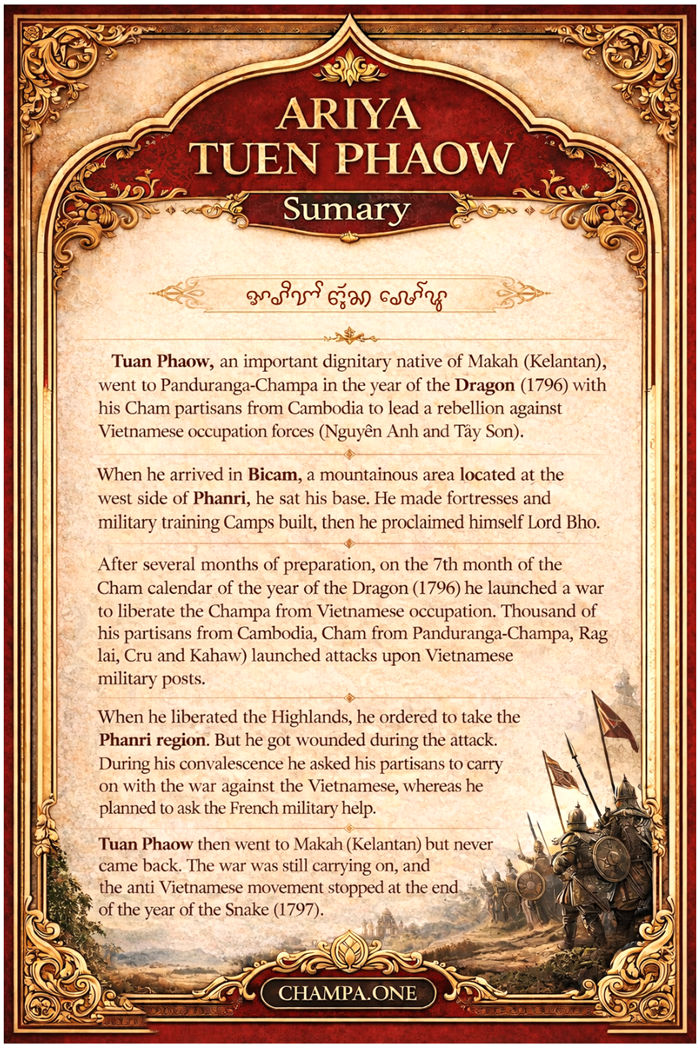
Figure 15. Summary of Ariya Tuen Phaow, published in volume no. 28, edited by Po Dharma, by the Department of Museums and Antiquities Malaysia in cooperation with the École Française d’Extrême-Orient in Kuala Lumpur in 2003.
References
- Étienne Aymonier. Les Chams et leurs religions. Paris: Ernest Leroux, late nineteenth century.
- Antoine Cabaton. Nouvelles recherches sur les Chams. Paris: Ernest Leroux, early twentieth century.
- Pierre-Bernard Lafont. Le Panduranga (Campa) 1802-1835: Ses rapports avec le Vietnam. Paris: École Française d’Extrême-Orient.
- Po Dharma. Le Panduranga (Campa) 1802-1835: Ses rapports avec le Vietnam. Paris: École Française d’Extrême-Orient.
- Po Dharma. “The Problem of the History of the Champa.” In collections of studies on Champa and Southeast Asia.
- Po Dharma and Gérard Moussay. Akayet Inra Patra. Kuala Lumpur: École Française d’Extrême-Orient and Department of Museums and Antiquities Malaysia.
- Danny Wong Tze Ken. Vietnam-Champa Relations and the Malay-Islam Regional Network in the 17th-19th Centuries.
- William Noseworthy. The Cham of Vietnam: History, Society and Art.
- Paul Mus. Studies on religion, culture, and syncretism in Cham society.
- Akhar Thrah manuscripts: Ariya Cam-Bani, Nai Mai Mang Makah, Dalikal texts, lineage genealogies, funerary texts, and ritual documents from Panduranga.
- Archival materials of the École Française d’Extrême-Orient on Champa, Panduranga, and the Cham of Ninh Thuận and Bình Thuận.
- Akhar Thrah manuscripts preserved at the École Française d’Extrême-Orient, the Department of Museums Malaysia, and the British Library.
- Fieldwork materials, ritual notes, and contemporary studies by Putra Podam on Agama Awal, Agama Ahier, the Acar system, and Panduranga rituals.