
This study examines the Agama Awal sect an early form of Islam in Panduranga-Champa) with a focus on its religious organization, the structure of the Acar clerical system, and their role in organizing rituals, transmitting the Qur’an (Koran), and preserving Cham cultural and religious identity. At the same time, the study compares the meaning and function of Acar with clerical models in other Islamic traditions in order to clarify the distinctive characteristics of Cham Islam.
1. Introduction
In the course of Champa’s history, Islam was introduced around the 10th century through regional trade networks and cultural exchanges. Over time, and especially from the 16th century onward, Islam in Champa developed significantly and gradually formed distinctive religious structures. Among these, Agama Awal played a central role in the spiritual and social life of the Cham community.
Agama Awal can be understood as an early form of Islam in Champa, emerging during a period when the religion, in the process of its adoption, remained closely intertwined with indigenous cultural and belief systems. This phenomenon reflects a broader pattern across Southeast Asia, where imported religions were often adapted to local contexts. Characteristics such as the Acar clerical system, ritual structures, and modes of community organization indicate a stage of Islam that had not yet become fully standardized, rather than the existence of a separate religious system.
During its formation, Islam in Champa likely absorbed multiple influences. Early phases show traces resembling Shia Islam, particularly in the prominent role of religious authorities, while from the 16th century onward, the influence of Sunni Islam became increasingly evident. However, these elements should be understood as successive historical layers within Islam itself, rather than as a basis for defining Agama Awal as an independent religious system.
Accordingly, this study seeks to clarify Agama Awal as a deeply localized form of Islam in Champa, shaped through multiple historical phases and reflecting a stage of incomplete doctrinal and practical standardization. On this basis, Agama Awal should be understood as an integral part of the historical development of Cham Islam, rather than as a religion existing outside the Islamic tradition.
2. Islam in Champa Before and After the 15th Century
2.1. The Origins of Islam in Champa
The introduction of Islam into Champa was closely linked to the maritime trade networks stretching from the Middle East to Southeast Asia during the medieval period. From roughly the 10th to the 14th century, Champa, strategically located along the trade routes of the South China Sea, became a stopping point for merchants from the Islamic world, including Arabs, Persians, and Indians. Through these routes, not only goods but also religion, ideas, and cultural practices were transmitted to the region.
Muslim communities (Bani) from the Arabian Peninsula and Persia, together with Islamic groups from the Indian subcontinent, established long-term connections with Champa. This process unfolded within an “expanded Indian Ocean sphere,” where Islam spread primarily through trade and intermarriage rather than military conquest. As a result, Islam in Champa developed gradually, in a decentralized manner, and with a strong capacity to adapt to local cultural contexts.
At the same time, Champa served as a link to major Islamic centers in the region, such as Malacca and Aceh. These interactions helped reinforce the presence of Islam while also fostering the emergence of local Muslim communities, including both settlers and Cham converts through marriage and cultural contact.
From the 15th century onward, particularly in Panduranga, Islam increasingly became a dominant force in social life, even as it coexisted with Hinduism (Balamon) and indigenous belief systems. Under the reigns of rulers such as Po Mah Taha and Po Rome, this trend became more pronounced and continued until the end of Champa in 1832, thereby strengthening the position of Islam in the region.
2.2. The 15th-Century Upheaval and Religious Transformation
Although Islam had been present from an early stage and held a prominent role in Vijaya from the mid-14th century under the reign of Chế Bồng Nga, the fall of Vijaya in 1471 when Đại Việt attacked and destroyed the capital marked a major turning point in Champa’s political and religious history. The destruction of the cultural and political center severely weakened the Brahmanic (Balamon) system, which had previously dominated spiritual and political life. The decline of the Balamon priesthood created a significant religious vacuum within Cham society.
In the context of social fragmentation and restructuring, Islam gradually shifted from a minority position to a central role in community life. From the late 15th century onward, Muslim (Bani) communities began to consolidate their religious organization, construct mosques, and strengthen the role of the clergy. This process was not merely a result of external influence, but rather reflected the adaptation of Islam to the Cham cultural context, at a time when doctrine and practice had not yet been fully standardized according to international scholastic models.
It was during this period that a new religious and social structure gradually emerged, with the Acar clergy occupying a central role in organizing rituals, transmitting the Qur’an (Koran), and guiding community life. At the same time, indigenous institutions such as teacher-disciple relationships, oral transmission of scripture, and ritual practices adapted to local customs were reinforced, forming the foundation for a distinctive Cham Islamic form, known as Agama Awal.
Thus, the fall of Vijaya was not merely a political event but also served as a catalyst for religious transformation, during which Islam in Panduranga gradually established a central position and simultaneously shaped a highly localized religious system in the history of Champa.
2.3. The Formation of Two Religious Streams: Awal and Ahier
From the 17th century onward, the Islamic community in Champa, particularly in Panduranga, developed into two principal religious streams, reflecting the evolution of religion within the Cham social context:
1. Agama Awal: commonly referred to as “early Islam” or “initial-stage Islam.” This represents a form of Islam that had not yet been fully standardized, similar to early Muslim communities in Southeast Asia such as those in Patani or Kelantan. This stream emphasizes strict monotheism, with exclusive devotion to Allah, while organizing religious life through ritual practices, local traditions, and a teacher-disciple system, including the oral transmission of the Qur’an (Koran). Acar clergy directly conduct rituals at mosques, particularly during the month of Ramadan (Ramawan).
2. Agama Ahier: often described as “later Islam.” This stream reflects a higher degree of accommodation with indigenous culture, incorporating influences from Hinduism and traditional Cham practices. While still recognizing Allah as the supreme deity, it also maintains the veneration of deities, heroes, and cultural symbols of Champa.
The Relationship between Awal and Ahier
Some earlier interpretations have suggested that Awal and Ahier constitute mutually syncretic systems, in which Awal worships Ahier deities and vice versa. However, this interpretation is inaccurate. In Panduranga, both Agama Awal and Agama Ahier recognize Allah as the supreme deity, but each assumes distinct roles within religious life.
This functional differentiation is clearly reflected in the role of the Acar clergy. In rituals directed toward Allah such as prayers for health, well-being, or ceremonies like Rija Ahier adherents typically invite Acar from Agama Awal to officiate. Conversely, Acar do not participate in rituals dedicated to Cham deities; when present at Cham temple-towers, they remain outside and do not perform Hindu rituals. Meanwhile, Ahier adherents may still participate in prayers at Awal mosques, particularly during Ramadan (Ramawan).
Therefore, Agama Awal should not be understood as a syncretic system with Ahier in the sense of a blended belief system. Rather, it represents a form of Islam that maintains a central role in rituals directed toward Allah. The two streams coexist within a shared religious framework, reflecting different levels of development and adaptation of Islam within Cham society.
3. The Religious Nature of Agama Awal
3.1. A Form of Islam - Agama Awal
Agama Awal, also known as Bani Awal, cannot be classified under the internationally recognized branches of Islam, such as Sunni or Shia. It represents an early-stage form of Islam in Champa, influenced by Shia currents prior to the 15th century and by Sunni Shafi‘i traditions from the 16th century onward, while developing within the distinct cultural and historical context of the Cham community.
This phenomenon aligns with broader Southeast Asian trends, where Muslim communities in Malacca, Kelantan, Patani, Aceh, or Java formed localized expressions of Islam. In the case of Champa, Islam in Panduranga reflects a synthesis between Islamic teachings and Cham culture, producing a religious system with its own identity while remaining within the framework of Islam.
By nature, Agama Awal is a monotheistic religion, devoted exclusively to Allah and recognizing Muhammad as the final Prophet, with the Qur’an as its central scripture. However, due to historical discontinuities and the lack of connection with major scholarly centers, this system has not reached the level of standardization seen in other Islamic traditions and retains layered influences from both Shia and Sunni Islam.
A key characteristic of Agama Awal is its two-tiered organizational structure:
+ Clergy - Acar (first tier): They directly worship Allah, follow the teachings of Muhammad, perform rituals, recite and transmit the Qur’an, and play a central role in Ramadan (Ramawan), Eid al-Adha (Waha), and Cham Bani life-cycle rituals.
+ Lay followers- Gahéh (second tier): They participate in religious life under the guidance of the Acar, indirectly worship Allah, and may, in some cases, become clergy if fully trained.
Therefore, when studying the Awal sect (Champa Islam or Early Islam), the focus should be on the Acar clergy and their ritual system, rather than the lay followers, Gahéh.
In practice, the Qur’an is primarily transmitted orally, read in Arabic but pronounced with a Cham accent; interpretation is often linked to the local cultural context. This demonstrates that Agama Awal is a highly practice-oriented form of Islam, maintaining core doctrinal elements while adapting to Cham social life.
In conclusion, Agama Awal is not a separate religion but a distinctive form of Islam in Champa. It is a system that carries both Shia and Sunni historical influences, reflects a strong process of localization, and emphasizes the central role of Acar clergy in sustaining the religious, cultural, and social life of the community.

Figure 1. Awal (Early Islam, Agama Awal) is one of the 73 branches of Islam.
3.2. Traces of Shia and Sunni in Agama Awal
Current research indicates that Agama Awal exhibits layered influences from both Shia and Sunni Islam, reflecting the process of Islam’s reception through multiple channels of cultural exchange across different regions.
3.2.1. Shia (Persian) Traces in Agama Awal
Historical records and textual evidence show that Agama Awal bears influences from Shia traditions, primarily through trade and cultural interactions with the Persian region between the 10th and 15th centuries. These influences are not evident in formal doctrinal teachings but are manifested in organizational structure and religious practice:
- Ritual structure and clergy roles: Certain religious rituals in Agama Awal reflect an “intermediary” organizational model similar to Shia traditions, where clergy not only guide rituals but also serve as mediators between the community and God. Some ceremonies involve the remembrance and veneration of religious figures, reminiscent of how Shia adherents respect senior scholars (Ayatollahs) as moral and doctrinal guides.
- Intermediary role of clergy (Acar): The Acar class in Agama Awal functions as spiritual and ethical guides for the community teaching the Qur’an, organizing rituals, and addressing social issues. This role parallels that of an Ayatollah in Shia Islam, who holds supreme scholarly authority, interprets religious law, and guides followers. However, unlike the Ayatollah, the Acar emerges from local Cham lineages, develops within the Cham cultural context, and does not hold centralized political power.
- Faith in the clergy: Within Agama Awal, the Acar are venerated by followers as central interpreters of doctrine and moral conduct, reflecting a Shia-like model in which clergy serve as primary points of reference in religious guidance.
- Localization: Shia traces in Agama Awal do not imply that the system became a fully orthodox Shia branch. Rather, these influences were absorbed and adapted to the Champa context, integrated into local religious structures, and combined with oral transmission, ritual practices, and Cham cultural expressions to create a unique form of Islam in Panduranga.
Overall, Shia elements in Agama Awal primarily manifest in the clergy’s organizational role and their intermediary function in community life, rather than in doctrinal content or orthodox Shia practices. This reflects a cross-cultural reception of Islam and contributes to the multi-layered character of the religious system in Champa.
3.2.2. Southeast Asian Sunni Shafi‘i Influence in Agama Awal
In addition to Shia traces, Agama Awal also exhibits clear influences from Sunni Shafi‘i Islam, particularly through trade networks, religious scholars, and cultural contacts with Southeast Asian Islamic centers such as Malacca, Aceh, Kelantan, and Patani. These influences are reflected in several aspects:
- Adherence to the Qur’an and orthodox teachings: Awal communities emphasized reading, studying, and interpreting the Qur’an, as well as observing core rituals and basic teachings of Sunni Shafi‘i Islam. This reflects the influence of Southeast Asian Sunni scholars and merchants who brought both scholarly traditions and pedagogical methods.
- Application of ritual law and scholarly traditions: Certain practices in Agama Awal mirror Sunni Shafi‘i organizational patterns for rituals, prayer, religious weeks, and months. Additionally, the scholarly tradition including orderly recitation of the Qur’an, documentation, and oral transmission of religious knowledge demonstrates reception from Southeast Asian Islamic centers.
- Adaptation to the local context: Despite incorporating Sunni Shafi‘i elements, Agama Awal retained a high degree of localization. Acar priests recited the Qur’an in Arabic but pronounced it with Cham phonetics, often without fully understanding the original content; rituals were adjusted to conform to local customs; and religious teachings were transmitted through teacher-student lineages, ensuring continuity while adapting to the Cham community.
- Flexible religious form: The combination of adherence to orthodox Sunni practices and local adaptation created a distinctive form of Islam in Panduranga, simultaneously maintaining religious legitimacy according to Islamic law and preserving Cham cultural identity. This explains why Agama Awal persisted over time, even as more orthodox forms of Islam emerged elsewhere in Southeast Asia.
Sunni Shafi‘i influence in Agama Awal was not only a doctrinal element but also a means of consolidating religious organization, education, and ritual practice. Combined with Shia traces and Cham cultural elements, it produced a unique hybrid form of Islam in the region.
3.2.3. Integration of Shia and Sunni Elements in Agama Awal
The blending of Shia traces and Sunni influences created a distinctive form of Champa Islam, known as Agama Awal, reflecting both cross-regional transmission and local development.
The Shia influence is evident in the clerical structure (Acar) and their intermediary role within the community, as well as in certain specific rituals where the clergy guide moral and doctrinal matters, similar to Shia models.
Sunni influence manifests in adherence to the Qur’an, application of standard ritual law, and scholarly traditions derived from Southeast Asian Sunni Shafi‘i centers such as Malacca, Aceh, and Kelantan. While adopting these elements, the Acar and the Cham community adapted them to the Cham social and cultural context, including recitation of the Qur’an with Cham phonetics, ritual adjustments, and community practices.
Agama Awal harmonized with Cham cultural life across language, music, religious rites, and communal customs, resulting in a religious system that both ensured legitimacy according to Islamic law and preserved Cham cultural identity.
Research indicates regional variations: in Ninh Thuận province, Agama Awal retains more Shia traces associated with Persian influence, whereas in Bình Thuận, Sunni influences predominate. Both regions of Panduranga were strongly affected by Malay Islamic culture (Sunni), similar to Muslim communities in Java and Malaysia.
Based on manuscripts currently used by Agama Awal clerics (Acar), religious practice aligns with the Shafi‘e madhhab, one of the main Sunni schools widely followed in Malaysia, Indonesia, Brunei, and other Southeast Asian countries. Some manuscripts also reflect Sufi influence, emphasizing simple living, moral cultivation, and spiritual purification.
Notably, Agama Awal texts often mention figures such as “Ali,” “Fatimah,” “Hasan,” and “Husayn,” raising the question of whether Agama Awal belongs to the Shia tradition. Although comprehensive research is lacking, the emphasis on Shafi‘e practice and organizational structure indicates that Agama Awal remains primarily Sunni. References to these Shia figures are normal, as Sunni Muslims also venerate them.
Agama Awal manuscripts preserved in Ninh Thuận and Bình Thuận include Qur’anic chapters, guidance on Salat rituals, Ramadan observances, almsgiving, marriage ceremonies, and other community rites. Clerics of Agama Awal, considered part of the Sunni tradition, refer to this sect as Awal Islam or Champa Islam, and it is the only Islamic school historically unique to Vietnam (within the Panduranga principality).
A common misconception among some scholars is to regard Agama Awal as a “local” or “indigenous” Islam without distinguishing which elements are truly local and which derive from normative Islam, due to incomplete understanding of orthodox Islamic teachings. Orthodox Islam refers to canonical teachings such as the Qur’an and Hadith, while sects or branches gradually develop their legitimacy based on these texts.
In practice, Islam in Southeast Asian communities has rarely strictly adhered to orthodox rules. For example, in early 20th-century Kelantan, Malaysia, women only covered below the chest, leaving the upper chest and shoulders exposed; traditional rituals such as Mak Yong performances, offerings to Yang spirits, divination, and healing through charms persisted. Only when the Pan-Malaysian Islamic Party (PMIP, later PAS) assumed power in 1959 were many of these practices curtailed, and Malaysian Islam gradually aligned with orthodox norms. Yet, in remote areas of Indonesia and Malaysia, certain traditional practices persisted, often reinterpreted within an Islamic framework.
Since the introduction of Islam into the Cham community, the Cham called this religion Asulam (later Awal) and identified themselves as Bani (converts), distinguishing themselves from Hindus. Later, Cham Hindus following Agama Ahier also recognized Allah and called themselves Cham Ahier, practicing devotion to Allah while maintaining Cham temple care and cultural preservation.
The integration of Shia and Sunni elements, combined with cross-regional cultural influences and Cham social practices, explains why Agama Awal cannot be classified under any normative Sunni or Shia branch. It demonstrates Islam’s adaptability and syncretic capacity in Southeast Asia. Agama Awal represents a multi-layered religious system that incorporates Cham cultural influences, cross-regional Islamic elements, and both Shia and Sunni traces, creating a uniquely distinctive religious identity for the Cham community in Panduranga-Champa after the 15th century.
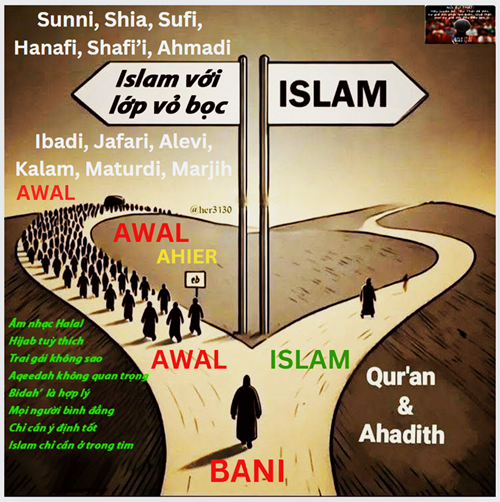
Figure 2. The branching within Islam and the perception of religious “layers of veneer.”
4. The Acar Clergy System: Structure and Function
4.1. Acar - The Core Organization of Agama Awal
One of the most distinctive features of Agama Awal is its clerical system, centered on the Acar, who serve as the nucleus for organizing and coordinating the religious life of the Cham community. Beyond their purely religious roles, the Acar also fulfill educational, social normative, and cultural preservation functions, thereby contributing to the social structure of Panduranga-Champa from the 15th century onward.
Organizationally, Agama Awal is structured into two main levels:
1. Acar (Clerics): These individuals lead mosques or community units and are responsible for guiding rituals, teaching the Qur’an, and preserving religious knowledge. Training of the Acar primarily occurs through two channels: family inheritance and the teacher-disciple system (gru, pataow), creating a mechanism of continuity and stability. Within this structure, the Acar act as intermediaries between Islamic doctrine and Cham social practice, maintaining religious orthodoxy while adapting rituals to local contexts.
2. Teacher-Disciple System (gru, pataow): This includes students and religious assistants who support rituals, study the Qur’an, and acquire knowledge from the Acar. This system establishes a clear hierarchical structure and ensures the transmission of religious knowledge and ritual practices, primarily through oral methods.
Based on this framework, the role of the Acar can be analyzed through three primary functions:
- Ritual Function: The Acar directly oversee religious rituals, from daily prayers and major observances such as Ramadan (Ramawan) to life-cycle ceremonies and community events.
- Preservation of Scripture: The Qur’an is copied, preserved, and transmitted across generations, sometimes accompanied by Cham-language annotations. Recitation with Cham phonetics allows the continuation of religious practice even when comprehension of classical Arabic is limited.
- Social and Ethical Function: The Acar guide ethical norms, advise on social relations, and resolve disputes within the community, functioning as an institutional mediator between Islamic doctrine and local social life.
Thus, the Acar are not merely a clerical class but constitute a central institution ensuring the functioning of Agama Awal across religious, educational, and social dimensions. This structure reflects a highly localized form of Islam, in which continuity of transmission and adaptability to Cham cultural context are crucial for the long-term sustainability of the system.
4.2. Ranks and Functions of Awal Acar Clergy
4.2.1. Concept of “Acar” in Agama Awal
Within the Agama Awal tradition, the term Acar serves as a general designation for clerics and religious officials, rather than a specific title. Etymologically, Acar refers to a teacher, a person of knowledge, or a high-level spiritual educator capable of transmitting religious doctrine and guiding the spiritual life of the faithful essentially, a spiritual master.
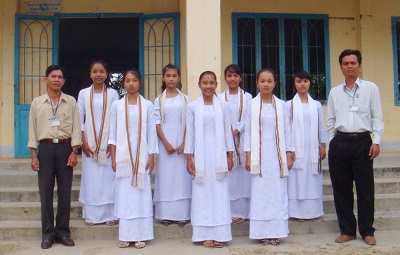
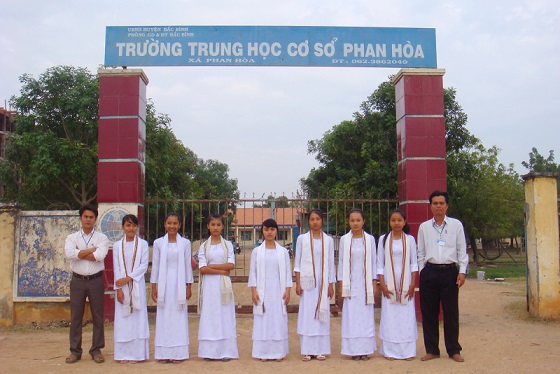
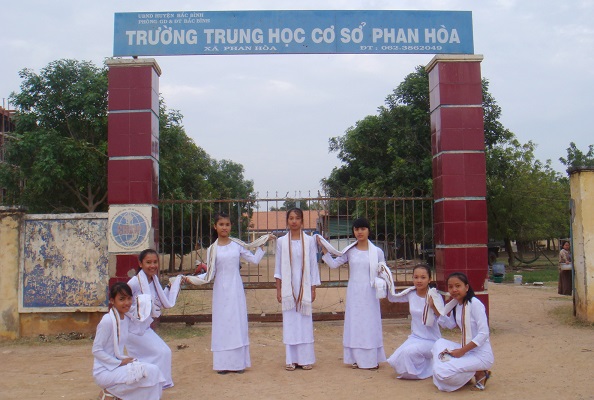
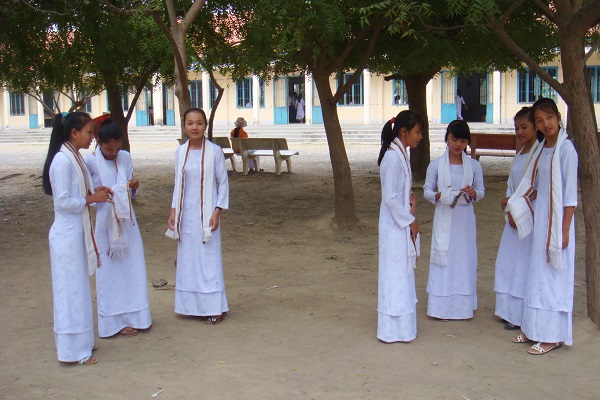
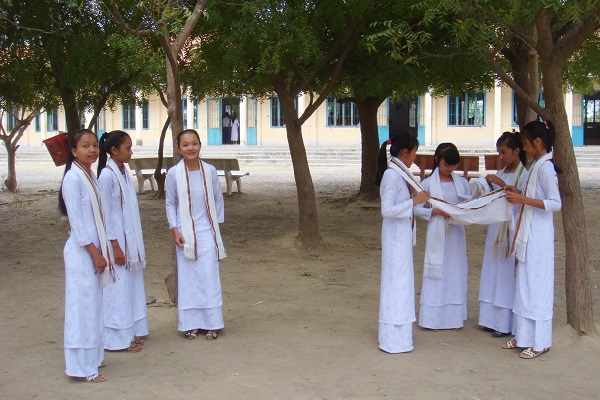
In practice, Acar typically wear a long white robe (jubah, of Arabic origin), a white sarong, and a headscarf (khen). This attire is considered a symbolic inheritance from the lineage of prophets, culminating with the final prophet, Muhammad. Individuals wearing this attire are recognized by the community as Acar, regardless of rank, and the term also applies to those undergoing religious training, reflecting the flexible and open nature of the Agama Awal educational system.
In Cham vernacular, the term Acar appears in several expressions:
- “ong aw kaok - ꨅꩃ ꨀꨥ ꨆꨯꨱꩀ”: refers to an Acar wearing a white turban;
- “Acar nao hamu - ꨀꨌꩉ ꨗꨯꨱ ꨨꨟꨭ”: literally “the Acar goes to the field,” denoting a cleric in general, without specifying rank or official title.
Linguistically, Acar is related to similar terms in other cultures:
- Cham: acar ≈ gru (teacher)
- Sanskrit/Hindi: ācārya (professor, spiritual teacher, transmitter of sacred knowledge)
- Malay: Cikgu ≈ guru (teacher, master, intellectual)
Thus, the core meaning of Acar is “teacher,” but within the Agama Awal context, it also encompasses the roles of cleric, ritual guide, religious instructor, and socially significant figure. The Acar help maintain community stability, transmit doctrine, and uphold moral values across generations of Cham society.
Although they do not wield absolute authority, the Acar system establishes a clear hierarchical structure, integrating religious, educational, and social functions. This structure ensures continuity in the transmission of the Qur’an, ritual practice, and ethical norms, enabling Agama Awal to persist and adapt within the Cham community over the long term.
4.2.2. Hierarchy of Acar Clerics
The Acar clerical system within Agama Awal is organized into five ranks, reflecting a clearly defined religious hierarchy:
1. Guru / Gru (Chief Teacher): The highest rank, possessing deep knowledge of religious doctrine and law, along with exemplary moral qualities. The Guru leads the mosque and presides over the clergy of Agama Awal (Bani Awal), making decisions on religious and ritual matters. Assisted by a deputy (Naep), the Guru also plays a central role in training clerics and guiding the community.
2. Imam: Clerics with knowledge superior to ordinary followers, responsible for leading prayers (Solat), particularly the main Friday prayer (Suk), Ramadan (Ramawan), and other special ceremonies. Imams manage ritual practice within the mosque, ensuring adherence to Agama Awal traditions. Outstanding Imams may become Imam Pak Pluh (Imam 40), forming the core group responsible for maintaining doctrinal integrity.
3. Katip (Khotip): Responsible for delivering sermons (khutbah) from the minbar during major prayers, especially Friday prayers and Ramadan. Their primary function is to convey normative religious teachings.
4. Madin (Tuan, Ustaz): Conduct rituals at both mosques and private homes, guiding followers in religious practice. They also assist in mosque management and support religious education. Currently, Agama Awal lacks formal Madin schools, so their educational role is limited, mainly assisting Acar and performing ritual duties.
5. Bilal: Responsible for the Azan (Adhan), calling the faithful to prayer. This is the lowest rank, supporting the daily religious activities and maintaining regular worship practices.
4.2.3. Origins and Linguistic Comparison of “Acar”
The term Acar in the Agama Awal of the Cham people originates from the Sanskrit word ācārya (acharya), meaning “teacher” or “spiritual instructor.” It refers to individuals with profound knowledge who are capable of transmitting religious teachings and guiding the spiritual life of their followers. The use of Sanskrit terms was common in Champa and other Southeast Asian countries, where these words were often adopted and localized within the local language and culture.
Comparisons with regional languages reveal similar terms with analogous meanings:
1. ꨀꨌꩉ (acar) in Cham, equivalent to ꨈꨴꨭ (gru): denotes a teacher or a knowledgeable master.
2. อาจารย์ (àchràn) in Thai, equivalent to ครู (khrū): teacher, intellectual, master, or skilled person.
3. आचार्य (ācārya / acharya) in Hindi/Sanskrit, equivalent to गुरु (guru): educator, learned person, spiritual guide, or master transmitting knowledge to disciples.
4. Cikgu - چئڬ (Cikgu) in Malay, equivalent to ꨈꨭꨣꨭ (guru): teacher, master, educated person, or someone with a high level of scholarly attainment.
5. आचार्य (acharyak) in Étienne Aymonier’s dictionary: teacher, high-level educator.
Overall, these terms emphasize the educational and knowledge-transmitting roles, reflecting the core meaning of “teacher” across various cultures. In the Cham context, Acar retains its pedagogical significance while also encompassing the functions of a cleric and ritual guide. This dual role illustrates the integration of Sanskrit terminology into the religious and social life of the Cham community.
4.2.4. Characteristics and Practical Limitations of Acar Today
In the modern context, the role of Acar should be understood according to practical realities, which differ from the original notion of a “master” or “spiritual teacher.” Acar are not monastic clergy like those in Buddhist traditions; they remain followers of Agama Awal (Champa Islam) and maintain close relationships with their communities, living integrated within society rather than in isolation.
The educational background and capabilities of contemporary Acar vary considerably, reflecting differences in training and practical experience. Most Acar today primarily perform the following basic functions:
- Reciting and teaching the Qur’an to community members in mosques and private homes;
- Conducting religious rituals according to Agama Awal traditions;
- Guiding basic religious life, including adherence to prayer practices, festivals, and customary observances.
The meaning of “master” implied by the term Acar has narrowed and evolved compared to its original sense. Their role now focuses mainly on religious practice and basic education, rather than serving as scholarly authorities or high-level religious leaders as historically understood.
4.2.5. Comparison with Other Religious Terms
To properly understand the position and significance of the term Acar within Agama Awal, it is helpful to compare it with equivalent religious terms in other traditions:
1. Ācārya: In Sanskrit, ācārya refers to a religious teacher or spiritual master, responsible for transmitting sacred texts and guiding ethical conduct. The role of an ācārya is personal, pedagogical, and educational, not inherently associated with official authority or hierarchical rank within a religious institution. This concept emphasizes teaching and knowledge transmission rather than collective leadership.
2. Ulama: The ulama constitute the scholarly class in Islam, encompassing individuals trained in the Qur’an, Hadith, and Islamic law (fiqh). This is an academic collective that interprets doctrine, guides the community, and develops religious traditions. Unlike ācārya or Acar, the ulama represent a professional collective and may include multiple academic ranks, rather than a specific personal title.
3. Ayatollah: In Shia Islam, an Ayatollah is a high-ranking title awarded to scholars of exceptional expertise, capable of independent legal reasoning (ijtihad) and spiritual leadership. This is an official rank, carrying significant religious and legal authority, far beyond the role of a simple “teacher.”
In terms of role and function, Acar is closest to the concept of ācārya, as it emphasizes teaching, guiding adherents, and transmitting spiritual knowledge, without being tied to a scholarly collective (ulama) or high-level religious authority (ayatollah). However, unlike ācārya in the Indian tradition, Acar also combines ritual performance and social functions, reflecting the localized adaptation of Islam in Champa.
4.3. Characteristics of the Acar System
The Acar clergy system in Agama Awal exhibits distinctive characteristics, markedly different from internationally standardized Islamic scholastic authorities such as ulama or ayatollahs. These features reflect the nature of Islam in the Cham community of Panduranga, which simultaneously maintains core religious teachings while adapting to local culture and society.
1. Not Internationally Trained Scholarly Clerics
- Acar were not trained at internationally recognized Islamic educational centers such as madrasahs in the Middle East or Shafi‘i centers in Southeast Asia (e.g., Malacca, Aceh, Kelantan).
- Their religious knowledge and competence were primarily based on local traditions and ritual practices, focusing on guiding the community, teaching moral conduct, and managing ceremonies, rather than advanced academic research, complex Sharia law, or internationally standardized theological reasoning.
- Consequently, Acar represent a form of practical clergy rather than scholastic scholars.
2. Locally Grounded and Oral Transmission
- The role and knowledge of Acar were typically transmitted from teacher to student or within families, forming a resilient internal network of clergy.
- This mode of transmission ensured the continuity of rituals, teachings, and cultural practices, preserving the identity of Agama Awal across generations, even amidst political, social, and cultural upheavals since the 15th century.
- Transmission relied on practice and memorization rather than formal diplomas or international certification, emphasizing the ability to perform rituals, recite the Qur’an, and guide the community.
3. Reading and Learning the Qur’an
- The Qur’an was recited in Arabic but pronounced in a Cham-accented phonology, creating a distinctive ritual form.
- In many cases, Acar and adherents did not fully comprehend the original content; the Qur’an was learned and transmitted as a sacred medium, often accompanied by Cham-language explanations or interpretations to guide the community.
- This practice reflects the early Cham form of Islam, which was primarily practical, culturally adapted, and distinct from the scholastic Sunni or Shia traditions found internationally.
These characteristics demonstrate that Acar functioned as a unique institutionalized form of Islamic leadership within Agama Awal, preserving the religion through ritual practice and oral transmission rather than relying on standardized scholastic training. This system enabled Agama Awal to maintain stability, identity, and continuity within the Cham community over centuries while illustrating Islam’s capacity to adapt within the Southeast Asian cultural environment, where religious practice frequently blended with local customs, traditions, and everyday life.
5. Religious Leaders in Shia Islam and Comparison with the Acar System
5.1. Ayatollah in Shia Islam
In Shia Islam, Ayatollah is a title given to senior clerics who have advanced knowledge of fiqh (Islamic law) and usul (principles of Islamic jurisprudence). It is one of the highest ranks within the Twelver Shia system, recognized based on scholarship, reputation, and the ability to guide the community. The term “Ayatollah” literally means “sign of God,” reflecting both the spiritual and scholarly roles of the cleric. It should be noted that an Ayatollah is a title for a human religious leader, not a designation of Allah (God) directly.
The roles of an Ayatollah include:
- Interpreting Sharia law: issuing fatwas (legal opinions) and providing guidance on religious teachings, resolving ethical and religious matters for the community.
- Religious and moral leadership: directing faith, practice, and religious education within the Shia community.
- Political leadership (if applicable): in some Shia-majority countries, such as Iran, Ayatollahs may hold supreme authority under the principle of Velayat-e Faqih.
- Grand Ayatollah (Marjaʿ al-Taqlid): some Ayatollahs attain the highest rank, becoming a “source of emulation” for followers in daily religious life.
Ayatollahs are senior clerics, scholars, and religious leaders, and they may assume political authority in Shia-dominant contexts. They serve as centers of scholarship, law, and ethics, and are trusted by the community in both religious teaching and practice.
Practices during Ramadan:
In Shia Islam, there is a practice called iʿtikāf, which involves staying in the mosque for 30 days to recite the Qur’an, pray, and withdraw from worldly activities, usually during the last ten days of Ramadan. Today, this practice is not obligatory for Ayatollahs but is considered a personal or communal act of devotion. Ayatollahs may participate in iʿtikāf if they choose, but it is a voluntary religious practice, not an official duty as it is for Acar clerics, who are required to directly participate in Ramadan rituals within the Agama Awal system.
5.2. Comparison with the Acar System in Agama Awal
The Acar system in Agama Awal of Champa shows some formal similarities with the Shia clerical model (Ayatollah), mainly in terms of practical roles and community guidance, but differs significantly in scholarship, authority, and scope of influence.
Similarities:
1. Coordinating religious life:
- Acar oversee religious life and rituals in the Cham community, similar to how Ayatollahs interpret doctrine and guide the Shia community.
- Both serve as intermediaries between religious teachings and followers, helping the community maintain faith and religious practice.
2. Community dependence on clerics:
- Agama Awal followers rely on Acar to guide rituals, read and understand the Qur’an, and practice religious teachings.
- Likewise, Shia followers rely on fatwas and doctrinal guidance from Ayatollahs.
- This dependence is practical and spiritual, not based on internationally standardized academic knowledge.
3. Clerics as intermediaries with God:
- Acar not only perform rituals but also act as spiritual bridges between the community and Allah (Po Aluah), similar to the role of Ayatollah in relation to Shia teachings.
Differences:
1. Scholarship and authority:
- Acar are practical clerics, not formal juristic scholars; their knowledge is based primarily on local tradition and ritual practice.
- Ayatollahs are legal scholars who can issue fatwas, provide spiritual leadership, and, in some Shia contexts, hold political authority.
2. Participation in rituals:
- Acar are continuously present in the mosque, guiding and performing rituals throughout the entire month of Ramadan (Ramawan).
- In contrast, Ayatollahs are not required to be present in the mosque for the whole month; participation in iʿtikāf staying in the mosque for recitation, prayer, and withdrawal from worldly activities is voluntary and personal.
Thus, the similarity between Acar and Ayatollah lies only in structural and practical roles. This does not mean that Acar are Shia ulama or follow Shia scholastic standards. Acar are a religious institution unique to Agama Awal, reflecting the local adaptation of Islam in Champa, maintaining community stability and identity without reliance on external clerical norms.
6. Conclusion
Agama Awal cannot be understood or categorized as a purely Shia or Sunni branch; it represents a distinct form of Cham Islam, also referred to as early Islam (Agama Awal), which emerged and flourished from the 17th century. Its formation was a direct consequence of political, social, and cultural upheavals in the 15th century, particularly following the fall of the Vijaya capital, when the Cham community was compelled to reorganize both religious and social life.
The Agama Awal system is organized around the clerical class of Acar, who serve as the central authority in:
- Coordinating and performing religious rituals;
- Preserving and orally transmitting the Qur’an;
- Guiding ethical, religious, and communal life.
The structure, functions, and traditions of Acar reflect the historical, cultural, and social characteristics of Champa, where early Islam was profoundly influenced by local culture. This religious form is not only ritualistic but also bears a strong Cham cultural imprint, expressed through language, music, ceremonies, and communal customs. The role of Acar extends beyond education and ritual to serve as intermediaries within social life, contributing to the cohesion of community structure and the preservation of Cham cultural identity.
Compared with Shia Ayatollahs, the Acar system shows similarities in community coordination and religious mediation, but it cannot be equated with the Shia ulama class; the authority, scholarship, and transmission mechanisms of Acar differ fundamentally, relying primarily on internal tradition and local practice rather than formalized scholastic or hierarchical structures.
Therefore, Agama Awal should be studied and approached as a distinct Cham Islamic phenomenon, reflecting a nuanced blending of Shia and Sunni influences while demonstrating Islam’s adaptability and flexibility within the Southeast Asian cultural context after the 15th century. This form of Islam ensures religious continuity while preserving the cultural and social identity of the Cham community, establishing itself as a unique and enduring branch in the history of Panduranga-Champa.
References
- Andaya, Barbara Watson. The Kingdom of Champa. University of Hawaii Press, 2008.
- Azra, Azyumardi. The Transmission of Islamic Reformist Thought in the Malay World. Amsterdam University Press, 2004.
- Bruckmayr, Philipp. Islamic Communities in Southeast Asia: Historical and Anthropological Perspectives. Routledge, 2019.
- Chou, Cecilia. Muslims in Southeast Asia: Historical Dynamics and Cultural Interactions. Singapore University Press, 2016.
- Fealy, Greg, and White, Sally. Expressing Islam: Religious Life and Politics in Indonesia. Singapore: ISEAS, 2008.
- Hooker, M. B. Islam in South-East Asia. London: Curzon Press, 1983.
- Putra Podam. Agama Awal in Champa: Religious Structure and the Role of Acar Clerics. Champa.one, 2026.
- Ricklefs, M. C. A History of Modern Indonesia since c. 1200. Palgrave Macmillan, 2008.
- Said, Hamid. Shafi’i Jurisprudence and the Spread of Islam in Maritime Southeast Asia. Kuala Lumpur: Dewan Bahasa dan Pustaka, 2012.
- Taylor, K. W. Cham Muslims of the Mekong Delta: Place and Identity in the Islamic World. Routledge, 2005.
- Watson, James L. Southeast Asia and the Middle East: Historical Interactions. Harvard University Press, 2010.
- Wibisono, Bambang. Islam in Java and the Malay World: History and Culture. Yogyakarta: Gadjah Mada University Press, 2011.