(Re: Request for the Rectification of Historical Content at Po Klong Mah Nai Temple)
To: - Department of Culture, Sports and Tourism of Lam Dong Province- (formerly Binh Thuan Province)
Petitioner
Full name: Putra Podam (Văn Ngọc Sáng)
Telephone: +1 (669) 269-3912
Email: [email protected]
I hereby submit this petition to formally request the review, clarification, and correction of inaccurate historical information concerning Champa history and the historical figure Po Klong Mah Nai (Maha Taha) that is currently displayed at Po Klong Mah Nai Temple and/or disseminated by the former Department of Culture, Sports and Tourism of Binh Thuan Province (now under Lam Dong Province).
These inaccuracies not only undermine the objectivity and transparency of Champa historiography but also distort public understanding, particularly among contemporary Cham communities, thereby negatively affecting cultural identity, historical consciousness, and heritage preservation.
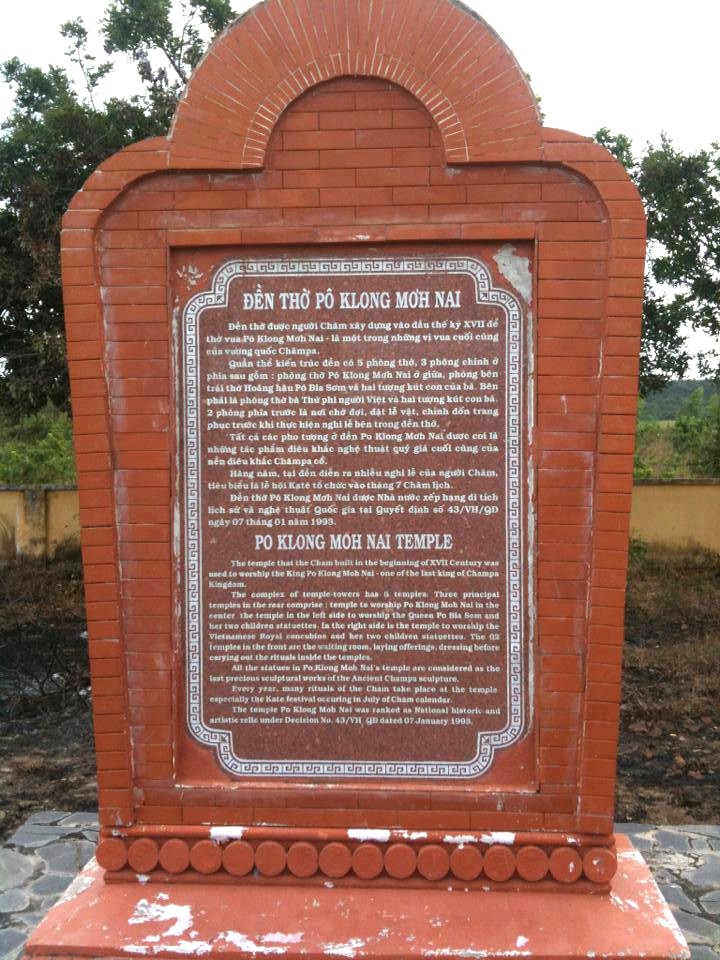
Pursuant to the Law on Cultural Heritage (2001), as amended and supplemented in 2009, and based on established academic research on Champa history in Panduranga, together with field observations conducted at Po Klong Mah Nai Temple, Bac Binh District, Lam Dong Province (formerly Binh Thuan Province), I have identified multiple inaccuracies engraved on the explanatory stone stele at the site.
These inaccuracies seriously distort the historical continuity of Champa, particularly in relation to royal genealogy, dynastic succession, and kinship relations of historical figures. Such distortions adversely affect scholarly research, public interpretation, educational value, and the preservation of Cham cultural heritage.
Accordingly, this petition respectfully requests that the competent authority review, clarify, and correct the inaccurate content currently presented on the stone inscriptions and interpretive materials at Po Klong Mah Nai Temple (also known as Po Mah Taha or Maha Taha). Such rectification is essential to ensure historical accuracy, respect for cultural heritage, and adherence to verifiable academic evidence relating to the Champa dynasties.
Based on comparative analysis of on-site inscriptions with the Panduranga Chronicle (Sakkarai Dak Rai Patao), Champa epigraphy, and the scholarly works of Étienne Aymonier, Henri Parmentier, Georges Maspero, Po Dharma, Durand, and William Noseworthy, the following three substantive issues require urgent review and correction.
II. Scholarly Rebuttal of the Content Requiring Rectification
The stone inscription stating that Po Klong Mah Nai was “the last king of the Kingdom of Champa” constitutes a serious historical misrepresentation.
According to the Panduranga Chronicle (Sakkarai Dak Rai Patao), Po Klong Mah Nai known by his Islamic regnal title Maha Taha, reigned from 1622 to 1627 in Bal Canar-Panduranga as the 18th ruler of the eighth Panduranga dynasty. He was a Muslim ruler who practiced Islam in a strict and consistent manner.
Historical records indicate that Po Klong Mah Nai voluntarily abdicated in favor of Po Rome after arranging the marriage of his biological daughter Sucih (Bia Sucih) to Po Rome, thereby consolidating dynastic legitimacy and succession within Panduranga.
Academic research conducted by the École française d’Extrême-Orient (EFEO) unequivocally confirms that the Panduranga polity continued to exist for many generations after Po Klong Mah Nai, with subsequent rulers including Po Rome, Po Nrop, and others. The final ruler of Panduranga was Po Phaok The, who reigned from 1828 to 1832, and who must therefore be recognized as the true last king.
Designating Po Klong Mah Nai as the “last king” fundamentally distorts the Champa historical timeline and creates serious misconceptions among visitors and the Cham community. Moreover, it erases nearly two centuries of Panduranga history, a period marked by significant political, diplomatic, and religious developments. This claim therefore requires correction based on authoritative chronicles and peer-recognized academic research.
2. Rebuttal of the Claim That Po Klong Mah Nai Transferred the Throne to Po Klong Khul
---> Binh Thuan Video Link:(BTV): Po Klong Mah Nai Ritual Ceremony ???
The assertion frequently repeated in local media that Po Klong Mah Nai abdicated in favor of Po Klong Khul represents a serious historiographical error.
Neither the Panduranga Chronicle (Sakkarai Dak Rai Patao) nor the corpus of EFEO research records the existence of any ruler named Po Klong Khul or Gahul in the Panduranga royal succession.
All authoritative sources consistently affirm that Po Klong Mah Nai transferred power exclusively to Po Rome, who was the sole legitimate successor of the Panduranga dynasty. The insertion of Po Klong Khul into the royal genealogy is therefore incorrect in both nomenclature and dynastic succession, resulting in a distortion of Champa political history.
This misrepresentation has serious implications for historical scholarship, as it obscures the structure of royal authority and succession within Panduranga. It also risks generating misunderstandings regarding political alliances and inter-dynastic marriages during the early Islamic period of Champa a critical transitional era involving relations with Đàng Trong, Aceh, Kelantan, Patani, Singgora, and other Islamic maritime polities of Southeast Asia.
3. Rebuttal of the Claim That Po Klong Mah Nai Married a Vietnamese Consort Named Nguyen Thi Ngoc Thuong
---> Binh Thuan Video Link:(BTV): Po Klong Mah Nai Ritual Ceremony ???
The stone inscription asserts that the northern shrine worships the Cham queen Bia Som, while the southern shrine worships a Vietnamese secondary consort named Nguyen Thi Ngoc Thuong, together with two Kut statues representing her children.
According to Putra Podam and the Panduranga Chronicle (Sakkarai Dak Rai Patao), Po Klong Mah Nai was a Muslim ruler whose principal consort was Queen Bia Som, along with several other Cham secondary consorts. No Champa historical chronicle, French scholarly work, or academic study records any marriage between Po Klong Mah Nai and a Vietnamese princess.
The figure referred to as “Princess Nguyen Thi Ngoc Thuong” most likely derives from later misinterpretations or retrospective fabrications and does not correspond to historical reality.
This misrepresentation directly affects the understanding of Champa religious identity and cultural norms. As a Muslim ruler, attributing such a marriage to Po Klong Mah Nai distorts interpretations of Islamic practice, dynastic policy, and political relations between Panduranga and neighboring Vietnamese polities. Removal or correction of this information is therefore essential to preserve historical authenticity and scholarly integrity.
Po Klong Mah Nai Temple was officially designated a National Historical Artistic Monument under Decision No. 43/VH/QĐ dated 7 January 1993. Inaccurate historical information presented at the site undermines its academic, educational, and cultural value.
Rectifying these inaccuracies will ensure that the monument accurately reflects historical continuity, religious practice, and cultural identity, while providing reliable data for scholarly research and cultural tourism.
I respectfully request that the Department of Culture, Sports and Tourism of Lam Dong Province appoint qualified historians and Champa studies specialists to verify, review, and correct the content engraved on the stone stele at Po Klong Mah Nai Temple.
Specifically, I request official confirmation that:
Po Klong Mah Nai was not the last king of Champa;
Po Klong Mah Nai transferred the throne solely to Po Rome;
All references to Po Klong Khul and the Vietnamese princess Nguyen Thi Ngoc Thuong be removed or corrected.
Furthermore, I request public disclosure of the review results, accompanied by transparent and verifiable reference materials, in order to safeguard the historical, cultural, and scientific value of this heritage site.
I hereby declare that all information presented in this petition is derived from recognized historical chronicles, including the Panduranga Chronicle, and established academic research. The content is objective, evidence-based, and free from political motivation.
Some related images
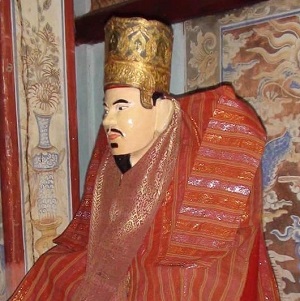
Figure 2. Po Klong Mah Nai (reigned 1622-1627), a Champa king who adhered to Islam, bearing the Islamic title Maha Taha. According to the Panduranga chronicle (Sakkarai dak rai patao), he ascended the throne in the Year of the Dog, abdicated in the Year of the Rabbit, ruled for six years, and established his capital at Bal Canar (Panrik-Panduranga). The Temple of King Po Klong Mah Nai was constructed on a sand hill near Palei Pabah Rabaong (Mai Lãnh hamlet, Phan Thanh commune), adjacent to Lương Bình hamlet, Lương Sơn commune, approximately 15 km from the administrative center of Bắc Bình District and about 50 km north of Phan Thiết City. According to H. Parmentier (Monuments chams de l’Annam, Publications of the EFEO, Paris, vol. 1, 1909, p. 38), Po Klong Mah Nai is the name by which King Po Mah Taha was known, who was the father-in-law of King Po Rome (1627-1651). The temple of Po Klong Mah Nai is a site of veneration dedicated to King Po Mah Taha, together with Queen Bia Som and other Champa consorts. Photo: Putra Podam.
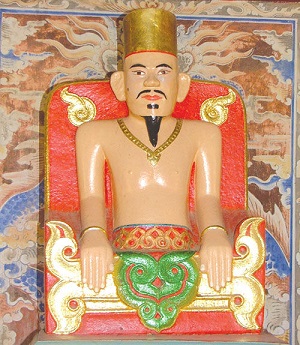
Figure 3. King Po Klong Mah Nai (Po Mah Taha, also known as Maha Taha), who reigned from 1622 to 1627, was a Champa king who adhered to Islam. The image shows the original statue prior to being dressed in Champa royal attire. Photo: Putra Podam.
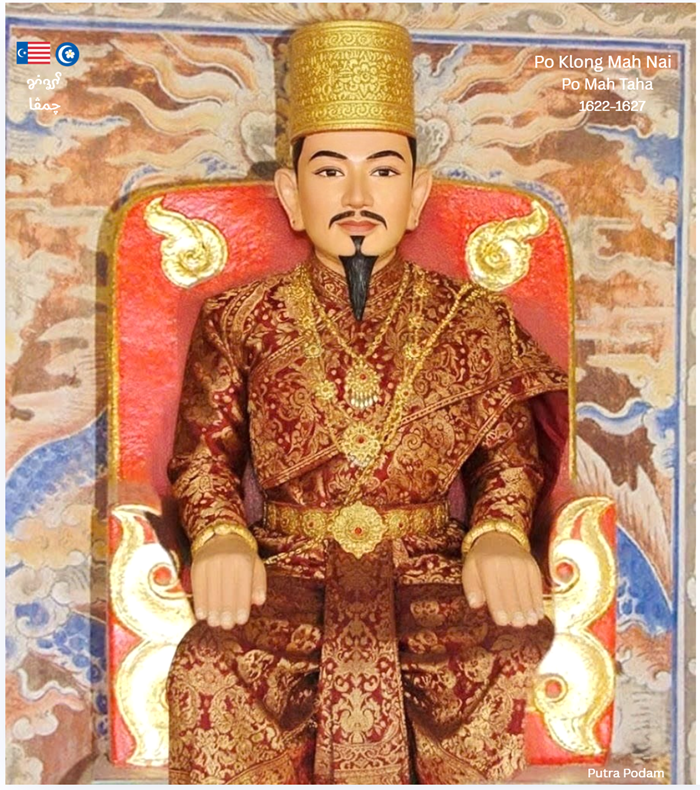
Figure 4. King Po Klong Mah Nai (Po Mah Taha, also known as Maha Taha), who reigned from 1622 to 1627, was a Champa king who adhered to Islam. Based on the original statue prior to being dressed in Champa royal attire, Putra Podam employed AI technology to reconstruct and replace the costume with seventeenth-century Champa royal attire. Photo: Putra Podam.
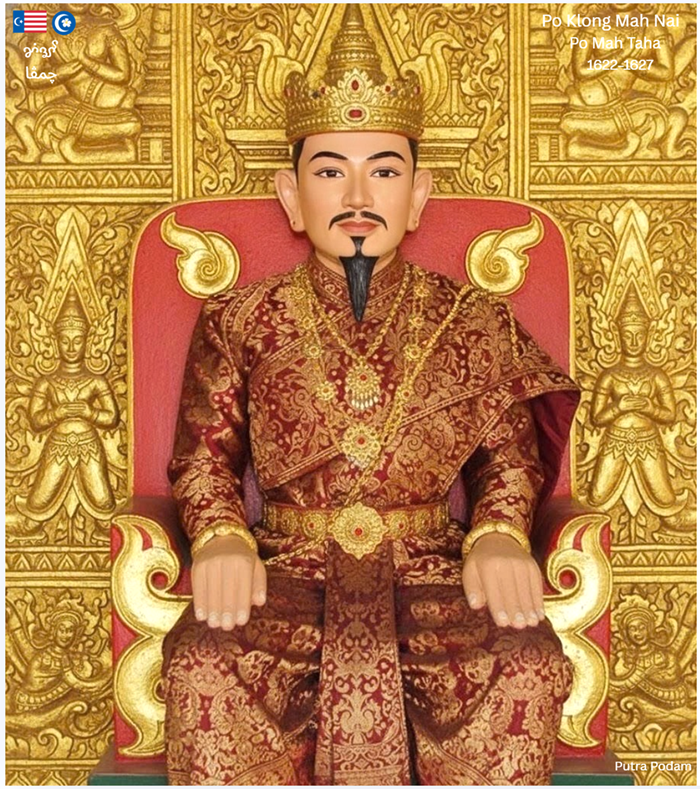
Figure 5. King Po Klong Mah Nai (Po Mah Taha, also known as Maha Taha), who reigned from 1622 to 1627, was a Champa king who adhered to Islam. Based on the original statue prior to being dressed in Champa royal attire, Putra Podam employed AI technology to reconstruct and replace the costume with seventeenth-century Champa royal attire. Photo: Putra Podam.
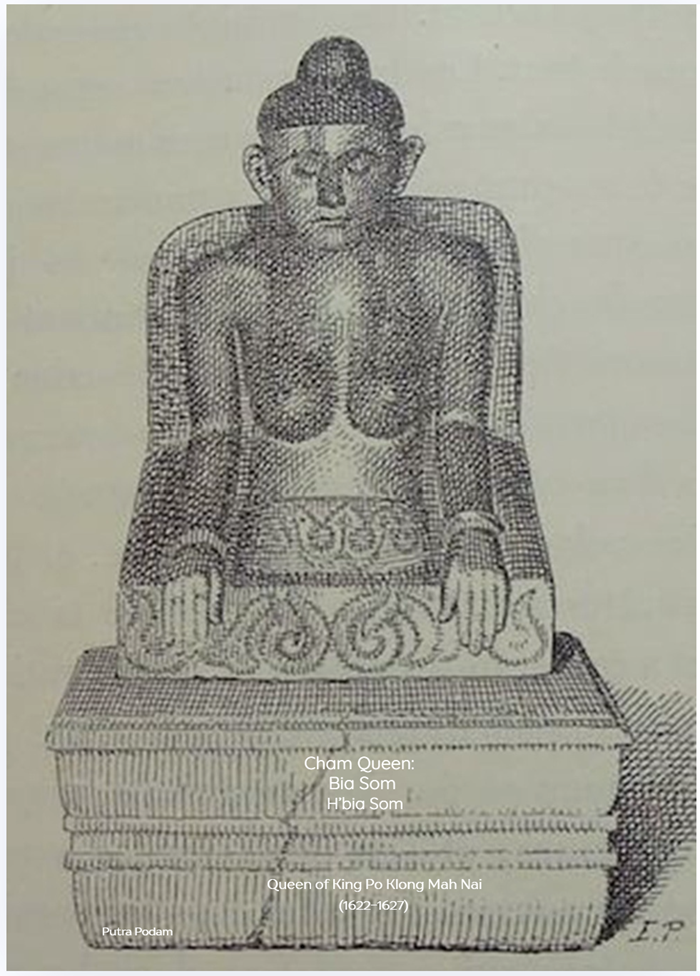
Figure 6. Queen Bia Som (Po Bia Som), the official queen of King Po Klong Mah Nai (Po Mah Taha), who adhered to Islam. The illustration was produced by Henri Parmentier (1871-1949), a French scholar and architect, and Director of the Archaeological Service of the École française d’Extrême-Orient (EFEO) in Vietnam. He conducted extensive research, documentation, and description of Champa monuments. His drawings of Champa sculptures and monuments were published in the seminal work Inventaire descriptif des monuments Cams de l’Annam. Image: Henri Parmentier.

Figure 7. Queen Bia Som (Po Bia Som), the official queen of King Po Klong Mah Nai (Po Mah Taha), who adhered to Islam. The illustration was produced by Henri Parmentier (1871-1949), a French scholar and architect, and Director of the Archaeological Service of the École française d’Extrême-Orient (EFEO) in Vietnam. He conducted extensive research, documentation, and description of Champa monuments. His drawings of Champa sculptures and monuments were published in the seminal work Inventaire descriptif des monuments Cams de l’Annam. Image: Henri Parmentier.
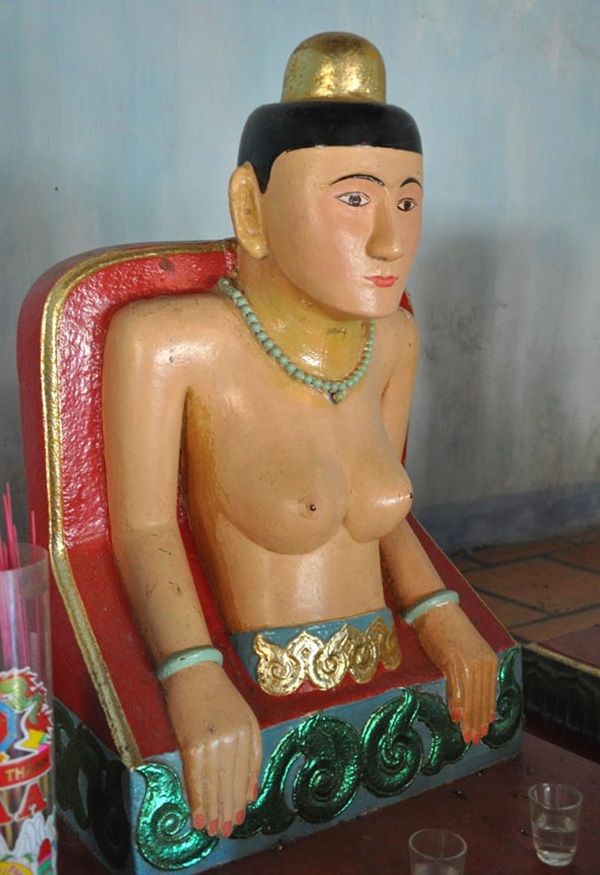
Figure 8. Queen Bia Som (Po Bia Som), the official queen of King Po Klong Mah Nai (Po Mah Taha), who adhered to Islam. The statue was photographed prior to being dressed in Champa royal attire. It is housed in the northern chamber of the Temple of Po Klong Mah Nai. Photo: Putra Podam.
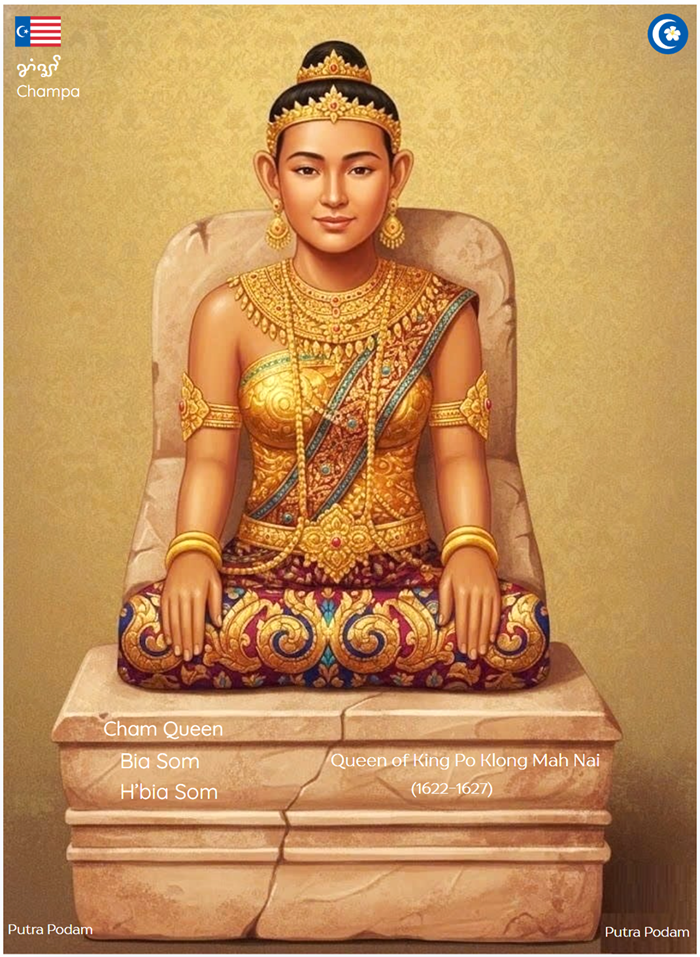
Figure 9. Queen Bia Som (Po Bia Som), the official queen of King Po Klong Mah Nai (Po Mah Taha), who adhered to Islam. The original photograph was produced by Henri Parmentier (1871-1949), a French scholar and architect, and Director of the Archaeological Service of the École française d’Extrême-Orient (EFEO) in Vietnam. Based on Parmentier’s photograph, Putra Podam employed AI technology to reconstruct and reinterpret the queen’s image in accordance with seventeenth-century Champa cultural conventions. Photo: Putra Podam.
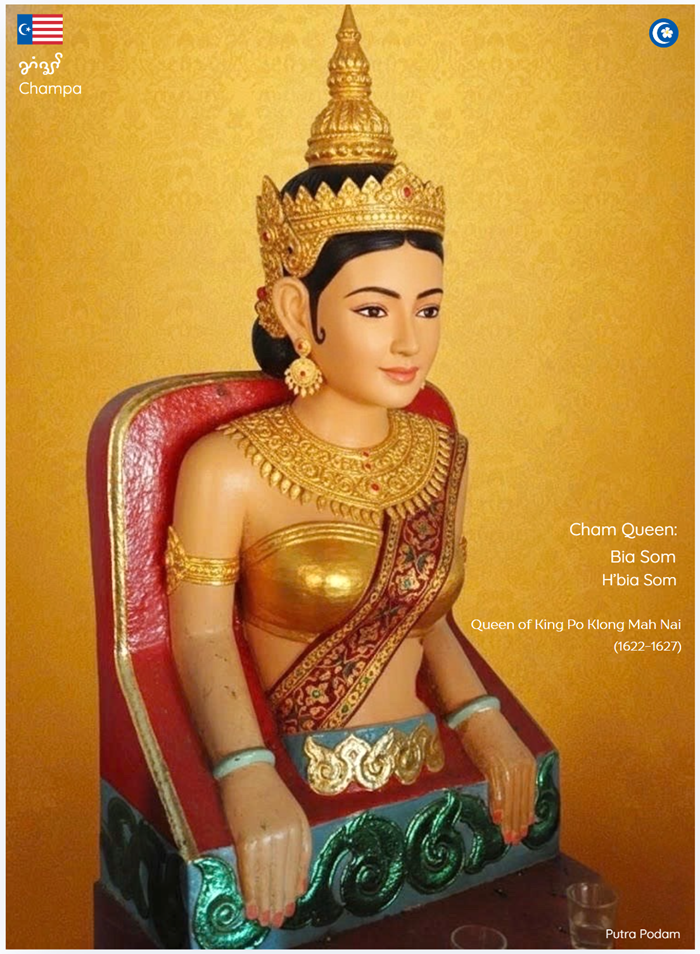
Figure 10. Queen Bia Som (Po Bia Som), the official queen of King Po Klong Mah Nai (Po Mah Taha), who adhered to Islam. The original photograph was produced by Henri Parmentier (1871-1949), a French scholar and architect, and Director of the Archaeological Service of the École française d’Extrême-Orient (EFEO) in Vietnam. Based on Parmentier’s photograph, Putra Podam employed AI technology to reconstruct and reinterpret the queen’s image according to seventeenth-century Champa cultural conventions. Photo: Putra Podam.
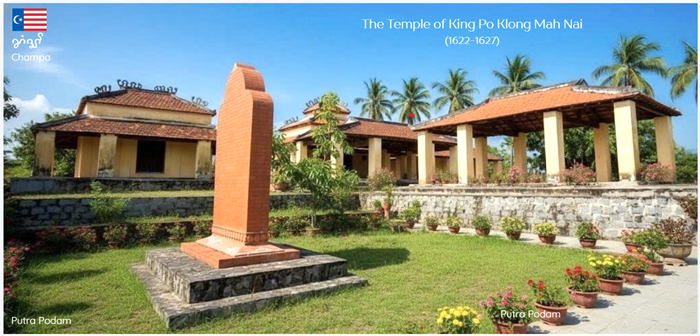
Figure 11. Po Klong Mah Nai Temple, dedicated to King Po Klong Mah Nai (r. 1622-1627), a ruler of the Champa polity who professed Islam and bore the Islamic honorific Maha Taha. According to the Panduranga chronicles (Sakkarai dak rai patao), he ascended the throne in the Year of the Dog, abdicated in the Year of the Rabbit, reigned for six years, and established his royal seat at Bal Canar (Panrik, Panduranga), the political center of the Panduranga region in the seventeenth century. The Po Klong Mah Nai Temple is situated on a sand hill in Luong Binh hamlet, Luong Son commune, Bac Binh District, Binh Thuan Province, approximately 15 km from the administrative center of Bac Binh District and about 50 km from Phan Thiet City. The temple constitutes a ritual and commemorative space dedicated to the veneration of King Po Mah Taha, his queen Bia Som, and his secondary consorts of Champa origin, reflecting the historical memory and religious traditions of the Cham community in southern Champa. Photo: Putra Podam.
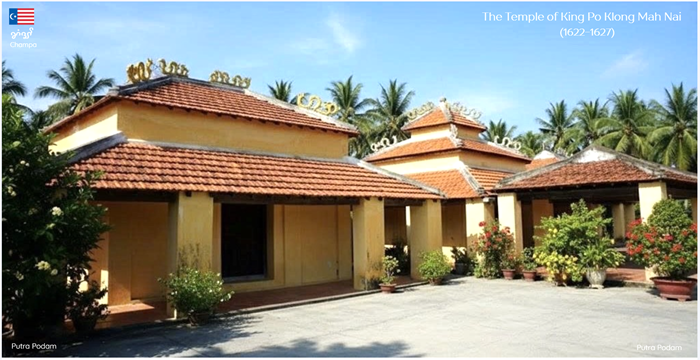
Figure 12. Po Klong Mah Nai Temple, dedicated to King Po Klong Mah Nai (r. 1622-1627), a ruler of the Champa polity who adhered to Islam and bore the Islamic honorific Maha Taha. According to the Panduranga chronicles (Sakkarai dak rai patao), he ascended the throne in the Year of the Dog, abdicated in the Year of the Rabbit, reigned for six years, and established his capital at Bal Canar (Panrik, Panduranga), which functioned as the political center of Panduranga in the seventeenth century. The Po Klong Mah Nai Temple was constructed on a sand hill in Luong Binh hamlet, Luong Son commune, Bac Binh District, Binh Thuan Province, approximately 15 km from the administrative center of Bac Binh District and about 50 km from Phan Thiet City. The site serves as a ritual and commemorative space for the worship and veneration of King Po Mah Taha, Queen Bia Som, and his secondary consorts of Champa origin, preserving the historical memory and religious traditions of the Cham community in southern Champa. Photo: Putra Podam.
Figure 13. The stele erected at the main gate of the Temple of Po Klong Mah Nai, dedicated to King Po Klong Mah Nai (reigned 1622-1627). The inscription on the stele was produced under the direction of the Department of Culture, Sports and Tourism of Lâm Đồng Province (formerly Bình Thuận Province). However, the content concerning Champa history contains several inaccuracies when compared with historical sources. Photo: Putra Podam.
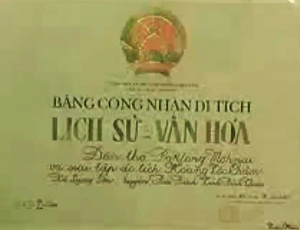
Figure 14. Po Klong Mah Nai Temple was officially designated as a National Historical and Artistic Monument of Vietnam under Decision No. 43/VH/QĐ, dated 7 January 1993, issued by the Ministry of Culture and Information. This designation recognizes the site’s outstanding historical, cultural, and artistic value within the heritage system of Vietnam. Photo: Putra Podam.
Related links
1. Petition Requesting the Correction of Historical Information at the Po Klong Mah Nai Heritage Site
2. Kiến nghị hiệu đính thông tin lịch sử tại di tích đền Po Klong Mah Nai
3. Po Klong Mah Nai truyền ngôi cho Po Rome (Nik Mustafa)
4. King Po Klong Mah Nai abdicated in favor of Po Rome (Nik Mustafa) (English)
5. Sở Văn hóa Bình Thuận đưa thông tin sai lệch về Po Klong Mah Nai
6. Bà Nguyễn Thị Thềm không phải hậu duệ của vua Po Klong Mah Nai
7. Putra Podam video: Vua Po Klaong Manai vị vua Islam (Hồi giáo)
8. Putra Podam video: Tháp Champa: Đền thờ Po Klaong Mah Nai
9. Video Đài Bình Thuận (BTV): Lễ phụng tế Po Klong Mah Nai ???
References
-
Panduranga Chronicle, Sakkarai Dak Rai Patao, Panduranga-Champa.
-
Griffiths, Arlo & Southworth, William (2012). Cham Patterns and Scripts: A Historical Overview. Singapore: Singapore University Press.
-
Hardy, Andrew (1985). Histories of Champa. Paris: Éditions Recherche sur l’Asie du Sud-Est.
-
Maspero, Georges (1912). Le Royaume de Champa. Paris: E. Leroux.
-
Nguyễn Phước tộc (1995). Thế phả của nhà Nguyễn. Huế, Vietnam.
-
Nguyễn, Văn Huy (2007). Văn hóa Cham và Panduranga. Hà Nội: NXB Văn hóa – Thông tin.
-
Podam, Putra (2020). Research on Panduranga - Champa. California, USA.
-
Quốc sử quán triều Nguyễn (1884-1885). Đại Nam Thực Lục. Huế, Vietnam.
-
Trần, Kim Hiếu (2015). Lịch sử Champa từ thế kỷ XVII đến XIX. Hà Nội: NXB Khoa học Xã hội.