
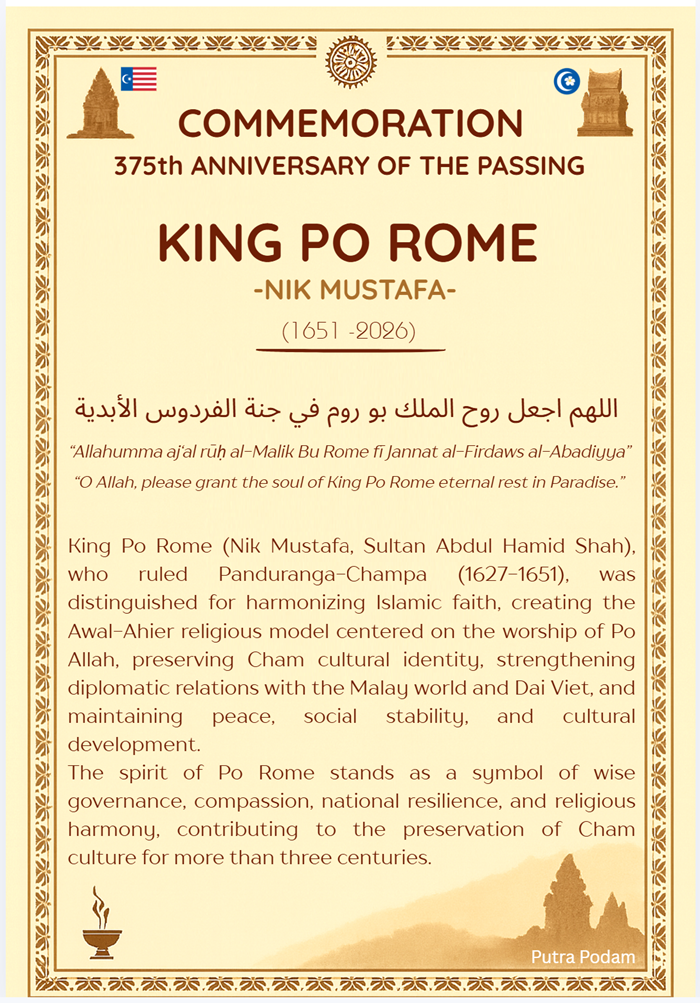
Commemorating the 375th Anniversary of the Passing of King Po Rome-Nik Mustafa (1651-2026)
“Allahumma aj‘al rūḥ al-Malik Bu Rome fī Jannat al-Firdaws al-Abadiyya”
Distinguished delegates,
Honorable Islamic, Awal, and Ahier religious dignitaries,
Respected communities of the ethnic groups of Panduranga-Champa,
And all members of the Cham community at home and abroad,
Today, in an atmosphere of solemnity and deep emotion, we gather here to commemorate the 375th anniversary of the passing of King Po Rome (Nik Mustafa), the illustrious monarch who guided Panduranga-Champa through the turbulent transformations of the seventeenth century. Three and a half centuries have passed, yet the radiance of Po Rome’s reign continues to illuminate the culture, religion, politics, and spiritual life of the peoples of the Panduranga-Champa land an enduring current that binds together the past, the present, and the future.
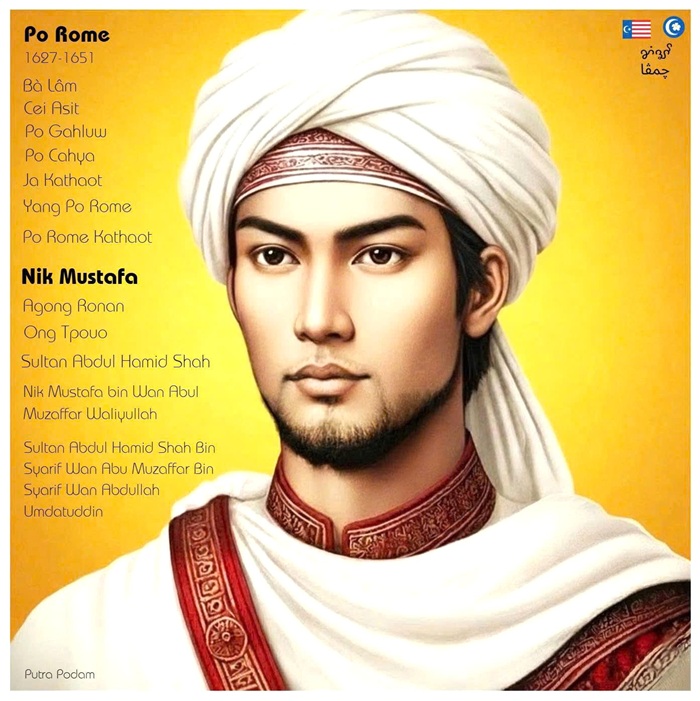
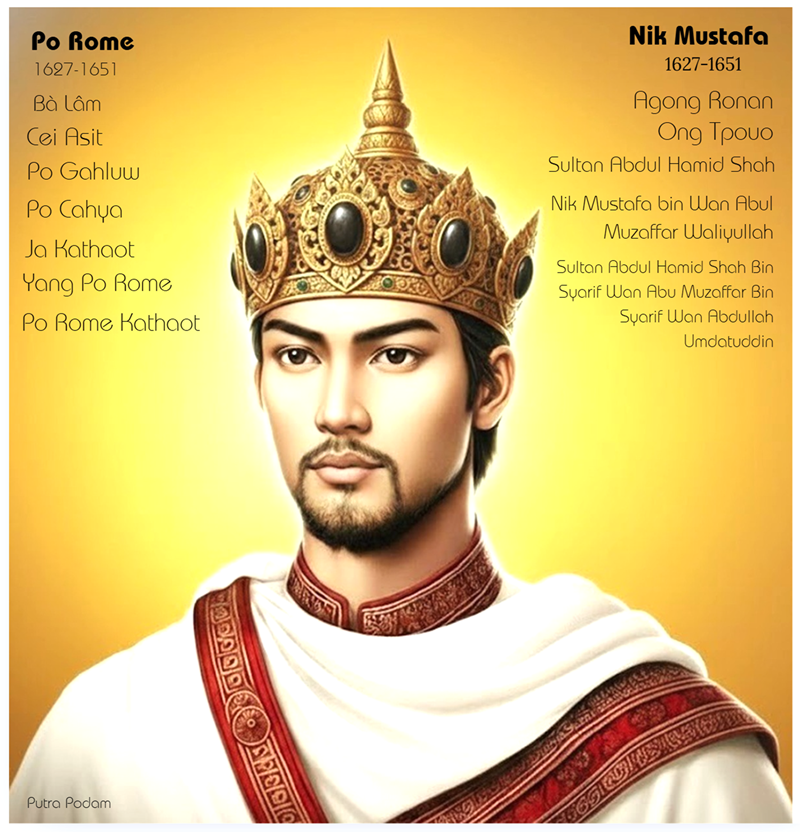
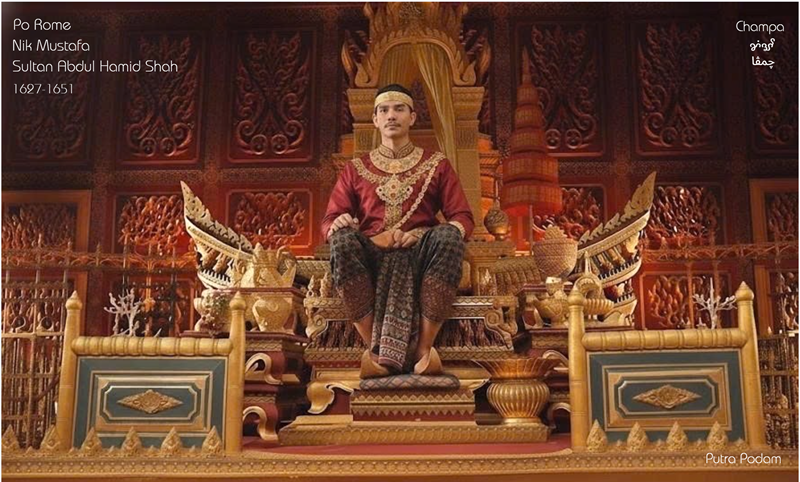
King Po Rome, known in the Melayu-Islamic world by the title Sultan Abdul Hamid Shah and by his Islamic name Nik Mustafa, stands as a remarkable symbol of the vision, wisdom, and compassion of a virtuous ruler. He ascended the throne at a time when the kingdom faced profound challenges: growing foreign pressures, internal divisions, economic decline, and hardships in the daily lives of the people. Amid such turmoil, Po Rome did not choose violence or radical confrontation; instead, he pursued reconciliation, reform, and a governance centered on the welfare of his subjects. His calm temperament, prudent judgment, and humane spirit distinguished his leadership revealing a king who understood deeply the destiny and needs of the Panduranga-Champa nation.
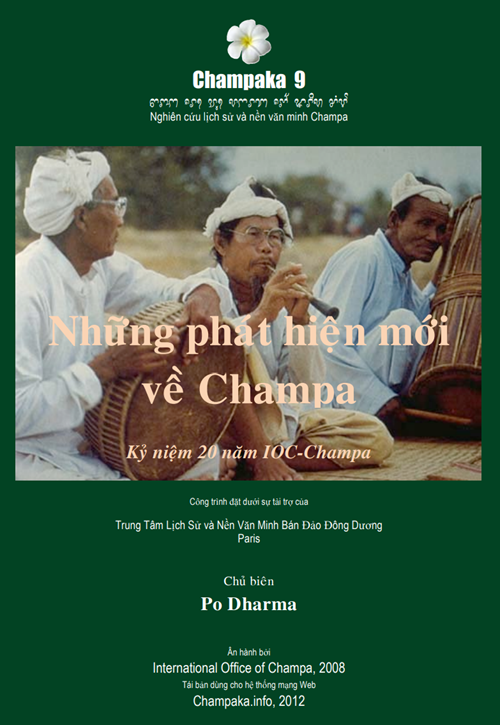
Throughout his twenty-four-year reign (1627-1651), Po Rome worked tirelessly to restore agricultural production, improve the livelihood of his people, defend the land, and reorganize the communal land system. These policies enabled Panduranga to overcome crisis and enter a period of stability and prosperity. Under Po Rome’s rule, the sound of the Paranang drums, the melodic Saranai horn, and the folk songs of the Cham people continued to resound; cultural life was not only preserved but strengthened upon the solid social foundation that he established.
One of the most remarkable and historically significant contributions of Po Rome’s reign was the establishment of the two religious terms Awal (Early Islam) and Ahier (Late Islam), which together formed the Awal, Ahier model of dual worship centered on the veneration of Po Allah. However, the Ahier tradition retained profound influences from indigenous cultural elements, particularly the Hindu Shaivite heritage, creating a unique synthesis between Islam and Cham ancestral beliefs. Through this delicate religious harmonization, Po Rome not only preserved the diversity of Cham spiritual identity but also maintained cultural unity within the community. This religious model has endured for 375 years and continues to play a vital role in the spiritual life of the contemporary Cham people.
Po Rome was chosen as successor by King Po Klong Mah Nai (Maha Taha), who also gave him Princess Bia Sucih (Bia Than Cih) in marriage a princess who played a crucial role in spreading Islam within the Panduranga royal household. This marriage not only strengthened Po Rome’s legitimacy but also contributed to expanding the influence of Islam in the Champa court. He later married Lady H’bia Than Can, the daughter of a Degar highland leader, thereby forming a strong political and social alliance between the Panduranga court and the indigenous Degar communities, reinforcing internal stability and cohesion within the kingdom.
From this firm foundation in domestic governance, Po Rome advanced a sophisticated foreign policy, particularly toward the Melayu world. His marriage to Princess Kelantan Puteri Siti marked a major turning point: Po Rome was granted the title Sultan Abdul Hamid Shah, becoming an officially recognized member of the Islamic royal lineage of Kelantan. This integration enabled Champa to enter deeply into the Islamic maritime network of Southeast Asia, expand regional trade, elevate its religious prestige, and solidify Panduranga’s position within the geopolitical landscape. The relationships with Kelantan, Patani, and Singgora were not only symbols of Melayu-Champa cultural exchange but also strategic assets essential to the survival of Panduranga-Champa during a turbulent era.
Alongside this expansion of ties with the Islamic world, Po Rome also demonstrated diplomatic finesse in managing relations with Đại Việt. Despite periods of conflict between the two states, Po Rome avoided extreme confrontation and instead pursued reconciliation through negotiation and a strategic dynastic marriage. His union with Lady Ngọc Khoa (Bia Ut), daughter of Lord Nguyễn Phúc Nguyên, established a stable diplomatic bridge between the two realms. Through this balanced yet resolute approach, Panduranga preserved its autonomy, avoided devastating warfare, and secured a prolonged period of peace necessary for social consolidation, cultural development, and internal strengthening.
It was through this sequence of wise policies fortifying internal unity, building alliances with indigenous communities, expanding relations with the Melayu world, and harmonizing diplomacy with Đại Việt that Panduranga-Champa continued to endure for more than two and a half centuries after Po Rome’s reign, even as many contemporary kingdoms vanished from the historical map.
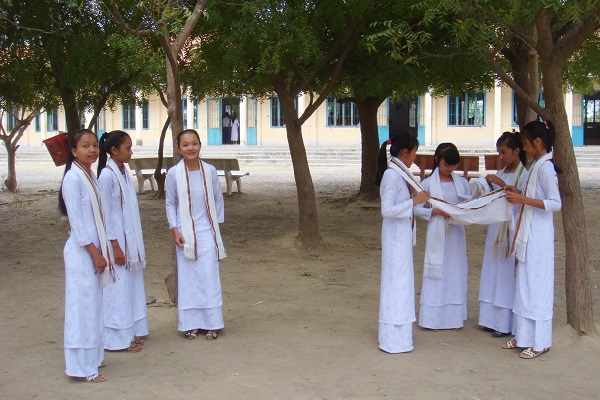
The legacy of Po Rome today is preserved not only in stone inscriptions or historical chronicles, but also in the towering presence of the Po Rome Tower in Ninh Thuận, in the vibrant colors of the Kate (Kartik) ceremonies, and in the ancestral chants sung by the Adhia, Kadhar,... and other ritual specialists within the community. Every Cham person who speaks of Po Rome holds him in special reverence, for he was not only a king, but a symbol of protection, compassion, and the resilient spirit of the Cham nation.
Three hundred and seventy-five years have passed, yet from the reign of Po Rome we continue to draw profound and enduring lessons. It is a lesson that religious tolerance can become a source of strength that unites a community. It is a lesson that flexible and prudent diplomacy can safeguard a nation in its most perilous moments. It is a lesson that social stability is only possible when the people are placed at the heart of every policy. And above all, it is a lesson that national identity endures when it is nurtured with wisdom, compassion, and courage qualities embodied by the spirit of Po Rome.
Today, at this solemn commemoration, we bow our heads in deep respect as we honor King Po Rome. He remains forever a source of pride for the Cham people and all ethnic communities of Panduranga-Champa a symbol of wisdom, benevolence, and tolerance; a sovereign whose legacy left an indelible mark on the history of Panduranga-Champa. May Allah bestow peace and light upon the soul of Po Rome, so that his legacy may continue to illuminate the path of future generations, guiding us to preserve our culture, uphold the heritage of our ancestors, and contribute to the prosperity of the Cham community today and for generations to come.
Thank you.


Links (Liên kết)
1. Putra Podam, Commemorating the 375th Anniversary of the Passing of King Po Rome (Nik Mustafa):1651-2026
2. Putra Podam, Po Rome: The King of two worlds - Indigenous Champa and Malay Islam
3. Putra Podam, Princess Ngọc Khoa: Cham memory and the symbol of national decline
4. Putra Podam, Po Rome: The Panduranga King of Churu (Chamic) Islamic Lineage
5. Putra Podam, Some names of King Po Rome (Nik Mustafa)
6. Putra Podam, Some Queens and Consorts of King Po Rome (Mustafa)
7. Putra Podam, Princess H'bia Hadrah Hajan of the Rhade people bocomes Consort Bia Than Can
8. Putra Podam, Mrs. Nguyen Thi Them is not a descendant of King Po Klong Mah Nai
9. Putra Podam, Binh Thuan Department of Culture providers incorrect information about Po Klong Mah Nai
10. Putra Podam, Awal and the history of Islam in Champa
11. Putra Podam, Awal: The Cham Islamic Sect
12. Putra Podam, Religious reconciliation - Bani Awwal (Cham Islam)
13. Putra Podam, Agama Awal (Bani Awal) as the Religious Sect of Champa
14. Putra Podam, Awal-Ahier: Islam of the Champa Kingdom
15. Putra Podam, Awal (Cham Islam) as one of 73 Branches
16. Putra Podam, Champa script and Rumi Champa 2000
17. Sakaya, Ahier as Later Islam - Awal as Islam
18. Basiron, Theologian Basiron explains the term "Bani"
19. Kelantan: http://www.royalark.net/Malaysia/kelant2.htm