In modern Champa history, there are events that were never recorded in official documents and never appeared in contemporary newspapers, yet they endure vividly in collective memory as symbols of courage, intellect, and the aspiration for freedom. The raising of the FULRO Champa flag atop Po Rome Tower (Nik Mustafa) in 1972 was one such event.
The architect behind this plan was Les Kosem (Haji Les Kosem), alias Po Nagar, a Cham of Cambodian origin and a senior officer in the Cambodian army. He played an important role in the Second Indochina War and the Cambodian civil conflicts, and was a prominent leader of the FULRO movement. Between 1964 and 1975, Les Kosem was among the most influential figures on the Indochinese political stage, particularly within the struggles of indigenous peoples, including the Champa nation.
In early April 1972, Les Kosem proposed a plan of strong symbolic significance: to raise the FULRO Champa flag atop Po Rome Tower, a sacred monument of the Cham people in Panduranga. Po Rome Tower is not only an architectural relic but also a spiritual symbol tied to Champa’s historical memory, religion, and cultural sovereignty. For this reason, raising the flag on the tower carried profound political meaning affirming the presence and voice of the Champa people in a context of oppression and historical marginalization.
Les Kosem convened four Cham individuals in Panduranga to seek their views on the plan. The initial proposal was to send five people directly to Panduranga Champa to carry out the mission. However, this plan entailed considerable risk, as any act bearing political symbolism in the area was subject to close surveillance.
Also in 1972, Po Dharma, after completing U.S. military intelligence training in Japan and achieving notable merits on the battlefield, was promoted from Captain to Major. Upon hearing the plan to raise the flag on Po Rome Tower, Major Po Dharma openly opposed the option of sending the entire team to Panduranga.
In his assessment, such an operation was extremely dangerous not only threatening the safety of the team but also risking serious consequences for the local community. Po Dharma argued that if the sole objective was to raise the flag atop Po Rome Tower (Nik Mustafa), it was unnecessary to deploy personnel from outside to Panduranga, as this would be easily detected and could lead to avoidable losses.
From this reasoning, Major Po Dharma put forward a bold yet highly prudent initiative: to raise the flag on the tower without anyone noticing, it would suffice to secretly hire a local cattle herder someone familiar with the terrain and unlikely to attract attention to climb the tower and plant the flag. No gunfire, no armed force, no traces left behind just a quiet but effective act.
After careful consideration, the entire team agreed with Po Dharma’s proposal. Secret communication channels were established, and the plan was carried out discreetly.
A week passed in tense anticipation.
Then, on an early morning in 1972, as sunlight first touched the sand dunes of Panduranga, people were suddenly astonished to see the FULRO Champa flag flying atop Po Rome Tower (Nik Mustafa). In the stillness surrounding the ancient tower, the flag fluttered like an unspoken declaration: Champa still exists; Champa still speaks.
No one knew who had climbed the tower.
No one witnessed the moment the flag was raised.
But everyone saw the flag.
The event quickly caused a stir. Within a short time, the flag was taken down, and thereafter the prohibition of displaying the Champa flag on Po Rome Tower became an implicit rule aimed at controlling symbolic expression. Yet what those who issued the ban could not erase was historical memory.
The flag could be lowered, but its meaning had already been etched deeply into the consciousness of the Cham people. The act of raising the flag in 1972 was not merely an event; it was a silent message sent to history: even in the harshest of times, the Champa nation had individuals who dared to act, dared to think, and dared to take responsibility for the honor of their people.
From then on, Po Rome Tower has not only been an ancient monument but also a silent witness to a moment that affirmed Champa identity amid the turbulence of Indochinese history.

Figure 1. Raising the FULRO Champa flag atop Po Rome Tower (Nik Mustafa), 1972. Photo: Putra Podam.

Figure 2. The banner of the “Champa Liberation Front” (1962-1975). In French: Front pour la libération du Champa (abbreviated FLC), an organization active in Ninh Thuận, Bình Thuận, and the Central Highlands of Vietnam, under the leadership of President Y Bham Enuol and Lieutenant General Les Kosem. Photo: FULRO.
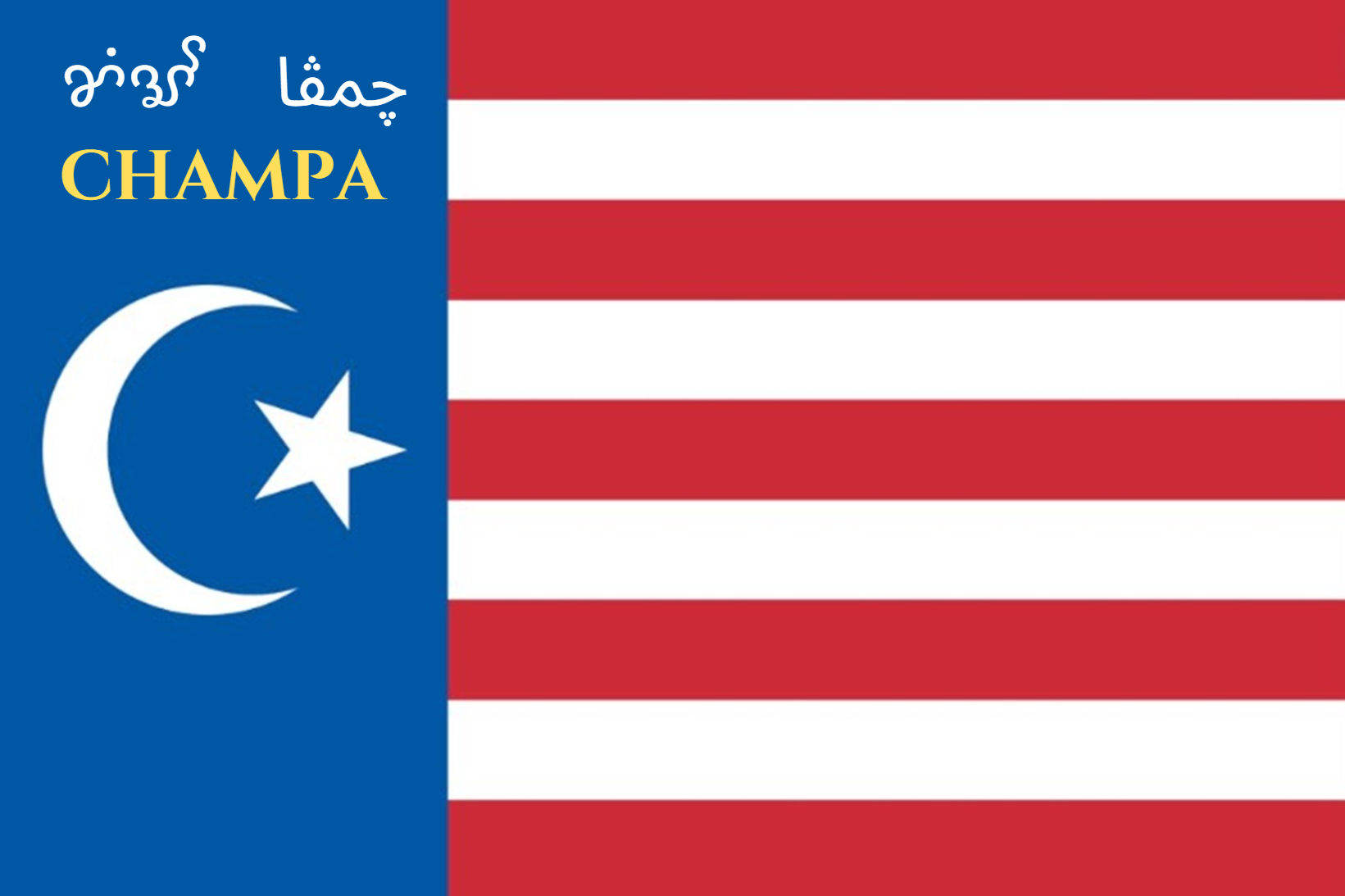
Figure 3. Meaning: The Champa flag (Cham language: Dok Champa) consists of nine alternating horizontal red and white stripes representing equality. On the left is a blue-and-white rectangle bearing a crescent moon (Aia Bulan) and a five-pointed star (Batuk). The five-pointed star represents unity among the former polities of Indrapura, Amaravati, Vijaya, Kauthara, and Panduranga. The crescent symbolizes Islam as the state religion of Champa; the sky-blue background represents the unity of the Champa people. The star and crescent were formerly yellow the royal color of Champa but were changed to white after Champa no longer had a king (an Islamic polity without a monarch).
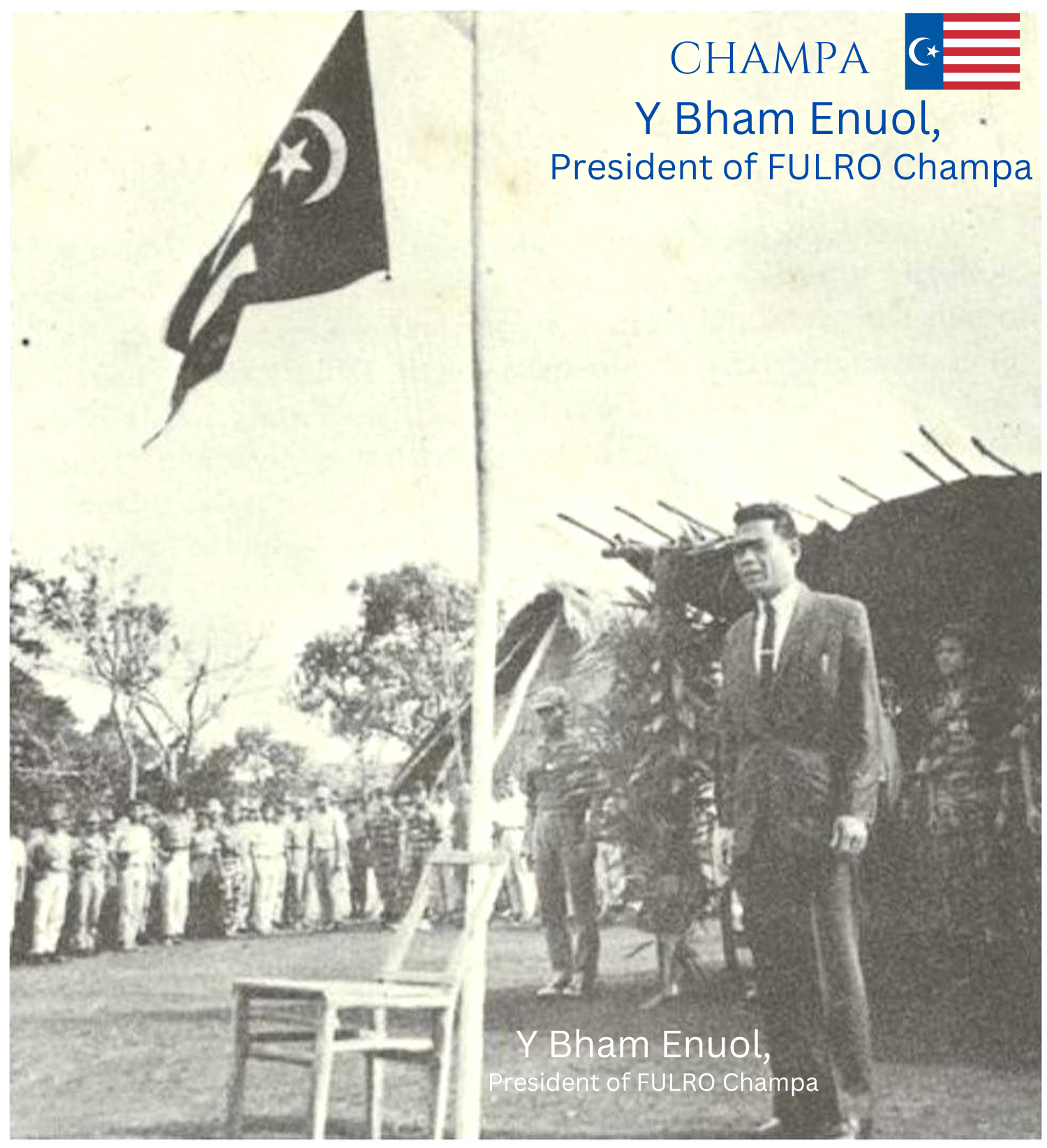
Figure 4. Y Bham Enuol, founder of the Bajaraka movement (1958-1964), served as President of the Champa Central Highlands Liberation Front from 1964 to 1975, a member organization of FULRO (the united front of oppressed ethnic groups) headquartered in Cambodia. He was not the President of FULRO; that position belonged to Norodom Sihanouk. The image shows Y Bham Enuol beneath the flag of the Champa Liberation Front (Front pour la libération du Champa - FLC, 1962-1975), active in Ninh Thuận, Bình Thuận, and the Central Highlands. Source: FULRO.